

Business Rich Communication Services (RCS) messaging is set for rapid expansion as enterprises migrate authentication, notifications, marketing and customer-service traffic away from traditional SMS.

Juniper Research forecasts global business RCS traffic will exceed 485 billion messages by 2030, up from 125 billion in 2026, representing 286 percent growth. Apple’s decision to support RCS, announced in 2024, has accelerated the addressable market by extending compatibility across a much larger share of smartphones.
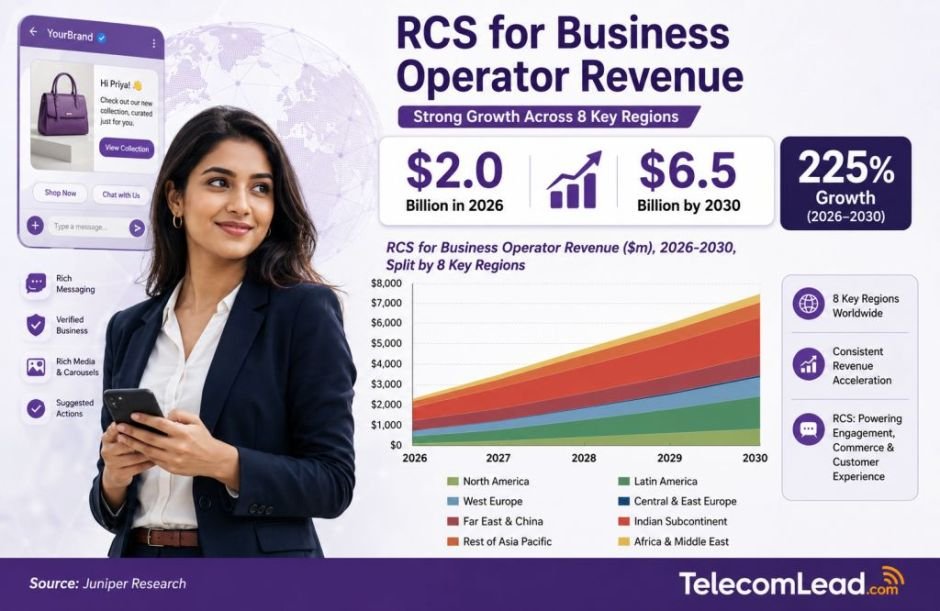
For telecom operators, the opportunity is significant. RCS for Business revenue is forecast to rise from US$2 billion in 2026 to more than US$7 billion in 2030.
Operator RCS Revenue to Reach US$3.1 Billion in 2027
Juniper Research expects mobile operator RCS for Business revenue to increase from US$1.2 billion in 2025 to US$3.1 billion in 2027.
The market spans eight regions: North America, Latin America, West Europe, Central & East Europe, Far East & China, the Indian Subcontinent, Rest of Asia Pacific, and Africa & Middle East.
The key opportunity for operators is to migrate high-volume SMS use cases first, particularly authentication and transactional notifications, before encouraging enterprises to adopt richer marketing and conversational messaging.
RCS supports verified sender identities, rich media, cards and interactive messaging, giving operators a stronger enterprise proposition than standard SMS.

Authentication Could Drive SMS-to-RCS Migration
Authentication is emerging as one of the most immediate RCS opportunities.
Banks, logistics companies and other enterprises can use verified RCS one-time passwords to reduce spoofing and improve customer trust. Faster message delivery can also reduce repeat OTP requests caused by delayed SMS.
The same model applies to banking alerts, delivery notifications and other high-volume transactional communications where verified identities can help reduce fraud risks.
Juniper Research recommends that communication service providers prioritize these relatively straightforward SMS migrations before upselling enterprises to branded marketing and conversational RCS services.
Retail to Generate More Than 30 Percent of RCS Traffic
Retail will remain the largest business RCS vertical, although its share will decline as other sectors expand faster.
Retail is expected to account for more than 30 percent of business RCS messages in 2030, compared with more than 37 percent in 2026.
Healthcare messaging is forecast to surge by more than 1,000 percent through 2030, while banking RCS traffic will increase by more than 600 percent. Retail traffic is expected to grow by just over 200 percent.
The figures indicate that RCS adoption is broadening beyond promotional campaigns into sectors where verification, security and real-time customer interaction are particularly important.
North America RCS Device Penetration Jumps to 86.5 Percent
North America has experienced one of the fastest increases in RCS availability.
RCS for Business-capable mobile-device penetration increased from 40.3 percent in 2024 to 86.5 percent in 2025.
In the United States, business RCS traffic jumped from 494 million messages in 2024 to 3.2 billion in 2025, representing growth of more than 500 percent.
Google reported that US users were exchanging more than 1 billion RCS messages per day in May 2025, highlighting the increasing scale of the ecosystem.
US Operators Develop RCS Pricing Models
US telecom operators are already establishing differentiated RCS pricing for authentication, utility and marketing use cases.
In January 2026, RCS Rich authentication and utility pricing stood at US$0.0045 for AT&T, US$0.0045 for T-Mobile, US$0.0040 for Verizon, US$0.0050 for US Cellular and US$0.0045 for other carriers.
The comparable WhatsApp price was US$0.0034.
RCS Rich Media marketing prices were higher at US$0.0100 for AT&T, US$0.0125 for T-Mobile, US$0.0060 for Verizon, US$0.0135 for US Cellular and US$0.0100 for other carriers.
WhatsApp’s comparable marketing price was US$0.0250.
The pricing shows how operators can segment RCS according to message type rather than relying on a single SMS-style tariff.
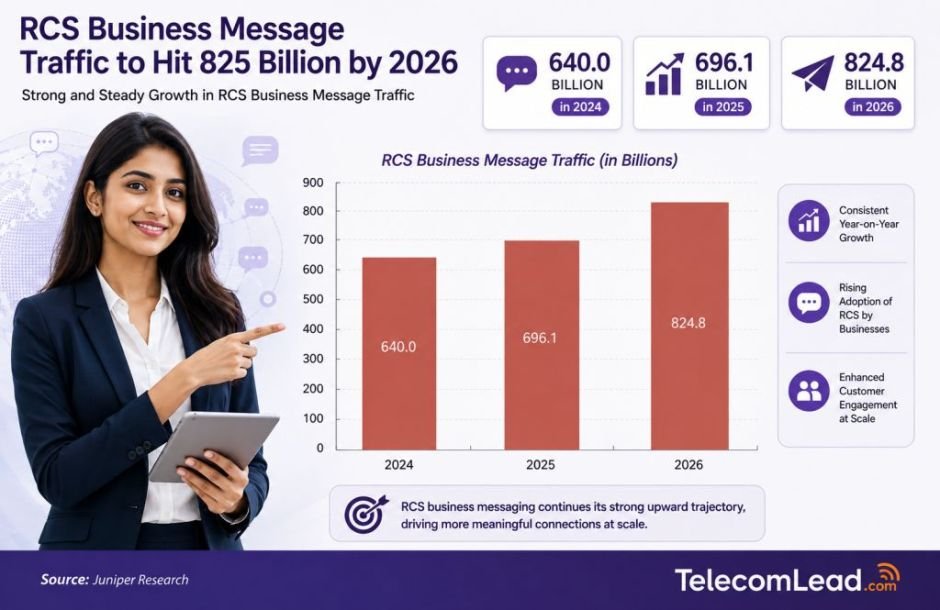
India RCS-Capable Subscribers to Reach 824.8 Million
India is becoming one of the largest RCS markets globally.
RCS for Business-capable subscribers increased from 640.0 million in 2024 to 696.1 million in 2025 and are forecast to reach 824.8 million in 2026.
That represents growth of 8.8 percent, followed by 18.5 percent.
Apple partnered with Jio in August 2025 to introduce RCS on iPhones for Jio users, expanding the addressable base beyond Android.
Bharti Airtel partnered with Google in December 2025 to offer RCS and integrate it with Airtel’s AI-enabled spam filtering capabilities.
These developments position India as a major testing ground for verified enterprise messaging, authentication and conversational commerce.
Google Tightens India RCS Promotional Controls
Google has also introduced controls designed to manage promotional RCS traffic in India.
High-reputation agents can send up to 8 initial messages per user, medium-reputation agents up to 4, and low-reputation agents up to 2.
The corresponding limits for unique users within a rolling 28-day period are 300 million for high-reputation agents, 25 million for medium-reputation agents and 1 million for low-reputation agents.
The controls increase the importance of sender reputation, consent and message relevance as RCS expands into commercial marketing.
AI and P2A Could Expand RCS Beyond Messaging
Person-to-Application, or P2A, messaging could extend RCS into customer service, product discovery and sales.
Consumers can initiate conversations through Google Search, deep links, QR codes and Google Ads, allowing brands to move users directly into interactive RCS experiences.
AI can further expand monetization by automating customer-service conversations, product recommendations and sales interactions.
For operators, this creates a need for more sophisticated pricing based on factors such as conversation duration, initiation method and message volume rather than simple per-message billing.
Vendors can also support the transition with SMS-to-RCS migration tools, AI-assisted content creation and verification services.
RCS Becomes a Major Telecom Enterprise Messaging Opportunity
Juniper Research’s study covers more than 160,000 datapoints across 61 countries and evaluates 17 RCS for Business vendors across retail, banking, healthcare, travel, hospitality and telecom.
The central opportunity for operators is to move enterprises from basic SMS toward verified and interactive communications.
Authentication and notification traffic can provide the first migration wave, followed by branded marketing, conversational messaging, P2A interactions and AI-powered customer engagement.
With global business RCS traffic forecast to rise from 125 billion messages in 2026 to more than 485 billion by 2030, and telecom operator revenue expected to increase from US$2 billion to more than US$7 billion, RCS is developing into a multibillion-dollar enterprise messaging platform for the telecom industry.
FASNA SHABEER