

The Indian smartphone market is entering a highly competitive and rapidly evolving phase in the sub-₹15,000 segment, where pricing, features, and consumer expectations are shifting faster than ever. Between December 2025 and April 2026, a detailed analysis of 10 popular 5G smartphones reveals price declines ranging from 3 percent to as high as 20 percent, even as these devices continue to integrate increasingly premium features.

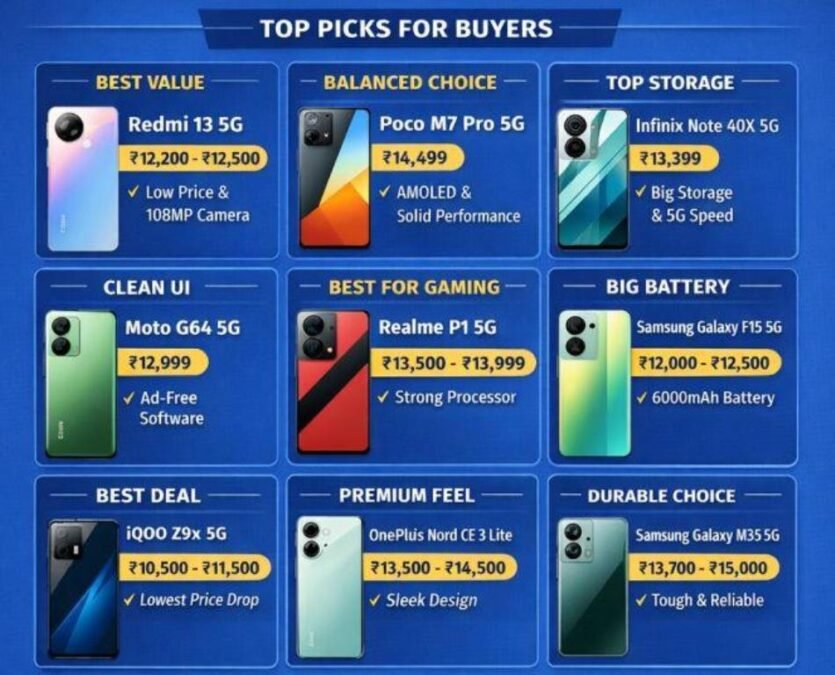
This transformation reflects an industry trend: the democratization of smartphone technology. Features that were once exclusive to mid-range or premium devices — such as 120Hz displays, large batteries, high-resolution cameras, and fast charging — are widely available in budget smartphones. As a result, differentiation has become more difficult, forcing brands to compete aggressively on pricing.
At the same time, user feedback indicates a growing gap between hardware innovation and software experience. While specifications have improved significantly, issues such as UI optimization, long-term performance stability, and camera consistency — especially in low-light conditions — continue to influence buying decisions.
Redmi 13 5G: Aggressive pricing strategy drives volume-led growth
The Redmi 13 5G has recorded a price decline of approximately 10–12 percent, falling from ₹13,999 in December 2025 to ₹12,200–₹12,500 in April 2026.
Redmi 13 5G smartphone offers a 120Hz display, Snapdragon 4 Gen 2 processor, 108MP primary camera, and a 5030mAh battery, targeting users seeking a balance of performance and camera capabilities.
Customer feedback highlights smooth scrolling, strong daylight photography, and overall value for money. However, users frequently report UI lag, occasional heating issues, and inconsistent battery optimization over prolonged use.
Poco M7 Pro 5G: Balanced hardware supports price stability
Poco M7 Pro 5G has seen a modest price correction, declining from ₹14,999 in December 2025 to around ₹14,499 in April 2026, making it one of the more stable devices in this analysis.
Poco M7 Pro 5G features a 120Hz AMOLED display, MediaTek Dimensity 7025 processor, OIS-enabled camera system, and 45W fast charging, offering a well-rounded experience.
Users highlight smooth multitasking, vibrant display quality, and reliable day-to-day performance, while concerns include delayed software updates and average low-light camera performance.
Infinix Note 40X 5G: Feature-heavy device with pricing variability
The Infinix Note 40X 5G has experienced moderate but inconsistent price movement, with the base variant dropping from ₹14,999 to around ₹13,399, while higher variants remain priced closer to ₹15,999.
Infinix Note 40X 5G offers a 120Hz display, Dimensity 6300 chipset, 108MP camera, and up to 256GB storage, making it attractive to storage-focused consumers.
Customer feedback points to strong storage value and dependable battery life, but also highlights bloatware-heavy UI, average gaming performance, and slower charging speeds compared to rivals.
Moto G64 5G: Clean Android experience offsets feature gaps
The Moto G64 5G has seen a steady decline from ₹13,999–₹14,499 to approximately ₹12,999, representing a 5–10 percent reduction.
Moto G64 5G differentiates itself through a 6000mAh battery, near-stock Android interface, and OIS-supported camera, appealing to users who prioritize a clean software experience.
Customers appreciate ad-free UI, stable performance, and strong battery life, but frequently mention slow charging speeds, limited software update cycles, and occasional lag during heavy usage.
Realme P1 5G: Performance-focused positioning faces pricing pressure
The price of Realme P1 5G has dropped from ₹14,999 in December 2025 to ₹13,500–₹13,999 in April 2026, reflecting a 7–10 percent decline.
Realme P1 5G features a Dimensity 7050 processor, 120Hz AMOLED display, and 45W fast charging, targeting performance-oriented users.
Users highlight strong gaming performance and vibrant display quality, but report UI clutter, pre-installed apps, and inconsistent camera performance in challenging lighting conditions.
Samsung Galaxy F15 5G: Battery and reliability drive value despite price drop
Samsung Galaxy F15 5G has experienced a sharp decline from ₹14,500–₹14,999 to ₹12,000–₹12,500, marking one of the steepest drops in this segment.
Samsung Galaxy F15 5G offers a Super AMOLED display, 6000mAh battery, and long-term software support, positioning it as a reliability-focused device.
Customers value display quality and battery endurance, but frequently note slower processing performance, limited multitasking capability, and slower charging speeds compared to rivals.
iQOO Z9x 5G: Aggressive discounting drives rapid adoption
The iQOO Z9x 5G has recorded the largest price correction, declining from ₹12,999–₹13,499 to ₹10,500–₹11,500, representing up to a 20 percent reduction.
iQOO Z9x 5G features a Snapdragon 6 Gen 1 processor, 120Hz display, and 6000mAh battery with 44W charging, making it highly competitive post price drop.
Users praise battery efficiency and overall value, but report software inconsistencies, occasional connectivity issues, and average camera performance.
OnePlus Nord CE 3 Lite 5G: Brand equity stabilizes pricing
The OnePlus Nord CE 3 Lite 5G has shown limited price movement, declining from ₹14,500–₹14,999 to ₹13,500–₹14,500.
OnePlus Nord CE 3 Lite 5G offers a 108MP camera, 67W fast charging, and a premium design with OxygenOS, targeting users seeking a refined experience.
Customers highlight clean UI, fast charging, and design quality, while criticisms include an outdated chipset and lack of AMOLED display.
Samsung Galaxy M35 5G: Durability and battery define its positioning
Price of Samsung Galaxy M35 5G has dropped from ₹14,999–₹15,499 to ₹13,700–₹15,000, reflecting moderate price adjustments influenced by promotional offers.
Samsung Galaxy M35 5G features a 120Hz AMOLED display, Exynos 1380 processor, Gorilla Glass protection, and a 6000mAh battery, emphasizing durability and longevity.
Customers appreciate build quality, display, and battery performance, while complaints include heavier design, slower charging speeds, and average gaming capability.
Redmi 15 5G: Battery differentiation slows depreciation
The Redmi 15 5G has seen a controlled price decline from ₹14,999 to ₹13,000–₹14,000, representing a 7–10 percent reduction.
Redmi 15 5G stands out with a 7000mAh battery, 144Hz display, and Snapdragon chipset, targeting users who prioritize endurance and display smoothness.
Users praise exceptional battery life and large screen size, while concerns include average camera quality and LCD panel limitations compared to AMOLED competitors.
Customer Trends: Convergence in Expectations and Pain Points
Across all 10 smartphones, customer behavior reveals a clear convergence in expectations. Buyers increasingly prioritize battery life, display quality, and overall reliability, with 5G connectivity now seen as a baseline requirement rather than a premium feature.
However, common pain points persist. Users frequently report software-related issues such as bloatware, delayed updates, and performance degradation over time. Camera performance, especially in low-light conditions, remains inconsistent across most devices, despite high megapixel counts.
The sub-₹15,000 smartphone segment in India is defined by value expansion and price depreciation. Consumers are benefiting from feature-rich devices at increasingly lower prices, while manufacturers face mounting pressure to differentiate and sustain profitability.
FASNA SHABEER