

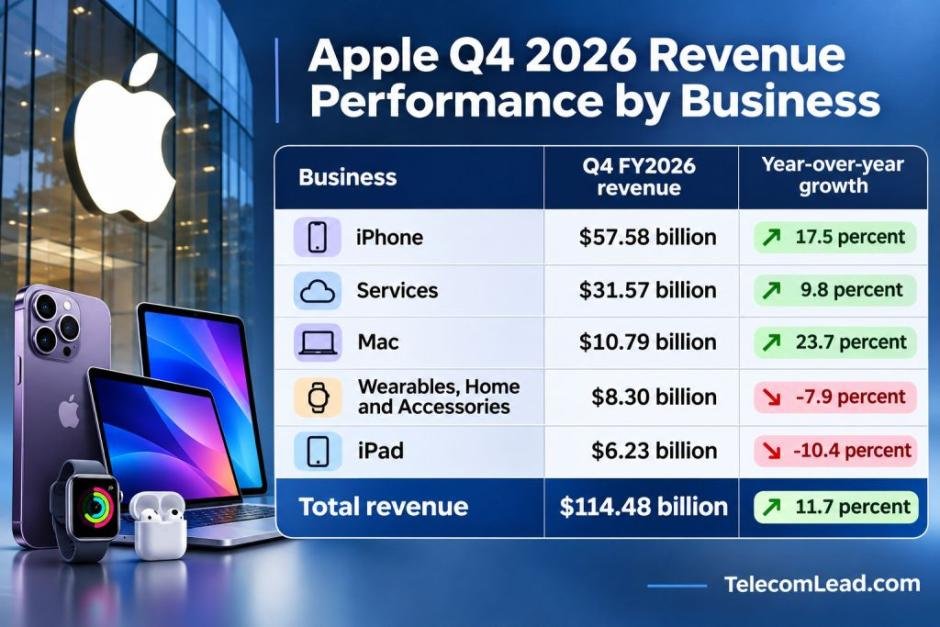
Apple has reported revenue of $114.48 billion for the fourth quarter of fiscal 2026, up 11.7 percent from $102.47 billion a year earlier, driven by strong iPhone sales, expanding Services revenue and growth across major geographic markets. The performance highlights Apple’s ability to increase revenue despite a significant contraction in global smartphone shipments.

“We’re closing the year with our most ambitious lineup. That includes the iPhone Duo, the most transformational iPhone, alongside iPhone 18 Pro and iPhone 18 Pro Max, our most powerful iPhonest. We also just introduced a whole new generation of hardware for the home and brought Touch to Mac for the first time,” John Ternus, Apple’s CEO, said announcing the Apple Q4 2026 results.
For the full fiscal year ended September 26, 2026, Apple’s revenue reached $478.83 billion, an increase of 15.1 percent from $416.16 billion in fiscal 2025.
Apple’s quarterly gross profit increased 13.4 percent to $54.82 billion from $48.34 billion. Its gross margin improved to 47.9 percent from 47.2 percent a year earlier.
For fiscal 2026, gross profit climbed 19.7 percent to $233.60 billion, compared with $195.20 billion in the previous year.
Apple iPhone Revenue Surges 17.5 Percent to $57.58 Billion
Apple’s iPhone business remained the largest revenue contributor, generating $57.58 billion in quarterly sales, up 17.5 percent from $49.03 billion a year earlier.
iPhone accounted for approximately 50.3 percent of Apple’s total quarterly revenue, reinforcing the smartphone business’s importance to the company’s financial performance.
For the full fiscal year, iPhone revenue increased 21.2 percent to $254.10 billion from $209.59 billion.
The strong revenue growth came despite weakening global smartphone demand.
According to data from IDC’s Worldwide Quarterly Mobile Phone Tracker, global smartphone shipments declined 22 percent year over year to 255.3 million units in the third quarter of 2026.
Apple shipped 57.3 million smartphones during the quarter, down 4 percent from 59.7 million units a year earlier, IDC said. Apple does not share the number of iPhone shipment.
Apple’s global smartphone market share increased to 22.4 percent from 18.2 percent, indicating that the company gained share even as its shipment volumes declined.
Samsung maintained its leadership position with shipments of 57.8 million units, representing a 22.6 percent market share. Samsung’s shipments declined 5.8 percent from 61.4 million units a year earlier.
The difference between Samsung and Apple narrowed to just 500,000 smartphones during the quarter.
Apple’s stronger revenue performance alongside lower smartphone shipments suggests that product mix, pricing and premium-device demand supported sales growth. However, the available figures do not establish how much of the increase came from higher average selling prices.
Apple Services Revenue Rises 9.8 Percent to $31.57 Billion
Apple’s Services business generated $31.57 billion in quarterly revenue, an increase of 9.8 percent from $28.75 billion in the corresponding quarter of fiscal 2025.
Services represented approximately 27.6 percent of Apple’s total quarterly revenue.
For fiscal 2026, Services revenue reached $123.30 billion, increasing 13 percent from $109.16 billion in fiscal 2025.
The Services segment includes Apple’s digital ecosystem, covering offerings such as the App Store, iCloud, Apple Music, Apple TV and other subscription and platform services.
The expansion of Services is strategically important because it provides recurring revenue opportunities beyond hardware purchases.
Apple’s quarterly Services gross margin reached approximately 76 percent, substantially higher than the Products gross margin of 37.2 percent.
Services generated approximately $23.98 billion in quarterly gross profit, compared with $30.84 billion from Products.
This demonstrates the growing contribution of Apple’s digital business to overall profitability.
Mac Revenue Jumps 23.7 Percent While iPad Sales Decline
Apple’s Mac business delivered strong quarterly growth, with revenue increasing 23.7 percent to $10.79 billion from $8.73 billion a year earlier.
For fiscal 2026, Mac revenue increased 12.5 percent to $37.93 billion from $33.71 billion.
The growth indicates stronger revenue performance in Apple’s computer portfolio, although the financial data does not separately identify enterprise purchases, consumer demand or shipment volumes.
Meanwhile, iPad revenue declined 10.4 percent to $6.23 billion from $6.95 billion in the year-earlier quarter.
Full-year iPad revenue remained relatively stable at $27.93 billion, compared with $28.02 billion in fiscal 2025.
Apple’s Wearables, Home and Accessories business also experienced weaker quarterly sales.
Revenue from the segment declined 7.9 percent to $8.30 billion from $9.01 billion.
For the full fiscal year, Wearables, Home and Accessories revenue reached $35.58 billion, compared with $35.69 billion in fiscal 2025.
The figures indicate that Apple’s quarterly growth was concentrated primarily in iPhone, Mac and Services, while iPad and Wearables recorded revenue declines.
Apple Greater China Revenue Surges 21 Percent
Apple recorded revenue growth across most of its geographic segments during the September quarter, with Greater China delivering the fastest expansion among its reportable regions.
Greater China revenue increased 21 percent to $17.54 billion, compared with $14.49 billion a year earlier.
For fiscal 2026, Greater China revenue reached $82.38 billion, representing growth of approximately 28 percent from $64.38 billion.
The Americas remained Apple’s largest geographic market, generating quarterly revenue of $48.68 billion, up 10.2 percent from $44.19 billion.
Americas revenue for the full fiscal year increased 11.1 percent to $198.08 billion.
Europe delivered quarterly revenue of $32.01 billion, increasing 11.5 percent from $28.70 billion.
For fiscal 2026, European revenue increased 14.9 percent to $127.60 billion.
Revenue from the Rest of Asia Pacific region increased 15 percent to $9.71 billion from $8.44 billion.
Japan was the only geographic segment reporting a quarterly revenue decline, with sales decreasing 1.4 percent to $6.54 billion from $6.64 billion.
However, Japan’s full-year revenue increased 7.7 percent to $30.91 billion.
Apple Gains Smartphone Market Share Despite Falling Shipments
The smartphone market data highlights an important distinction between Apple’s financial performance and the broader industry’s shipment trends.
Worldwide smartphone shipments contracted sharply during the third quarter of 2026, reflecting significant pressure on device volumes.
Apple’s shipments declined 4 percent, substantially less than the global market’s 22 percent contraction.
Consequently, Apple’s market share increased by 4.2 percentage points.
Samsung’s market share also increased, rising from 18.7 percent to 22.6 percent despite lower shipments.
Together, Samsung and Apple accounted for 45 percent of global smartphone shipments in the third quarter of 2026, compared with 36.9 percent a year earlier.
The figures suggest that the two leading smartphone vendors strengthened their combined market position during the downturn.
Apple’s iPhone revenue growth of 17.5 percent, compared with a 4 percent decline in shipments, also highlights the importance of premium-device sales and product mix in determining financial performance.
However, Apple’s fiscal fourth-quarter revenue and IDC’s calendar third-quarter shipment figures measure different financial and operational indicators and should not be interpreted as a direct calculation of average selling prices.
Apple’s Growth Strategy: Premium Devices and Services
Apple’s fiscal 2026 performance demonstrates the financial importance of combining premium hardware with a large digital services business.
Three developments stand out.
First, iPhone revenue increased significantly despite declining global smartphone shipments, demonstrating Apple’s relative resilience during a difficult period for the industry.
Second, Services generated more than $123 billion in annual revenue and maintained substantially higher gross margins than hardware.
Third, Apple’s geographic expansion was broad-based, with particularly strong revenue growth in Greater China and the Rest of Asia Pacific.
For investors and technology industry executives, the central question is whether Apple can sustain strong iPhone revenue growth while global smartphone demand remains under pressure.
The company’s expanding Services business provides an additional source of revenue and gross profit, while Mac growth creates opportunities beyond smartphones.
Apple ended fiscal 2026 with revenue of $478.83 billion, supported by $254.10 billion in iPhone sales and $123.30 billion in Services revenue. Its ability to increase market share during a major smartphone industry downturn reinforces its competitive position in the premium device market.
BABURAJAN KIZHAKEDATH