

Apple’s first foldable smartphone, the iPhone Duo, is attracting strong consumer demand, with delivery dates for some orders extending into January 2027. However, reports of damaged displays, expensive repairs and app compatibility issues are raising concerns about the reliability and long-term ownership costs of Apple’s premium foldable iPhone.


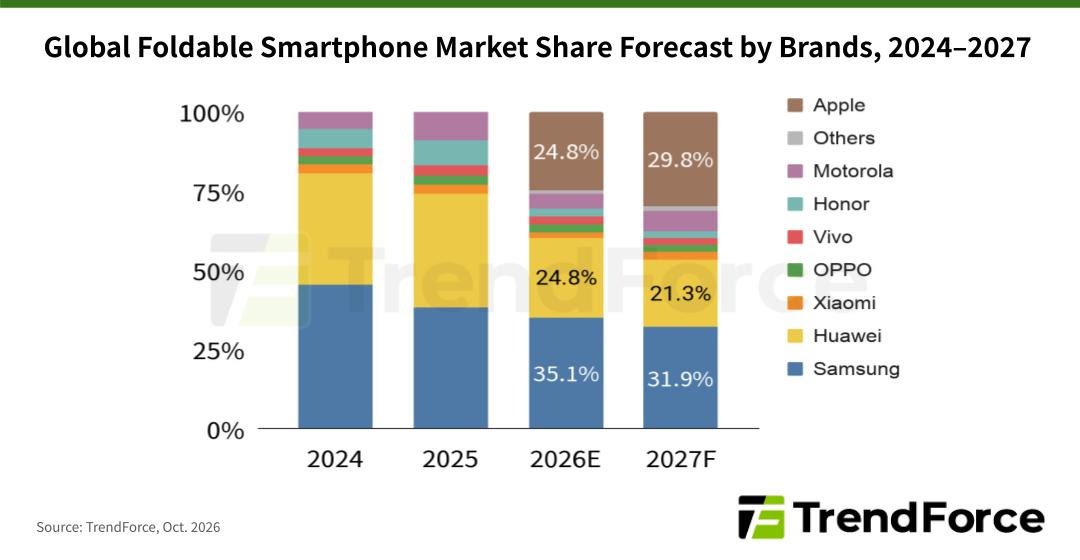
According to market research firm TrendForce, the iPhone Duo is expected to achieve approximately 5 million shipments in 2026, capturing 24.8 percent of the global foldable smartphone market.
The forecast highlights Apple’s potential to become a major player in the foldable smartphone segment despite entering a market where overall shipment growth remains limited.
Meanwhile, Counterpoint Research’s Smartphone Weekly Sales Tracker indicated Apple’s iPhone 18 Pro series recorded 3.1 percent growth in global sales during the first three weeks following its September 2026 launch. Combined sales of the iPhone 18 Pro and iPhone 18 Pro Max exceeded those of the iPhone 17 Pro series during the corresponding launch period in 2025.
iPhone Duo Demand Pushes Delivery Dates to January 2027
Less than a week after Apple opened preorders for the iPhone Duo, its official website was displaying delivery estimates extending into January 2027 for certain configurations.
The extended delivery timelines indicate strong initial demand relative to available inventory, although they do not independently establish total sales volumes.
Apple’s entry comes as global foldable smartphone shipments are expected to increase by just 0.5 percent in 2026, according to TrendForce.
The research firm estimates that Apple will ship approximately 5 million iPhone Duo units during the year, representing nearly one-quarter of worldwide foldable smartphone shipments.
Based on these estimates, the global foldable smartphone market would reach approximately 20.2 million units in 2026.
Apple’s arrival could significantly change market-share rankings, putting pressure on established foldable smartphone manufacturers, including Samsung, Huawei and other Android device vendors.

Apple iPhone Duo Screen Damage Raises Reliability Concerns
The iPhone Duo has received positive feedback for its large unfolded display, multitasking capabilities and nearly invisible screen crease.
However, early customers have also reported problems involving damaged inner displays and unusually high repair estimates.
Apple has confirmed that it will replace a small number of iPhone Duo devices exhibiting screen abnormalities, according to an October 26 Reuters report.
The development has increased attention on the durability of foldable OLED displays, particularly because the iPhone Duo targets premium smartphone buyers.
Unlike conventional smartphones, foldable devices use flexible display structures that repeatedly bend during everyday operation.
This creates additional engineering challenges involving mechanical stress, hinge movement, display adhesives and protective layers.
Although the reported problems affect a limited number of devices, their occurrence during the initial launch period could influence consumer confidence.
The actual failure rate remains unclear because Apple has not disclosed the total number of affected units.
Why the iPhone Duo Display Crease Is Almost Invisible
One of the iPhone Duo’s most important technological improvements is its barely visible display crease.
TrendForce explains that foldable OLED displays contain multiple layers, including cover materials, optical adhesives, display components and encapsulation structures.
When the display folds, these layers experience different mechanical stresses.
Apple’s display design attempts to reduce these stresses through adjustments to bending radius, material thickness and adhesive flexibility.
The adhesive layers allow controlled movement within the display structure, reducing pressure on sensitive components.
Nanoscale surface textures also help scatter reflected light, making the crease less noticeable when the display is unfolded.
These technologies improve the viewing experience by reducing visible differences across the folding area.
However, reducing the appearance of the crease does not eliminate the mechanical challenges associated with repeated folding.
Teardrop Hinge Design Could Be Linked to Display Damage
The iPhone Duo uses a teardrop-style hinge designed to manage the movement of its flexible OLED display.
When unfolded, the hinge supports the display and maintains a flat surface for viewing and touch interaction.
When closed, the mechanism creates sufficient space for the display to bend along a controlled curve.
TrendForce highlights a possible explanation emerging from teardown analyses of damaged devices.
If the central support mechanism does not retract sufficiently during folding, unintended contact could create localized pressure on the inner display.
Such pressure concentrations may contribute to display abnormalities or damage.
However, this remains an engineering hypothesis rather than a confirmed explanation for the reported failures.
Potential improvements could involve tighter manufacturing tolerances, more precise hinge movement and better coordination between display support structures.
For Apple, addressing these issues will be important because consumers expect premium devices to deliver durability alongside advanced features.
iPhone Duo Multitasking Features Face App Compatibility Challenges
The iPhone Duo offers a larger workspace than conventional smartphones, enabling users to operate multiple applications simultaneously.
The expanded display can support document reading, content editing, video viewing and AI-powered productivity applications.
Users can potentially review AI-generated summaries while reading documents or working with other applications.
However, TrendForce reports that some applications continue to display black borders or fail to utilize the entire unfolded screen.
Other users have reported difficulties adapting to the device’s button placement and fingerprint authentication system.
These issues suggest that software optimization remains a challenge for Apple’s first foldable smartphone.
For multitasking to deliver meaningful productivity improvements, applications must adjust automatically when users fold or unfold the device.
They must also preserve ongoing tasks, text input and reading positions during transitions between screen sizes.
Apple’s developer ecosystem could become an important competitive advantage as more applications are optimized for foldable displays.
Larger Foldable Display Creates Battery Life Challenges
Battery efficiency is another important consideration for iPhone Duo buyers.
The larger OLED display requires additional power, particularly when users operate multiple applications or maintain high screen brightness.
TrendForce notes that reducing the display refresh rate can lower some power consumption, but OLED energy requirements also depend on brightness, active display area and content.
Even displaying a static document with a white background consumes power.
Running AI applications alongside multitasking features could increase energy demand further.
Improving battery efficiency will require advances in OLED materials, display-driving technologies and power management.
Apple’s ability to optimize its processors, operating system and display hardware could help improve performance and battery life through future software updates and hardware generations.
Global Foldable Smartphone Market: Key Figures for 2026
| Market indicator | 2026 estimate |
| Global foldable smartphone shipment growth | 0.5 percent |
| Estimated global foldable shipments | Approximately 20.2 million |
| Apple iPhone Duo shipments | Approximately 5 million |
| Apple foldable smartphone market share | 24.8 percent |
| iPhone Duo delivery estimates for some orders | January 2027 |
| Reported inner-display problems | Limited number of devices |
| Apple replacement policy | Replacement for qualifying affected devices |
Source: TrendForce estimates and reported Apple product developments.
Apple vs Samsung vs Huawei: Foldable Smartphone Competition Intensifies
Apple’s expected 24.8 percent market share could reshape competition in the global foldable smartphone market.
Samsung and Huawei have established positions in foldable devices, supported by multiple product generations and experience in flexible display manufacturing.
Apple’s entry introduces another major competitor with substantial strengths in hardware-software integration, processor design and developer support.
However, Apple’s initial success will depend on more than shipment volumes.
Display durability, repair costs, battery performance and application compatibility could become important factors influencing customer satisfaction and repeat purchases.
Samsung and Huawei may also benefit from their experience addressing hinge durability, display protection and software optimization across successive foldable smartphone generations.
With global foldable smartphone shipments forecast to grow just 0.5 percent in 2026, Apple’s projected 5 million shipments suggest that competition will ly involve capturing market share from existing manufacturers rather than relying solely on industry expansion.
Will iPhone Duo Display Problems Affect Apple’s Foldable Strategy?
The iPhone Duo combines strong initial demand with several challenges common to first-generation foldable devices.
Apple’s willingness to replace qualifying devices experiencing display abnormalities could help address early customer concerns.
However, the company will need to demonstrate that its hinge technology and flexible OLED display can withstand regular use over several years.
Software compatibility also remains important because the larger screen must deliver practical benefits beyond an improved viewing experience.
For Apple, the immediate opportunity is to capture nearly 25 percent of the global foldable smartphone market in 2026. The longer-term challenge is ensuring that display reliability, battery performance and multitasking capabilities justify the premium positioning of the iPhone Duo.
The next phase of competition among Apple, Samsung, Huawei and other smartphone manufacturers is likely to focus ly on durability, software experience and productivity rather than foldable display design alone.
BABURAJAN KIZHAKEDATH