

Apple expects its gross margin to decline to 45–46 percent in the December 2026 quarter as rising memory chip prices, AI infrastructure expenses and supply constraints threaten profitability despite strong demand for premium iPhones.

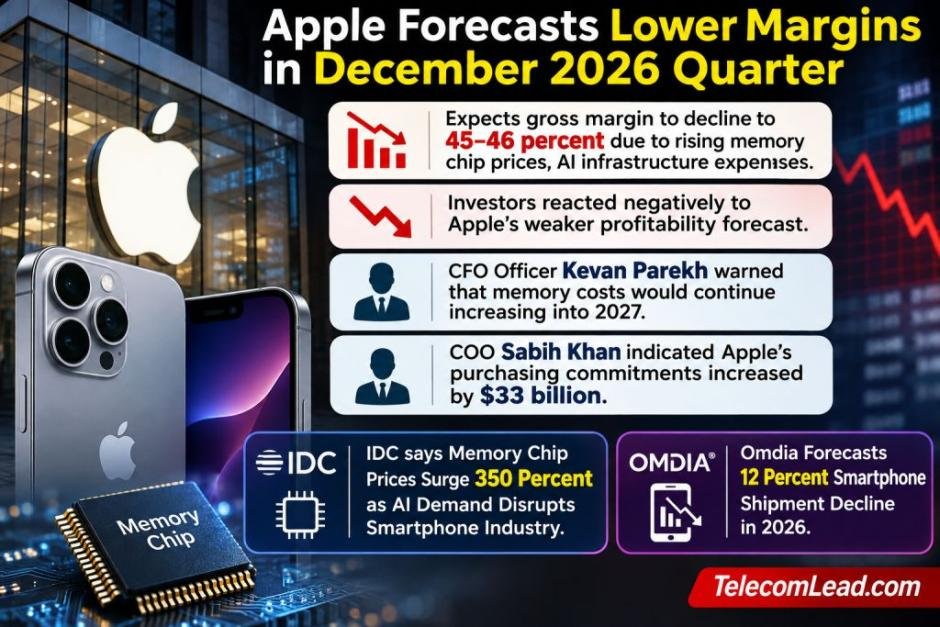
The Apple sales outlook comes as the global smartphone industry faces a severe downturn, with IDC and Omdia forecasting continued market weakness through 2027.
Apple reported fiscal fourth-quarter revenue of $114.48 billion, up 11.7 percent year over year. Earnings per share reached $2.10.
However, investors reacted negatively to Apple’s weaker profitability forecast, with shares falling as much as 4 percent during the earnings conference call before recovering partially, Reuters news report said.
Apple Forecasts Gross Margin Decline in Holiday Quarter
Apple expects gross margin of 45–46 percent for the December quarter, compared with 47.9 percent in its fiscal fourth quarter.
The guidance indicates a sequential decline of 1.9–2.9 percentage points, reflecting rising memory prices and additional operating pressures.
Apple also forecasts services revenue growth of 8–9 percent.
Services generated $31.57 billion in the September quarter, making the division an important contributor to Apple’s profitability.
Chief Financial Officer Kevan Parekh warned that memory costs would continue increasing into 2027, potentially limiting margin recovery.
Apple has responded by increasing purchasing commitments, negotiating with semiconductor suppliers and adjusting product pricing.
Chief Operating Officer Sabih Khan indicated that Apple’s purchasing commitments increased by $33 billion during the quarter, reflecting efforts to secure critical components.
Memory Chip Prices Surge 350 Percent as AI Demand Disrupts Smartphone Industry
The biggest challenge facing Apple and other smartphone manufacturers is the sharp increase in memory semiconductor prices.
IDC’s report on memory costs indicated that smartphone vendors have faced an increase of 350 percent in the price of memory chips over the past year as AI infrastructure demand disrupts semiconductor supply.
The rapid expansion of AI data centers has increased demand for high-bandwidth memory, encouraging semiconductor manufacturers to prioritize higher-value products, Francisco Jeronimo, vice president for Worldwide Devices, IDC, said.
This shift has constrained conventional memory supplies used in smartphones, PCs and consumer electronics.
IDC reported that memory price inflation moderated to a low double-digit sequential increase in Q3 2026, compared with approximately 50–100 percent sequential increases in earlier quarters.
Nevertheless, prices remain elevated, and shortages continue affecting manufacturers.
Apple’s purchasing power provides advantages over smaller smartphone vendors, but its margin forecast demonstrates that even leading manufacturers cannot fully escape semiconductor inflation.
Apple Raises Prices to Protect Profitability
Apple has introduced selective price increases to reduce the financial impact of higher component costs.
The company increased prices of certain iPhone 17 models by $100 and raised prices on selected MacBook configurations.
These adjustments helped offset rising semiconductor expenses during the September quarter.
Apple reported a gross margin of 47.9 percent, exceeding analysts’ expectations of 47.5 percent.
However, the December-quarter forecast suggests that pricing adjustments and inventory advantages may not fully compensate for continued memory inflation.
Higher device prices also create demand risks, particularly in markets where consumers are delaying smartphone upgrades.
iPhone 18 Pro Demand Strong, but iPhone Duo Faces Supply Constraints
Apple’s iPhone business generated $57.58 billion in fiscal fourth-quarter revenue, exceeding analysts’ expectations of $56.54 billion.
Demand for the iPhone 18 Pro lineup supported revenue growth, while higher selling prices contributed to financial performance.
Apple has also changed its traditional product-launch strategy.
Instead of introducing most new iPhones during autumn, the company launched premium iPhone 18 Pro models and the foldable iPhone Duo in 2026, while other models are expected in 2027.
The staggered launch strategy could help Apple distribute revenue more evenly throughout the year.
However, the iPhone Duo faces manufacturing and product-quality challenges.
Apple CEO John Ternus acknowledged display problems affecting a small percentage of foldable devices.
The company is replacing affected units but has not provided a timeline for resolving supply shortages.
Strong demand demonstrates consumer interest in Apple’s first foldable smartphone, but production bottlenecks could restrict holiday-quarter revenue.
AI Infrastructure Costs Add Pressure
Apple’s growing investment in artificial intelligence introduces another source of margin pressure.
The company identified Siri AI, which relies partly on Google’s cloud infrastructure, as a factor affecting profitability.
Cloud-based AI processing creates recurring infrastructure expenses that increase with customer usage.
Apple is considering higher iCloud+ subscription prices to offset these costs, although specific pricing changes have not been announced.
The company also plans usage limits for certain server-based AI features, including Siri AI and intelligent photo editing.
Apple must develop a sustainable business model that balances AI capabilities, subscription revenue and infrastructure spending.
IDC Forecasts Smartphone Market Weakness Through 2027
According to IDC’s Worldwide Quarterly Mobile Phone Tracker, global smartphone shipments declined 22 percent year over year to 255.3 million units in Q3 2026.
The decline represents the largest year-over-year quarterly contraction recorded by IDC.
IDC expects smartphone market growth to remain constrained through 2027, with a potential recovery delayed until at least 2028.
The research firm believes the semiconductor crisis represents a structural shift in smartphone manufacturing costs rather than a temporary supply disruption.
Higher memory prices, expensive components and weakening consumer demand could continue reducing shipments.
Large vendors with secure semiconductor supplies and strong premium portfolios are expected to outperform smaller competitors.
Omdia Forecasts 12 Percent Smartphone Shipment Decline in 2026
Omdia’s report on global smartphone shipments indicated that global smartphone vendors faced a drop of 20 percent in smartphone shipment to 254.7 million units in Q3 2026.
The figure represents the lowest third-quarter shipment volume since 2013.
Omdia forecasts global smartphone shipments will decline 12 percent for full-year 2026, followed by another contraction in 2027.
Continued shortages of high-bandwidth memory and conventional memory chips are expected to keep manufacturing costs elevated.
Higher smartphone prices could also weaken consumer demand during the holiday shopping season.
Amber Liu, Practice Leader at Omdia, warned that manufacturers and distributors face increasing inventory risks as they balance existing stock against upcoming product launches.
Apple Gains Market Share Despite Smartphone Industry Collapse
Despite the industry downturn, Apple demonstrated greater shipment resilience than several Android competitors.
Omdia estimated that Apple shipped 56.5 million iPhones during Q3 2026, broadly unchanged from the previous year.
Samsung remained the global market leader with 57.8 million shipments, representing a 5 percent decline.
Xiaomi shipped 30.7 million smartphones, down 29 percent.
OPPO, including realme and OnePlus, recorded shipments of 23.4 million units, declining 39 percent.
Vivo shipments fell 33 percent to 19.3 million units.
Apple’s stable shipment performance indicates that its premium positioning, brand loyalty and established distribution network are helping protect demand.
China and Emerging Markets Present Challenges
Apple reported revenue of $17.54 billion in China during its fiscal fourth quarter, below analysts’ expectations of $18.58 billion.
The performance highlights competitive pressure in one of Apple’s most important smartphone markets.
Omdia reported that smartphone shipments in Africa fell 39 percent year over year during Q3 2026.
Asia-Pacific excluding Greater China, the Middle East and Latin America also experienced declines exceeding 20 percent.
Rising smartphone prices, currency depreciation and weaker purchasing power are encouraging customers to retain existing devices longer.
North America demonstrated greater resilience because premium smartphone demand is supported by operator financing, trade-in programs and device upgrade offers.
Apple Outlook for 2027: Key Challenges
Apple’s financial performance in 2027 will depend on its ability to address five major challenges: semiconductor inflation, premium smartphone pricing, iPhone Duo production constraints, AI infrastructure expenses and weakening global smartphone demand.
Continued memory shortages could restrict margin recovery, while higher device prices may discourage upgrades.
Apple must also improve foldable smartphone production and generate additional revenue from AI services.
Its strong balance sheet, premium customer base and supplier relationships provide competitive advantages.
However, the December-quarter margin guidance indicates that higher memory costs are beginning to outweigh some of these strengths.
With IDC projecting a possible smartphone market recovery no earlier than 2028 and Omdia forecasting another shipment decline in 2027, Apple’s ability to secure memory supplies, control AI costs and sustain premium iPhone demand will determine its profitability outlook.
BABURAJAN KIZHAKEDATH