

Apple has emerged as one of the biggest winners in the global smartphone market during the second quarter of 2026, outperforming the industry despite weakening consumer demand and rising component costs. Both IDC and Omdia highlighted Apple’s resilience, though each research firm emphasized different aspects of the company’s performance amid the ongoing global memory shortage.

Apple Performance According to IDC
IDC report said Apple was one of only two smartphone vendors in the global top five to record year-on-year shipment growth in Q2 2026, alongside Samsung, even as worldwide smartphone shipments declined 6.7 percent to 277.5 million units due to the memory crisis. Apple benefited from its premium product strategy, stronger relationships with memory suppliers, and ability to absorb rising component costs better than Android rivals, Francisco Jeronimo, vice president for Worldwide Client Devices, IDC, said.
According to IDC’s Worldwide Quarterly Mobile Phone Tracker:
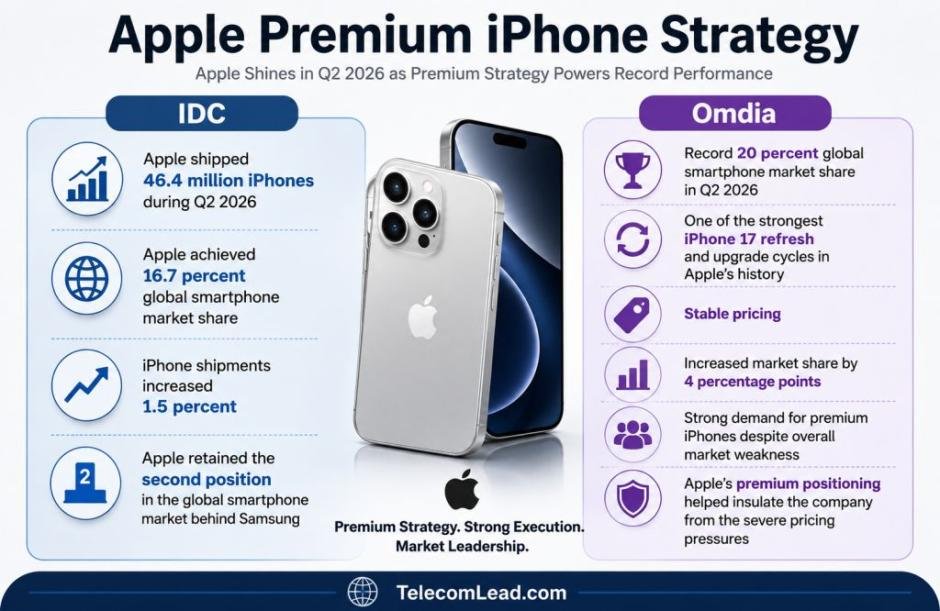
Apple shipped 46.4 million iPhones during Q2 2026.
Apple achieved 16.7 percent global smartphone market share.
iPhone shipments increased 1.5 percent year over year.
Apple retained the second position in the global smartphone market behind Samsung.
IDC noted that premium smartphone vendors such as Apple were less affected by memory shortages because of stronger purchasing power, higher profit margins, and greater pricing flexibility. The research firm said many Android manufacturers faced pressure from rising memory costs, forcing shipment reductions and price increases.
Apple Performance According to Omdia
Omdia report presented Apple as one of the strongest performers in the smartphone industry despite an overall market decline of 4 percent during Q2 2026. The research firm said Apple delivered its best-ever second-quarter performance, capturing a record 20 percent global smartphone market share, traditionally Apple’s weakest seasonal quarter.
Omdia attributed Apple’s strong performance to several factors:
Record 20 percent global smartphone market share in Q2 2026.
One of the strongest iPhone 17 refresh and upgrade cycles in Apple’s history.
Stable pricing while many Android competitors raised prices because of higher memory costs.
Increased market share by 4 percentage points compared with Q2 2025.
Strong demand for premium iPhones despite overall market weakness.
Omdia added that Apple’s premium positioning helped insulate the company from the severe pricing pressures affecting the entry-level Android smartphone market. Consumers continued upgrading to higher-end iPhones while many budget Android vendors struggled with shrinking margins and supply constraints, Runar Bjorhovde, Principal Analyst at Omdia, said.
Premium Strategy Drives Apple Growth
Both IDC and Omdia agree that Apple’s premium-focused strategy enabled the company to outperform the global smartphone market during Q2 2026. While the industry struggled with memory shortages, higher bill-of-material costs, and weakening demand, Apple leveraged its flagship iPhone portfolio, pricing discipline, and supply chain advantages to gain market share.
Premium smartphones remain more resilient than budget devices, suggesting Apple is well positioned to navigate continued supply chain challenges through the remainder of 2026.
SHAFANA FAZAL