

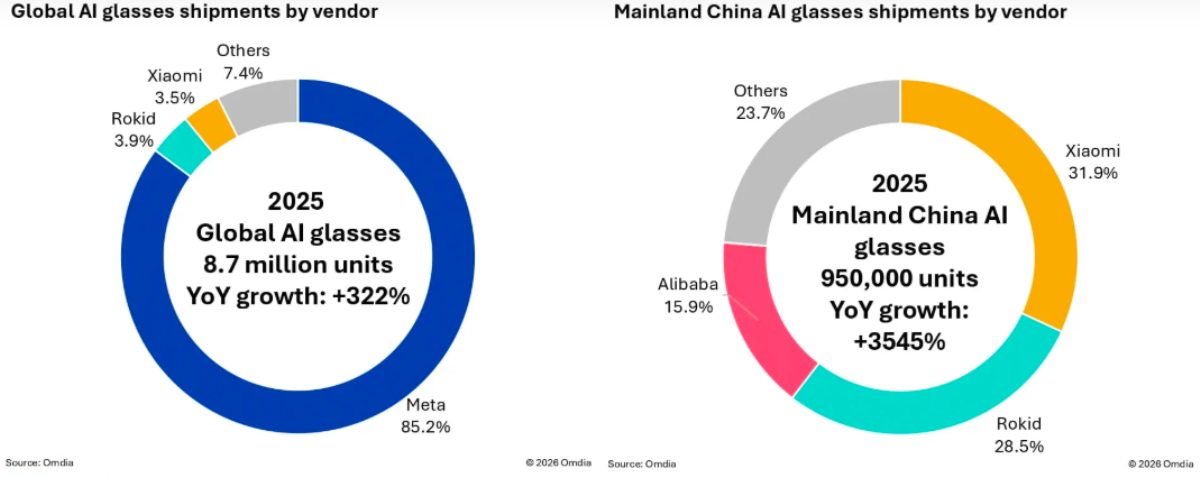
Global shipments of AI glass reached 8.7 million units in 2025, reflecting 322 percent increase as the emerging wearable AI device category gains traction among consumers and technology vendors. According to research firm Omdia, the rapid growth is being driven by advances in AI assistants, expanding device ecosystems, and rising interest in hands-free intelligent interfaces.

Meta Dominates Global AI Glasses Market
Meta Platforms continues to dominate the global AI glasses market with an 85.2 percent share. The company shipped approximately 7.4 million units in 2025, representing a 281.3 percent growth compared with the previous year, Omdia report said.
The strong performance was supported by popular AI-enabled smart glasses developed in collaboration with brands such as Oakley and Ray-Ban. The second-generation Ray-Ban AI glasses played a key role in driving adoption as Meta expanded distribution into new markets including India, Mexico, and Brazil.
Meta’s strategy combines advanced AI capabilities, voice interaction, and seamless connectivity with smartphones and cloud services, helping the company establish an early leadership position in the fast-growing wearable AI segment.
Rokid is the second largest AI smart glass supplier with 3.9 percent share in 2025. Xiaomi is the third largest AI smart glass vendor with 3.5 percent share in 2025.
China Emerges as Fastest-Growing AI Glasses Market
While Meta leads globally, Mainland China has quickly become the fastest-growing market for AI glasses. The country accounted for 10.9 percent of global shipments in 2025, with volumes approaching one million units, making it the second-largest market after the United States.
The rapid expansion in China is driven by aggressive pricing strategies, frequent product launches, and increasing participation from local technology companies. Among them, Rokid has emerged as a strong competitor, while smartphone maker Xiaomi has also entered the segment, securing the third-largest global position.
In China, Xiaomi is the largest AI smart glass vendor with 31.9 percent share in 2025. Rokid is the largest AI smart glass vendor in China with 28.5 percent share in 2025. Alibaba has 15.9 percent share in the AI smart glass market in China in 2025.
Qiran Ju, Senior Analyst at Omdia, said that Rokid’s open ecosystem approach allows users greater flexibility in choosing AI assistants and applications, helping the company expand beyond domestic markets.
Display-Based AI Glasses Gain Momentum
Another key trend in 2025 was the growth of AI glasses equipped with built-in displays. The share of display-enabled devices increased from 3.3 percent in 2024 to 8.4 percent in 2025, with shipments reaching about 730,000 units.
Chinese companies including Alibaba Group, Rokid, and Even Realities dominated this segment, collectively accounting for 71 percent of display-equipped AI glasses.
Meta’s Ray-Ban Display glasses also attracted strong demand, shipping around 84,000 units despite supply constraints. These devices integrate display technology with AI assistants, enabling contextual information to appear directly in the user’s field of view, creating what analysts describe as an “ambient AI” experience.
Ecosystem Integration Becomes Key Battleground
The competitive landscape for AI glasses is expanding as new participants enter the market. Companies such as Xiaomi and electric vehicle manufacturer Li Auto are exploring the category, signaling a broader shift toward ecosystem-driven wearable devices.
Analysts believe that the long-term success of AI glasses will depend on how well vendors integrate them with smartphones, vehicles, smart homes, and cloud-based services. Instead of functioning as standalone devices, AI glasses are increasingly positioned as part of a broader connected ecosystem.
AI Glasses Shipments to Exceed 15 Million in 2026
Looking ahead, Omdia forecasts that global AI glasses shipments will surpass 15 million units in 2026. Growth will be supported by increased production from Meta, new entrants from major technology companies, and rising competition from vendors in markets such as India, Japan, and South Korea.
To sustain this growth, manufacturers will need to improve hardware capabilities, including more efficient system-on-chip designs, better integration between visual displays and interaction systems, and improved battery performance.
SHAFANA FAZAL