

Africa’s smartphone market is entering a major affordability reset as rising memory costs squeeze the ultra-low-cost devices that have supported digital inclusion across the continent for more than a decade.

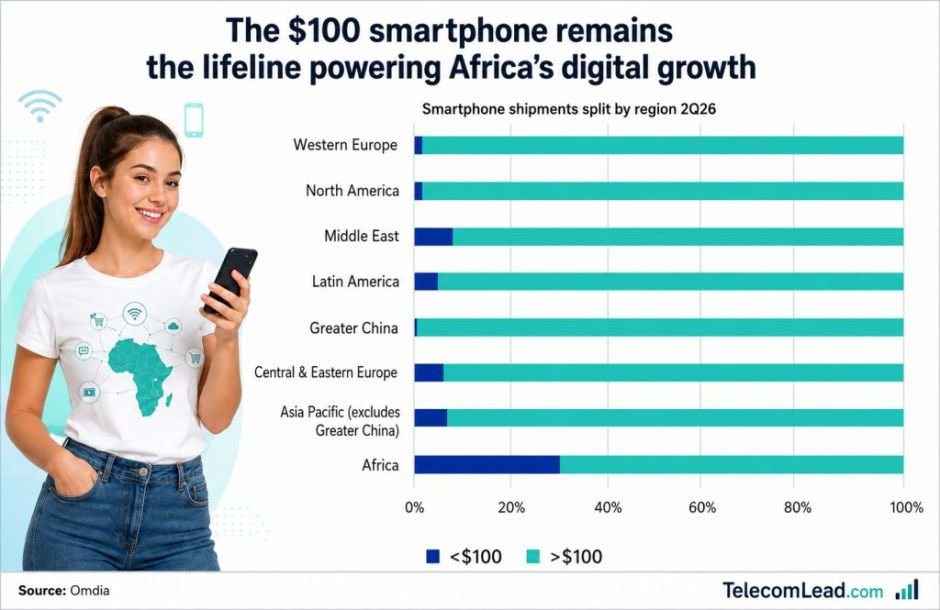
Smartphone shipments in Africa declined 7 percent year on year in Q2 2026, while shipments of devices priced below $100 plunged 34 percent, according to Omdia. The much steeper decline in the entry segment highlights how component inflation is reshaping smartphone demand among price-sensitive consumers, Omdia report said.
For millions of users, sub-$100 smartphones remain an entry point to mobile banking, education, digital payments, social media and e-commerce. But as manufacturers face higher DRAM and NAND costs, the economics of producing these devices are becoming increasingly difficult, Manish Pravinkumar, Principal Analyst at Omdia, said in a blog post.
Memory Costs Threaten Africa’s Sub-$100 Smartphone Market
The global memory shortage is creating acute pressure at the lower end of the smartphone market as AI data centers absorb growing volumes of DRAM and NAND.
Memory now accounts for nearly 60 percent of the bill of materials for smartphones priced below $400 and more than 64 percent for smartphones costing below $99, according to Omdia.
That exposure is particularly significant in Africa, where purchasing power is limited. An entry-level smartphone can cost as much as 73 percent of a low-income adult’s monthly income in Sub-Saharan Africa.
Even relatively small price increases can therefore delay replacement cycles, force buyers toward lower storage or memory configurations, or prevent consumers from purchasing smartphones altogether.
The pressure is pushing vendors away from aggressive price cutting toward financing, better inventory management, stronger channels and higher-value devices.
TRANSSION Holds 47% of Africa Smartphone Market
TRANSSION remains the dominant smartphone supplier in Africa through its TECNO, itel and other brands.
Omdia’s Q1 2026 data showed TRANSSION holding a 47 percent share of Africa’s smartphone market, while shipments increased 4 percent year on year.
Its position reflects a combination of affordable devices, extensive retail networks, local distribution capabilities and tight inventory management.
However, the sharp contraction in sub-$100 shipments means even established low-cost specialists are under pressure to rebalance specifications and protect margins.
Instead of competing solely on the lowest price, vendors are increasingly preserving features consumers value most, including battery life, display size, storage and camera performance, while reducing costs in less visible components.
Samsung Gains From Higher-Value Smartphone Demand
Samsung is benefiting from a different part of the market.
The company’s Galaxy A series remained strong in the $150-$299 price segment during Q1 2026, according to Omdia.
South Africa illustrates the shift toward higher-value smartphones. Smartphone shipments in the country increased 17 percent, while average selling prices climbed 4 percent to $369.
Samsung’s premium ecosystem and broad Galaxy portfolio give it greater exposure to replacement demand, 5G adoption and consumers willing to pay more for better specifications.
The performance highlights Africa’s increasingly divided smartphone market, with mature economies moving toward higher-price devices while much of Sub-Saharan Africa remains dependent on affordable first-time smartphones.
HONOR Smartphone Shipments Surge 101%
HONOR was one of Africa’s fastest-growing smartphone brands in early 2026.
Its shipments increased 101 percent year on year in Q1 2026, supported particularly by South Africa’s operator-led mid-range market and smartphone financing programs.
The expansion demonstrates how financing can support demand above the traditional ultra-low-cost segment.
By reducing upfront payments, financing allows consumers to move from sub-$100 devices toward models in the $120-$150 range, where vendors can offer improved specifications while maintaining more sustainable margins.
Xiaomi Shipments Fall 28%, OPPO Drops 7%
Not every major vendor benefited from the changing market.
Xiaomi smartphone shipments in Africa declined 28 percent year on year, with memory constraints affecting its entry-tier strategy.
OPPO shipments fell 7 percent.
The results show the risks faced by companies whose competitive positioning relies heavily on delivering aggressive specifications at low prices. Rising component costs make it more difficult to maintain such strategies without sacrificing profitability.
Safaricom 4G and 5G Device Base Expands Rapidly
Telecom operators are becoming increasingly important to smartphone affordability because they combine device distribution, connectivity, financing and customer relationships.
Safaricom reported 30.78 million 4G-plus devices in FY26, representing growth of 31.8 percent year on year.
Its 4G device base reached 29.15 million, up 30.6 percent, while the number of 5G devices increased 55.5 percent to 1.64 million.
Safaricom has also distributed more than 4 million affordable devices, illustrating how operators can expand smartphone adoption through bundles, financing and retail channels.
As hardware margins tighten, partnerships between handset makers and telecom operators are likely to become more important across African markets.
M-KOPA Reaches 10 Million Customers and $2 Billion in Credit
Device financing is emerging as one of the strongest alternatives to deep handset discounts.
M-KOPA reached 10 million customers across five African markets in 2026 and says its platform has unlocked more than $2 billion in credit. The company also reports enabling 1.7 million first-time mobile internet users.
Such financing models can lower the initial payment required to acquire a smartphone without forcing manufacturers to slash retail prices.
For consumers, this can make devices in the $120-$150 range more accessible. For vendors, the higher price band provides more room to offer 5G connectivity, additional memory, larger storage and stronger displays while maintaining better economics than the sub-$100 category.
Africa Becomes a Two-Speed Smartphone Market
Africa’s smartphone market is increasingly diverging by country and income level.
Markets including Mozambique, Malawi, Burundi and Liberia remain highly sensitive to relatively small price increases. In these countries, distribution reach, inventory discipline and access to financing can determine whether consumers can afford smartphones at all.
By contrast, South Africa, Egypt, Morocco and Tunisia are increasingly driven by replacement cycles, 5G adoption and higher-value devices.
The result is a two-speed market in which vendors can no longer depend on one pricing and product strategy across the entire continent.
Smartphone Vendors Shift Focus From Price to Lifetime Value
The pressure on device margins is also encouraging manufacturers and channel partners to look beyond the initial smartphone sale.
Cloud storage, digital content, payments, insurance and device-protection services can increase customer lifetime value and provide additional revenue streams.
Exclusive operator bundles, organized retail partnerships, education programs and enterprise deployments are also becoming more attractive than short-term discounting.
The strategic priority is shifting from producing the cheapest handset possible to making a better device affordable over time.
Africa Smartphone Market Outlook: Affordability Moves Beyond $100
The 34 percent decline in sub-$100 smartphone shipments in Q2 2026, compared with the overall market’s 7 percent contraction, suggests that Africa’s ultra-budget smartphone model is under growing pressure.
Memory represents more than 64 percent of the bill of materials in devices below $99, while an entry-level smartphone can already consume as much as 73 percent of a low-income adult’s monthly income in Sub-Saharan Africa.
At the same time, growth in higher-value devices is evident. HONOR shipments increased 101 percent, TRANSSION retained a 47 percent market share, Safaricom’s 5G device base grew 55.5 percent to 1.64 million, and M-KOPA expanded to 10 million customers with more than $2 billion in credit.
Africa’s next phase of smartphone growth is therefore likely to depend less on keeping retail prices permanently below $100 and more on reducing the upfront cost of ownership through financing, operator partnerships, efficient distribution and digital services.
Rising memory costs may have accelerated the change, but the longer-term result could be a smartphone market built around sustainable affordability rather than simply the lowest possible handset price.
FASNA SHABEER