

The global semiconductor industry is set for unprecedented expansion, with the World Semiconductor Trade Statistics (WSTS) organization significantly upgrading its Spring 2026 forecast following stronger-than-expected performance in late 2025 and early 2026.

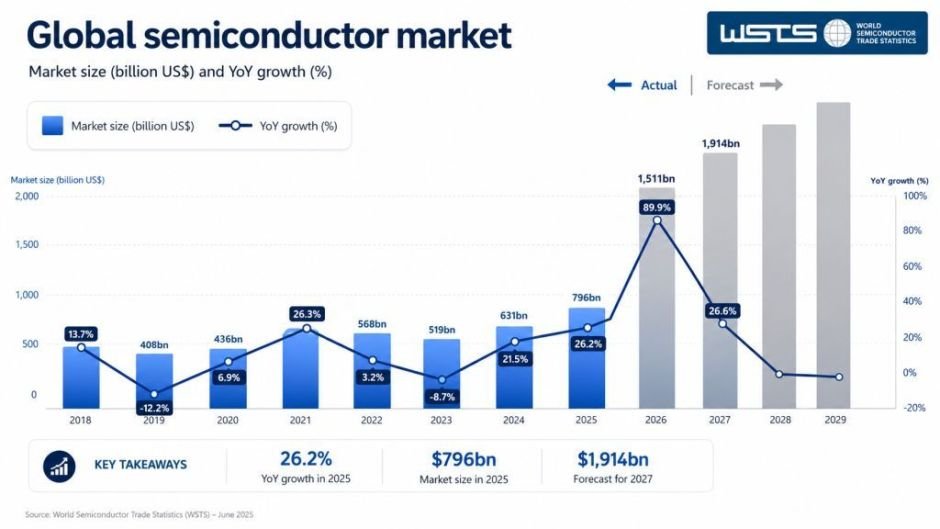
WSTS now expects the global semiconductor market to grow 89.9 percent in 2026, reaching a record $1.51 trillion in revenue. The forecast reflects accelerating demand for artificial intelligence (AI) infrastructure, high-bandwidth memory (HBM), advanced processors, and cloud computing platforms.
The Memory segment is projected to be the industry’s biggest growth driver, with revenue expected to surge around 250 percent year-over-year to more than $800 billion in 2026. Strong demand for AI servers, HBM, and accelerated computing systems is fueling the dramatic expansion.
Logic semiconductors are forecast to grow 37 percent in 2026, making them the second-largest contributor to industry growth. Other semiconductor categories are expected to deliver steady gains, including Microprocessors with 20 percent growth, Analog semiconductors with 10 percent growth, Discrete Semiconductors with 8 percent growth, and Sensors and Optoelectronics with 3 percent growth.
Regional markets are also expected to post robust performance. The Americas will lead global growth with a projected 112 percent increase in semiconductor sales during 2026, supported by massive investments in AI infrastructure and cloud data centers. Asia Pacific is forecast to grow 87 percent, while Europe is expected to expand 58 percent and Japan 28 percent.
Regional Performance
Americas: Revenue is projected to surge from $256.5 billion in 2025 to $543.7 billion in 2026, a 112.0 percent increase, before reaching $701.4 billion in 2027, up 29.0 percent.
Europe: Semiconductor sales are expected to rise from $54.7 billion in 2025 to $86.6 billion in 2026 (58.4 percent growth) and $101.6 billion in 2027 (17.2 percent growth).
Japan: Revenue is forecast to grow from $44.7 billion in 2025 to $57.1 billion in 2026 (27.6 percent), reaching $67.3 billion in 2027 (18.0 percent growth).
Asia Pacific: The largest regional market is expected to increase from $439.7 billion in 2025 to $823.9 billion in 2026 (87.4 percent growth) and exceed $1.04 trillion in 2027 (26.6 percent growth).
Product Segment Outlook
Integrated Circuits (ICs) will remain the industry’s growth engine, rising from $701.0 billion in 2025 to $1.41 trillion in 2026 (101.5 percent growth) and $1.81 trillion in 2027 (28.1 percent growth).
Within ICs:
Memory revenue is forecast to jump from $230.0 billion in 2025 to $803.9 billion in 2026, an extraordinary 249.5 percent increase, before reaching $1.06 trillion in 2027 (32.1 percent growth).
Logic semiconductors are projected to grow from $299.5 billion to $411.4 billion in 2026 (37.3 percent) and $522.8 billion in 2027 (27.1 percent).
Microprocessors are expected to rise from $84.9 billion in 2025 to $101.7 billion in 2026 (19.8 percent) and $122.0 billion in 2027 (20.0 percent).
Analog chips are forecast to increase from $86.5 billion to $95.4 billion in 2026 (10.2 percent) and $101.7 billion in 2027 (6.6 percent).
Outside ICs:
Discrete Semiconductors will grow from $30.7 billion in 2025 to $33.2 billion in 2026 (8.0 percent) and $35.7 billion in 2027 (7.6 percent).
Optoelectronics revenue is expected to rise from $43.0 billion to $44.2 billion in 2026 (2.7 percent) and $46.4 billion in 2027 (5.0 percent).
Sensors are forecast to increase from $20.9 billion in 2025 to $21.5 billion in 2026 (3.0 percent) and $23.0 billion in 2027 (6.9 percent).
The strong momentum is forecast to continue into 2027. WSTS expects the global semiconductor market to grow an additional 27 percent, reaching approximately $1.9 trillion.
Memory is projected to remain the fastest-growing product category in 2027, with revenue increasing 32 percent. Logic semiconductors are expected to grow 27 percent, reflecting continued investment in AI computing, advanced processors, and next-generation digital infrastructure.
WSTS said expanding AI deployments, growing semiconductor content across end markets, and ongoing investments in advanced computing infrastructure will continue to support industry growth. All major geographic regions are expected to remain on a growth trajectory in 2027, with the Americas and Asia Pacific continuing to lead the market expansion.
BABURAJAN KIZHAKEDATH