

SK Hynix delivered its strongest financial performance ever in 2025, driven by surging demand for high bandwidth memory (HBM) and conventional memory solutions used in AI and server applications.

The South Korean chipmaker reported full-year revenue of 97.1467 trillion won, operating profit of 47.2063 trillion won, and net profit of 42.9479 trillion won. Operating margin stood at 49 percent, while net margin reached 44 percent. Annual revenue increased by more than 30 trillion won, and operating profit nearly doubled year on year, marking the highest annual performance in the company’s history.
Record quarterly momentum
SK Hynix also achieved record-high quarterly results across all key indicators. Quarterly revenue rose 34 percent to 32.8267 trillion won, operating profit surged 68 percent to 19.1696 trillion won, and operating margin expanded to 58 percent quarter on quarter. The company said the strong results reflected proactive responses to rising demand not only for HBM but also for conventional server memory.
HBM and advanced DRAM reinforce technology leadership
According to SK Hynix, 2025 was a year that reaffirmed its technological leadership. In the DRAM segment, HBM revenue more than doubled, making a major contribution to the record performance. Conventional DRAM entered full-scale mass production based on the 1cnm process, the sixth generation of the 10-nanometer class technology.
The company also strengthened its leadership in server modules with the development of a 256GB DDR5 RDIMM, a high-capacity server module built on 32Gb fifth-generation 10nm-class (1b) DRAM.
NAND recovery and eSSD-driven growth
In the NAND business, SK Hynix faced sluggish demand in the first half of 2025 but completed development of 321-layer QLC products. In the second half, the company responded to customer demand centered on enterprise SSDs, achieving the highest annual NAND revenue in its history.
AI inference to boost future memory demand
SK Hynix expects demand for high-performance memory such as HBM, along with server DRAM and NAND products, to continue growing. As the AI market shifts from training to inference and distributed architectures expand, the role of memory is expected to become increasingly critical.
The company plans to strengthen quality, technological leadership, and mass-production capabilities, supported by customer trust built as the only industry player capable of stably supplying both HBM3E and HBM4 simultaneously.
Roadmap for DRAM, NAND, and manufacturing expansion
For conventional DRAM, SK Hynix aims to accelerate the transition to the 1cnm process and expand its AI memory portfolio with solutions such as SOCAMM2 and GDDR7. In NAND, the company plans to enhance competitiveness by transitioning to 321-layer technology while addressing AI data center storage demand through Solidigm’s QLC eSSD offerings.
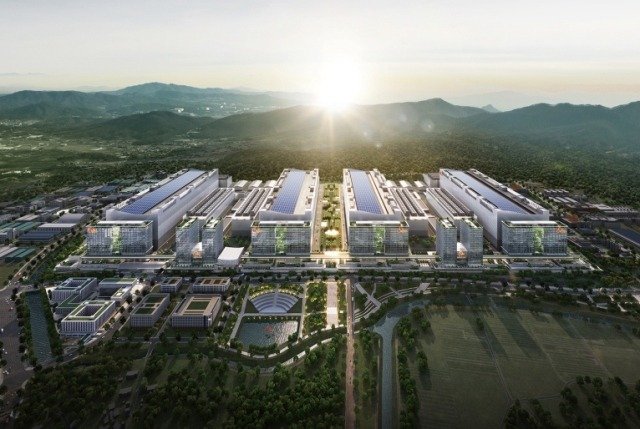
On the manufacturing front, SK Hynix plans to maximize production capacity at the M15X fab in Cheongju at an early stage. It also intends to secure stable mid-to-long-term capacity through construction of its first fab in the Yongin Semiconductor Cluster. Advanced packaging facilities in Cheongju and Indiana in the United States are progressing smoothly.
Song Hyun Jong, President and Head of Corporate Center at SK Hynix, said the company will continue to pursue sustainable performance growth while maintaining an optimal balance between future investment, financial stability, and shareholder returns, supported by its technological edge.
BABURAJAN KIZHAKEDATH