

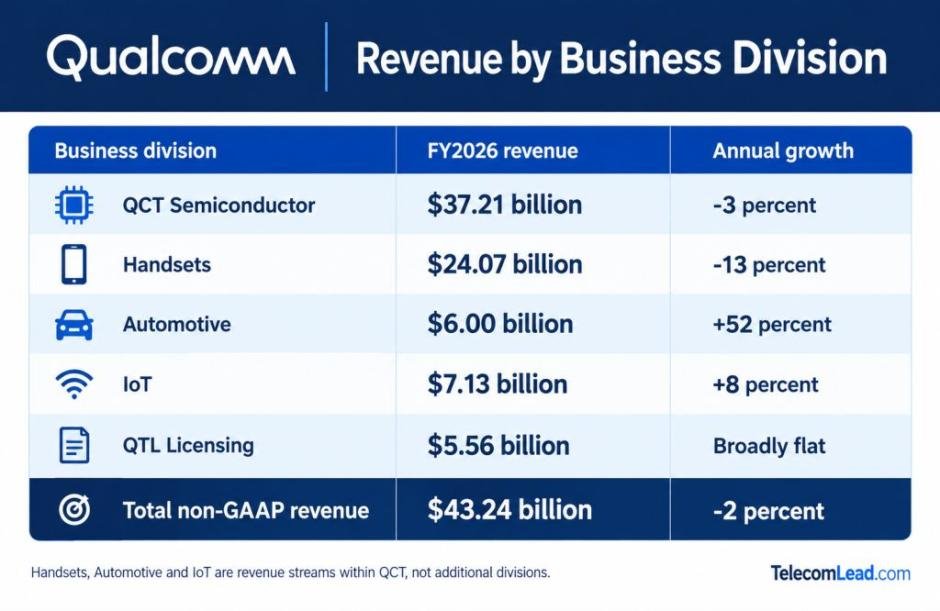
Qualcomm reported revenue of $43.24 billion for fiscal 2026, declining 2 percent from $44.14 billion in fiscal 2025, as weaker smartphone chip sales offset strong growth in automotive, Internet of Things (IoT), and emerging AI data center businesses.

The semiconductor company is accelerating its diversification strategy, targeting AI infrastructure, automotive technology, industrial IoT, AI PCs, robotics, and telecommunications infrastructure to reduce its dependence on smartphones.
Qualcomm’s growth strategy includes expanding its customer relationships with Amazon, Meta, SpaceX, Google, Dell, HP, and leading smartphone manufacturers.
Qualcomm Q4 2026 Revenue Declines 7 Percent
Qualcomm generated revenue of $10.44 billion in the fourth quarter of fiscal 2026, compared with $11.27 billion in the corresponding quarter of fiscal 2025, representing a decline of 7 percent.
Its semiconductor business, Qualcomm CDMA Technologies (QCT), reported quarterly revenue of $9.02 billion, down 8 percent from $9.82 billion.
Qualcomm Technology Licensing (QTL) generated revenue of $1.30 billion, declining 7 percent from $1.41 billion.
For the full fiscal year, QCT revenue decreased 3 percent to $37.21 billion from $38.37 billion, while QTL revenue remained broadly stable at $5.56 billion.
Qualcomm expects revenue of $10.4 billion to $11.2 billion in the first quarter of fiscal 2027, supported by its expanding semiconductor portfolio and growing data center business.
Smartphone Revenue Falls 26 Percent in Q4
Qualcomm’s handset semiconductor revenue declined 26 percent to $5.14 billion in Q4 FY2026 from $6.96 billion a year earlier.
For fiscal 2026, handset revenue fell 13 percent to $24.07 billion from $27.79 billion.
Despite the decline, smartphones remain Qualcomm’s largest semiconductor revenue source.
Qualcomm is strengthening its premium smartphone strategy through the Snapdragon 8 Elite Extreme Gen 6 and Snapdragon 8 Elite Gen 6 platforms, targeting smartphones with advanced on-device AI capabilities.
Its smartphone customers and ecosystem partners include HONOR, iQOO, Motorola, OnePlus, OPPO, REDMI, RedMagic, vivo, and Xiaomi.
The company aims to expand its presence in premium smartphones while developing additional revenue streams beyond mobile devices.
Qualcomm’s declining smartphone chip revenue reflects the downturn in the smartphone market. According to IDC’s latest smartphone market report, worldwide smartphone shipments plunged 22 percent to 255.3 million units in Q3 2026 from 327.3 million units a year earlier, marking the steepest annual quarterly decline on record.
The slowdown in the smartphone industry presents challenges for Qualcomm, whose Q4 FY2026 handset semiconductor revenue declined 26 percent to $5.14 billion. IDC expects smartphone market growth to remain constrained through 2027, with a potential recovery delayed until at least 2028, reinforcing the importance of Qualcomm’s strategy to expand revenue from automotive, IoT and AI data centers.
Automotive Revenue Jumps 52 Percent to $6 Billion
Automotive emerged as Qualcomm’s strongest established semiconductor growth business during fiscal 2026.
Automotive revenue increased 52 percent to $6.00 billion from $3.96 billion in fiscal 2025.
In Q4 FY2026, automotive revenue surged 89 percent to a record $1.99 billion from $1.05 billion.
The business achieved its first quarterly revenue level approaching $2 billion, reflecting Qualcomm’s expanding presence in connected vehicles, digital cockpits, automotive computing, and intelligent vehicle platforms.
Qualcomm’s automotive strategy focuses on expanding its relationships with vehicle manufacturers and technology suppliers while increasing the adoption of its Snapdragon Digital Chassis solutions.
The company is positioning automotive as a major contributor to its long-term non-handset revenue growth.
IoT Revenue Rises 8 Percent to $7.13 Billion
Qualcomm’s IoT business generated $7.13 billion in fiscal 2026 revenue, increasing 8 percent from $6.62 billion.
Fourth-quarter IoT revenue rose 4 percent to $1.89 billion from $1.81 billion.
The company’s IoT growth strategy covers industrial computing, enterprise connectivity, broadband infrastructure, AI PCs, robotics, and intelligent connected devices.
Qualcomm is expanding its Dragonwing portfolio to address industrial and enterprise customers seeking AI-enabled computing and connectivity solutions.
In broadband infrastructure, Qualcomm is collaborating with gFiber and Gemtek on AI-native Wi-Fi 8 gateway technology.
The company is also strengthening its industrial AI ecosystem through a robotics investment initiative in Japan and the establishment of the Qualcomm Japan Robotics Center.
Qualcomm Targets $15 Billion AI Data Center Revenue by FY2029
AI data centers represent one of Qualcomm’s largest new revenue opportunities.
The company expects data center revenue of at least $650 million in Q1 FY2027, followed by sequential quarterly growth throughout fiscal 2027.
Qualcomm targets an annualized data center revenue run rate of $7 billion by the end of fiscal 2027.
Its longer-term target is to generate more than $15 billion in annual data center revenue by fiscal 2029, compared with its fiscal 2027 revenue target of $5 billion.
Qualcomm has secured multi-generation design wins across three major data center categories.
Connectivity: Two customers, including Amazon.
Custom silicon and AI accelerators: Three customers, including Amazon.
CPU platforms: Meta is a confirmed customer.
Qualcomm’s partnership with Amazon is particularly important to its AI infrastructure expansion.
The multi-generation collaboration covers customized silicon for AI inference and optical connectivity solutions supporting Amazon Web Services infrastructure.
The agreement includes warrants associated with up to $60 billion in potential Amazon purchases over ten years. This amount represents potential purchases covered by the warrant arrangement, not guaranteed revenue.
Qualcomm expects revenue from the Amazon collaboration to begin in the December 2026 quarter.
The company is also pursuing additional large data center customers for its high-bandwidth computing and CPU platforms.
Qualcomm Targets Two-Thirds Non-Handset Revenue by FY2029
Qualcomm has established a strategic objective of generating approximately two-thirds of QCT revenue from non-handset businesses by fiscal 2029.
The target includes automotive, IoT, and data center revenue.
Beginning in fiscal 2027, Qualcomm will report Data Center as a separate revenue stream within QCT.
The updated QCT reporting structure will include Handsets, Automotive, IoT, and Data Center.
This change reflects Qualcomm’s transformation from a predominantly smartphone-focused semiconductor supplier into a diversified computing, connectivity, and AI infrastructure company.
Automotive and IoT together generated approximately $13.14 billion in fiscal 2026 revenue, representing substantial progress toward diversification before the planned expansion of data center revenue.
Qualcomm Strengthens Licensing Business with Apple, Huawei and Transsion
Qualcomm has renewed long-term patent licensing agreements with Apple, Huawei, and Transsion, strengthening its licensing revenue base.
The agreements complete Qualcomm’s major licensing renewal cycle for the 5G era.
The company expects its next major licensing renewal cycle to begin in fiscal 2030 and continue through fiscal 2033.
Qualcomm said the latest agreements do not change the revenue run rate of its QTL business.
The licensing strategy provides continuity in customer relationships while positioning Qualcomm’s intellectual property business for the transition toward 6G technologies.
AI PCs, SpaceX and Robotics Support Qualcomm’s Growth Strategy
Qualcomm is expanding its AI PC business through Snapdragon X processors and partnerships with Google, Dell, and HP.
The Snapdragon X Elite platform powers Googlebook devices designed around Google’s Gemini AI capabilities, opening another potential revenue opportunity beyond traditional Windows-based computing.
In telecommunications infrastructure, SpaceX has selected Qualcomm’s Dragonwing cellular infrastructure platforms for Starlink Mobile’s planned nationwide terrestrial 5G network in the United States.
The collaboration expands Qualcomm’s addressable market in cellular base stations and network infrastructure.
Qualcomm is also developing its robotics and physical AI ecosystem through partnerships with Japanese industrial automation and technology companies.
Its broader strategy is to create additional semiconductor revenue opportunities across enterprise computing, AI infrastructure, industrial automation, connected vehicles, and intelligent devices.
Qualcomm’s central growth objective is to reduce its reliance on smartphones and establish automotive, IoT, and AI data centers as major revenue engines, with non-handset businesses targeted to contribute two-thirds of QCT revenue by fiscal 2029.
BABURAJAN KIZHAKEDATH