

India Semiconductor Industry 2026: India is moving from semiconductor design and engineering toward a broader domestic chip ecosystem spanning fabrication, advanced packaging, compound semiconductors, materials, equipment and R&D. The scale is becoming significant: 12 semiconductor projects with $17 billion in investment commitments have been approved, while the government has followed its initial $8 billion Semicon 1.0 programme with a $13.4 billion Semicon 2.0 framework.

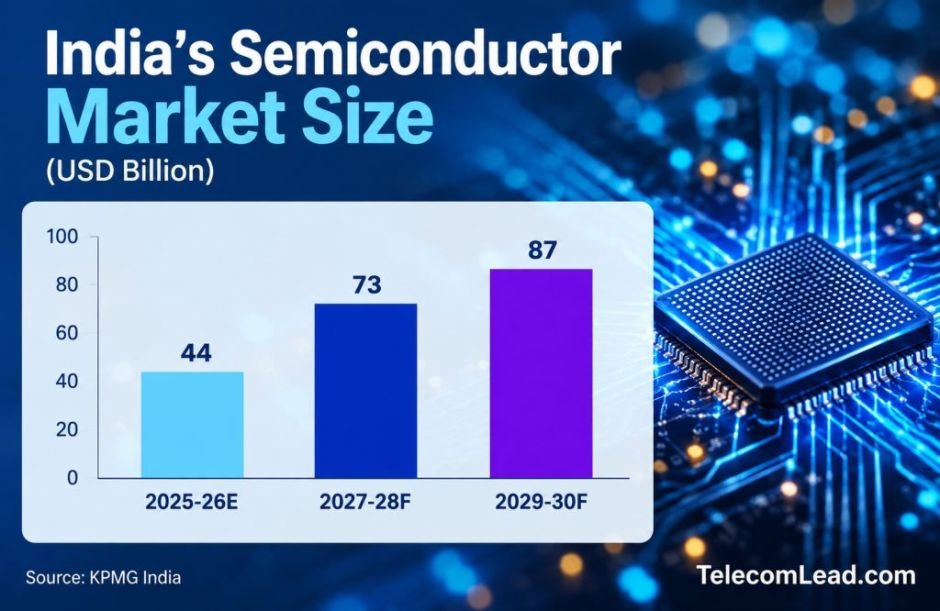
The investment push comes as India’s semiconductor demand is projected to rise from around $44 billion in 2025-26 to about $90 billion by 2029-30, driven by mobile devices, telecom networks, IT infrastructure, automobiles, industrial automation and artificial intelligence.
Here are 10 important developments shaping India’s semiconductor opportunity, based on the September 2026 India’s Semiconductor Opportunity: Building a Globally Competitive Ecosystem report published by the India Deep Tech Alliance with KPMG in India and Nishith Desai Associates.
1. $17 Billion Investment Across 12 Semiconductor Projects
India has already approved 12 semiconductor projects involving investment commitments of $17 billion across six states. More importantly, the programme is beginning to move beyond announcements: three facilities have started commercial production.
The projects cover semiconductor fabrication, assembly, testing and packaging and form the physical foundation of India’s effort to reduce dependence on imported chips.
India currently meets an estimated 90-95 percent of its semiconductor requirements through imports, illustrating the scale of the localisation opportunity. Integrated-circuit imports alone were worth $30.3 billion in 2025-26, while semiconductor-device imports were another $6.2 billion.
2. Semicon 2.0 Brings $13.4 Billion for the Next Investment Cycle
The next major investment catalyst is Semicon 2.0, which carries a total government budget outlay of $13.4 billion.
The programme significantly broadens India’s semiconductor strategy. It covers chip design, semiconductor equipment and materials, new fabs, advanced packaging, R&D and workforce development.
The incentive structure is substantial. Semicon 2.0 provides fiscal support of 40 percent of eligible capex for silicon fabs and 35 percent for compound-semiconductor, photonics, sensor/MEMS and display fabs. Advanced packaging can receive support equal to 35 percent of eligible capital expenditure, compared with 25 percent for legacy packaging.
This could make Semicon 2.0 one of the central drivers of India’s next generation of semiconductor projects.
3. India’s Chip Market Heads Toward $90 Billion
The commercial justification for these investments is India’s rapidly expanding domestic market.
Semiconductor demand is expected to increase from approximately $44 billion in 2025-26 to $90 billion by 2029-30, representing a CAGR of around 19 percent.
Mobile devices and wearables will represent the largest opportunity at an estimated $42.13 billion by 2029-30.
Telecom semiconductor demand could reach $13.22 billion, followed by information technology at $11.31 billion, industrial applications at $7.95 billion, consumer electronics at $5.55 billion, automotive at $4.52 billion and strategic sectors such as defence at $2.19 billion.
That demand gives semiconductor manufacturers locating production in India a potentially large domestic customer base before exports are considered.
4. 28/40 nm Could Become India’s Manufacturing Sweet Spot
India does not necessarily need to begin by competing directly with Taiwan, South Korea and the US in the most advanced semiconductor nodes.
The report identifies 28/40 nm logic manufacturing as one of India’s strongest opportunities.
Around 75 percent of India’s logic demand could use 300 mm wafers by 2030, while 28/40 nm is expected to represent roughly 35 percent of demand within this segment. India’s first fabrication plant at Dholera is designed for 28 nm and more mature nodes.
These chips have broad applications across automotive electronics, industrial systems, telecommunications, connectivity, power management and consumer devices.
Logic is expected to account for about 54 percent of India’s component-level semiconductor demand by 2029-30, compared with memory at 21 percent and discrete semiconductors at 19 percent.
5. Semiconductor Expansion Creates a High-Value Jobs Opportunity
Jobs are one of the most important economic benefits of India’s semiconductor investment programme.
The report describes semiconductors as a high-quality job multiplier, creating high-value direct employment while generating additional jobs throughout the broader semiconductor and electronics value chain.
Employment opportunities will extend beyond engineers working inside fabs. Semiconductor expansion requires specialists in chip design, equipment maintenance, clean-room operations, chemicals and materials, testing, packaging, construction, logistics, research and supply-chain management.
Semicon 2.0 therefore makes talent one of its six pillars, covering student training as well as clean-room, fab-construction and ecosystem skills. The programme can fund up to 75 percent of project costs for education and workforce-development initiatives.
6. More Than 68,000 Students Already Trained in Chip Design
India’s semiconductor strategy is already producing measurable workforce-development numbers.
Under the Chips to Startup programme, more than 68,000 students have been trained in advanced chip-design capabilities, while 320 academic institutions have received access to Electronic Design Automation tools.
The Design Linked Incentive programme has separately approved 24 semiconductor design projects, while EDA-tool support has been provided to 105 startups and MSMEs.
These initiatives matter because India’s existing strength is semiconductor engineering and design. Building domestic IP companies around this talent could potentially generate more economic value than treating India only as a manufacturing destination.
7. Semiconductor Investment Is Expanding Into Private Capital
Government incentives are beginning to be accompanied by private investment.
India’s semiconductor sector attracted $687 million of PE-VC funding between 2016 and 2026 YTD, according to Venture Intelligence data cited in the report. Almost 75 percent of the funding arrived after 2021, when Semicon 1.0 was approved.
Fabless semiconductor design has dominated deal activity. The report identifies 56 fabless-design deals, compared with much smaller numbers in integrated device manufacturers, foundries/OSAT and equipment and materials.
Separately, India Deep Tech Alliance venture-capital members initially committed $1 billion to Indian deep-tech ventures over five to ten years, with total commitments subsequently increasing to approximately $3 billion.
8. Electronics Manufacturing at $133 Billion Creates Chip Demand
India’s semiconductor ambitions are closely linked to its rapidly growing electronics manufacturing industry.
Electronics production nearly doubled from $74.7 billion in FY2021 to $133 billion in FY2025. Mobile-phone manufacturing expanded at approximately 21 percent CAGR between FY2021 and FY2025.
Government programmes are adding another investment layer. The Electronics Component Manufacturing Scheme represents a $4.2 billion programme, while the large-scale electronics manufacturing PLI has achieved about $1.8 billion in investment and $11.5 billion in production.
The expansion of smartphones, wearables, IT hardware and consumer electronics provides domestic semiconductor fabs and packaging facilities with an increasingly attractive demand base.
9. Advanced Packaging Could Become a Major Indian Opportunity
India’s opportunity is not limited to wafer fabrication.
The report places advanced packaging, ATMP and OSAT among the areas where India can scale relatively quickly, alongside semiconductor design, fabless IP, AI accelerator and ASIC design, mature-node fabs and connectivity and power ICs.
Semicon 2.0’s 35 percent fiscal support for eligible advanced-packaging capex could encourage additional investment.
Advanced packaging is particularly important as AI processors increasingly combine multiple dies, high-bandwidth memory and specialised accelerators. It also gives India a route into higher-value semiconductor manufacturing without immediately assuming the enormous capital requirements associated with cutting-edge fabs.
10. AI, Telecom and Cloud Could Drive India’s Next Semiconductor Investment Wave
India’s semiconductor expansion increasingly intersects with AI infrastructure.
Telecom alone is projected to create $13.22 billion of semiconductor demand by 2029-30, while information technology could generate another $11.31 billion. Mobile and wearables add $42.13 billion.
The opportunity extends from processors and memory to networking silicon, RF chips, connectivity ICs and power-management semiconductors.
The report therefore identifies AI infrastructure chips, advanced memory, next-generation packaging and high-performance computing chips as longer-term strategic opportunities requiring sustained investment in R&D and talent.
India’s cooperation with the US is also expanding into AI infrastructure through the TRUST initiative, covering investment and partnerships in data centres, advanced computing, reliable energy infrastructure and digital connectivity.
India Semiconductor Outlook: From $17 Billion Projects to a Broader Chip Ecosystem
The numbers indicate that India’s semiconductor strategy is moving beyond policy announcements. Twelve approved projects carrying $17 billion of investment commitments, three facilities in commercial production, a $13.4 billion Semicon 2.0 programme, 68,000-plus students trained and $687 million of PE-VC funding provide measurable indicators of ecosystem development.
The larger opportunity is the domestic market. Semiconductor demand approaching $90 billion by 2029-30, combined with $133 billion of electronics manufacturing, creates a sizeable economic base for fabrication, packaging, chip design and component localisation.
The next test will be execution: converting incentives into operating fabs and packaging plants, expanding the semiconductor supplier base and creating enough skilled engineers and technicians to support the projects. With 90-95 percent of current semiconductor requirements still met through imports, the potential for domestic value creation remains substantial.
BABURAJAN KIZHAKEDATH