

Global semiconductor revenues are set to exceed $1 trillion in 2026, marking an unprecedented milestone for the industry, according to Omdia’s latest market analysis. This historic growth is being fueled by surging demand for memory and logic ICs, primarily driven by the rapid expansion of AI applications across computing, data storage, and consumer electronics.

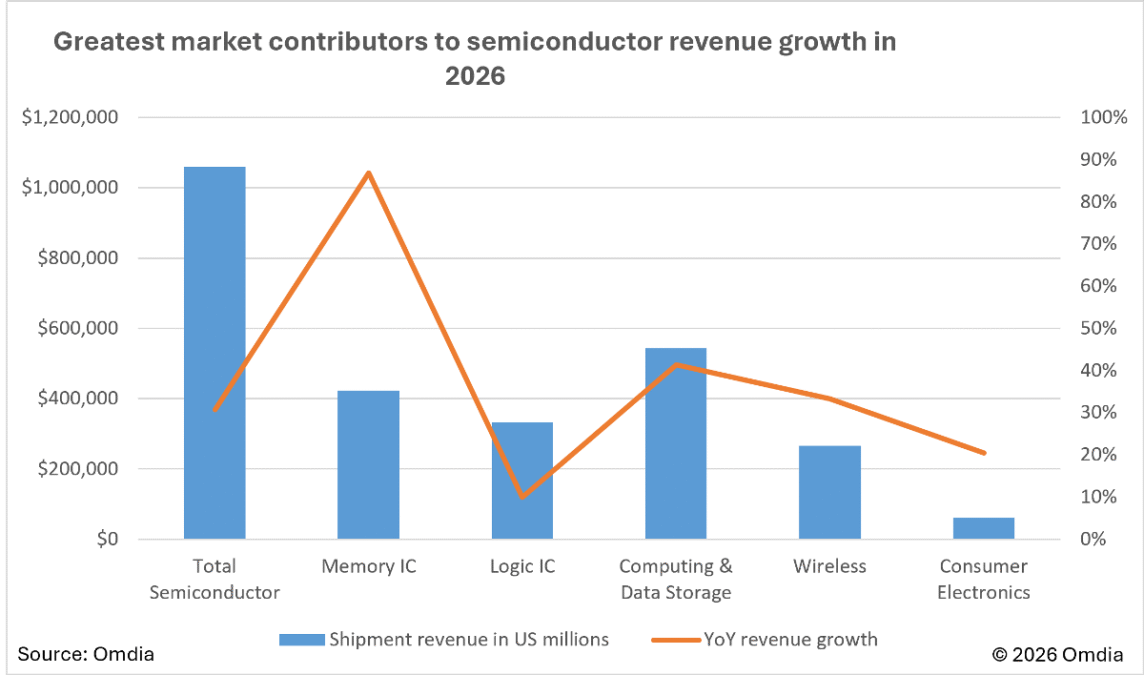
Omdia’s updated forecast shows semiconductor revenue growth of 20.3 percent year-over-year (YoY) in 2025, following stronger-than-anticipated third-quarter results and continued momentum into the fourth quarter. In 2026, revenue growth is expected to accelerate further to 30.7 percent YoY, led by DRAM and NAND memory ICs as well as high-performance logic ICs.
Top Contributors to Semiconductor Revenue Growth in 2026
- Computing & Data Storage: Projected to lead all segments with a 41.4 percent YoY increase in 2026, surpassing $500 billion in revenue. This surge is driven by high demand for memory-intensive data center servers, AI infrastructure, and enterprise refresh cycles. The top four hyperscalers alone are expected to spend approximately $500 billion on capital expenditures this year.
- Consumer Electronics & Wireless Applications: Growth is supported by next-generation foldable smartphones, upgraded AI photography in flagship devices, and refreshed wearable, smart speaker, and virtual reality (VR) markets. Rising memory IC pricing further contributes to revenue gains.
- Notebook PCs: Expansion is driven by widespread AI-capable device adoption and large-scale enterprise upgrades.
“Semiconductor revenue growth in 2026 is being driven by highly concentrated, AI-related demand, rather than broad-based consumer or industrial trends,” said Myson Robles-Bruce, Senior Principal Analyst at Omdia. “Without contributions from memory and logic ICs, overall semiconductor growth would drop from 30.7 percent to only 8 percent, highlighting the transformative impact of AI on the market.”
Potential Risks to Semiconductor Growth
Omdia cautions that several macroeconomic factors could temper growth in 2026, including:
- Inflation pressures, particularly in the US, despite stable conditions in China and the Eurozone.
- Rising labor and energy costs.
- Supply chain disruptions due to reorganization and government policies.
- Price volatility and shortages related to large-scale AI-driven investments.
Despite these risks, the semiconductor industry is poised for a landmark year in 2026, with AI adoption and memory-driven demand reshaping the global market and driving historic revenue milestones, Omdia report indicated.
BABURAJAN KIZHAKEDATH