

Global semiconductor revenue is forecast to nearly double to $1.6 trillion in 2026 as rapid AI infrastructure investment and soaring memory prices reshape the chip industry, according to Gartner report.

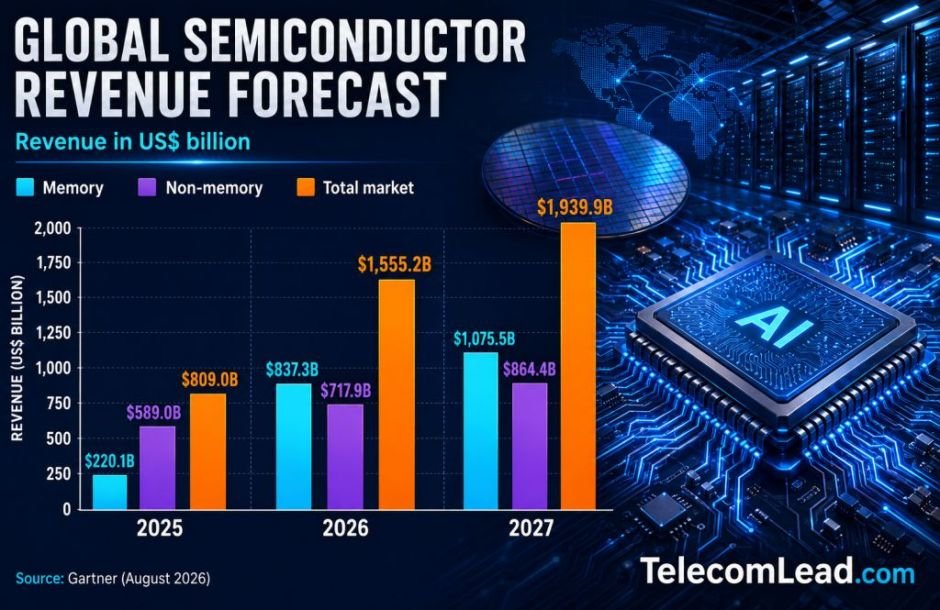
Worldwide semiconductor revenue is expected to reach $1.555 trillion in 2026, representing growth of 92 percent from $809 billion in 2025. The market is forecast to expand further to $1.940 trillion in 2027.
The semiconductor industry is entering a fundamentally new growth phase, supported by sustained investment in AI data centres and a stronger-than-expected memory pricing cycle. AI infrastructure is also changing the industry’s application mix and broadening demand across memory, processors, networking, power management and optical technologies.
Memory Revenue to Cross $1 Trillion in 2027
Memory will be the biggest contributor to semiconductor market growth. Global memory revenue is forecast to rise from $220.1 billion in 2025 to $837.3 billion in 2026 before reaching $1.076 trillion in 2027.
Memory is projected to represent 54 percent of total semiconductor revenue in 2026, compared with only 27 percent in 2025.
The increase reflects higher memory prices, growing memory content in AI servers and sustained demand for high-bandwidth memory. AI infrastructure deployments are consuming significantly more memory as computing clusters become larger and more powerful.
DRAM revenue is expected to increase 246.6 percent in 2026, while NAND flash revenue is forecast to soar 371.9 percent.
Additional manufacturing capacity is expected to enter the market during 2027. However, Gartner expects supply-demand conditions to remain tight because continued AI infrastructure deployment will increase memory consumption.
Higher memory content per AI server and strong HBM demand are expected to support memory revenue growth through 2027 and beyond.
AI Data Centres to Generate More Than Half of Chip Revenue by 2030
The AI data-centre ecosystem is forecast to account for 36.5 percent of global semiconductor revenue in 2026. Its share is projected to exceed 53 percent by 2030.
This increase demonstrates a structural change in where semiconductor value is being created. Demand is shifting from traditional device markets toward AI servers, accelerators, data-centre networking, memory systems, power infrastructure and high-speed connectivity.
AI clusters are becoming larger, faster and more power-intensive. Their deployment requires increasing investment in CPUs, networking silicon, power-management chips, analogue devices and optical interconnect technologies.
Consequently, AI is expanding the semiconductor opportunity across the entire data-centre infrastructure stack instead of benefiting only one category of chip.
Non-Memory Semiconductor Revenue to Reach $864 Billion
The non-memory semiconductor market will also record strong growth, although at a slower pace than memory.
Non-memory revenue is forecast to increase from $589 billion in 2025 to $717.9 billion, or approximately $718 billion, in 2026. This represents growth of 21.9 percent.
Gartner expects non-memory semiconductor revenue to reach $864.4 billion, or approximately $864 billion, in 2027.
The expansion will be supported by demand for CPUs, networking silicon, analogue semiconductors, optical interconnects and power-management components used in increasingly complex AI data centres.
The forecast indicates that the global semiconductor market is moving beyond its traditional cyclical expansion. AI infrastructure, tight memory supply and higher semiconductor content in servers are creating a longer-term transformation that could push annual industry revenue close to $2 trillion in 2027.