

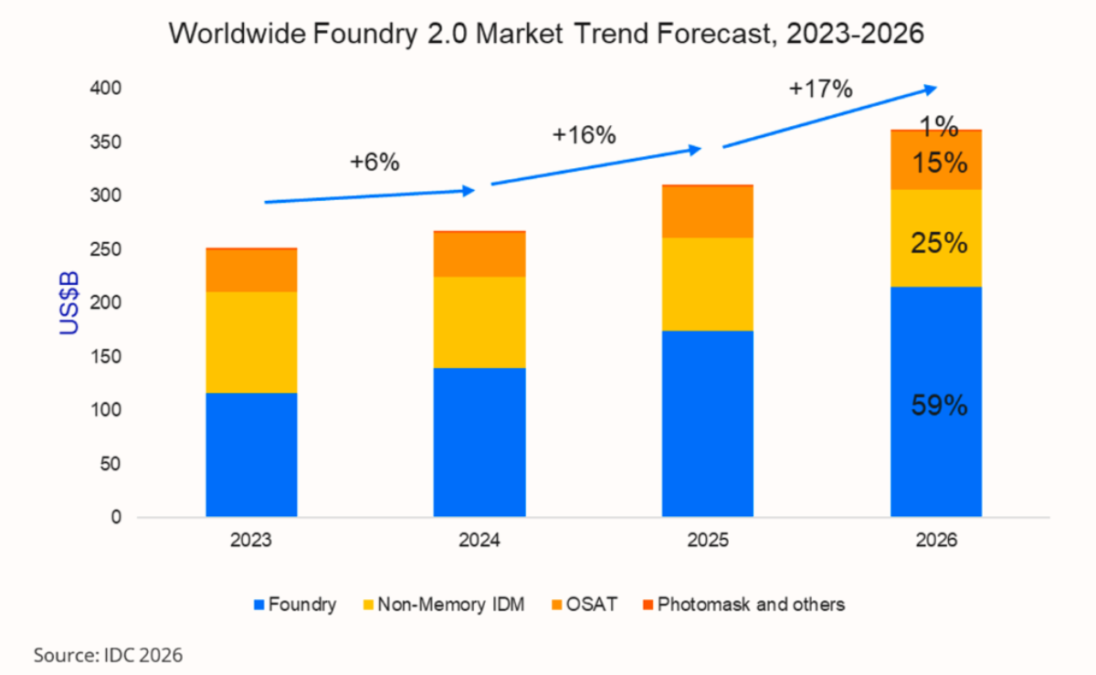
The global semiconductor ecosystem is entering a strong growth phase, with the “Foundry 2.0” market projected to exceed $360 billion in 2026, marking a 17 percent increase, according to International Data Corporation. This expansion is being fueled by accelerating demand for artificial intelligence, advanced chip manufacturing, and next-generation packaging technologies.

AI is now the central driver of semiconductor investments, pushing demand for advanced nodes and packaging solutions beyond current supply levels. At the same time, mature nodes are recovering from years of pricing pressure, supported by capacity reductions and renewed demand for power-related chips used in AI infrastructure.
In the foundry segment, TSMC continues to dominate advanced node production, driven by strong demand from AI chip leaders like NVIDIA, AMD, and Broadcom. TSMC is expanding its 3nm and advanced packaging capacity while increasing wafer pricing, positioning itself to capture around 44 percent of the global foundry market in 2026.
Samsung Electronics is improving advanced node yields and strengthening its position through AI accelerator and mobile processor demand, alongside strategic partnerships such as its multi-billion-dollar agreement with Tesla.
Mature node dynamics are also shifting. Industry-wide reductions in 8-inch wafer capacity are tightening supply, allowing foundries to raise prices by up to 10 percent. This marks a clear end to the aggressive price competition seen after the pandemic, with overall foundry market growth expected to reach 24 percent in 2026.
The non-memory IDM segment is forecast to grow 5 percent, led by Intel, which is advancing its 18A process into mass production. New processors and collaborations are helping Intel expand its customer base, while automotive chipmakers such as Infineon Technologies, NXP Semiconductors, and STMicroelectronics are seeing demand recovery after inventory corrections. At the same time, Texas Instruments is benefiting from steady growth in industrial and automotive segments.
The OSAT (outsourced semiconductor assembly and test) market is expected to grow 15 percent, driven by rising demand for advanced packaging in AI chips. ASE Technology Holding is emerging as a key beneficiary, capitalizing on capacity shortages in advanced packaging technologies such as CoWoS. Increasing complexity in chip integration is elevating the importance of backend processes, with packaging and testing now playing a strategic role comparable to wafer fabrication.
Overall, the Foundry 2.0 market is projected to achieve an 11 percent CAGR from 2026 to 2030, underpinned by sustained investments in AI infrastructure. However, factors such as semiconductor inflation, geopolitical tensions, energy supply risks, and evolving global policies will continue to influence the industry’s long-term trajectory.