

The US Federal Communications Commission (FCC) has blocked two electronic devices — a dashboard camera and a wireless video transmitter — from receiving equipment authorization after discovering that they contain a semiconductor chip manufactured by Huawei subsidiary HiSilicon, which is included on the FCC’s Covered List.

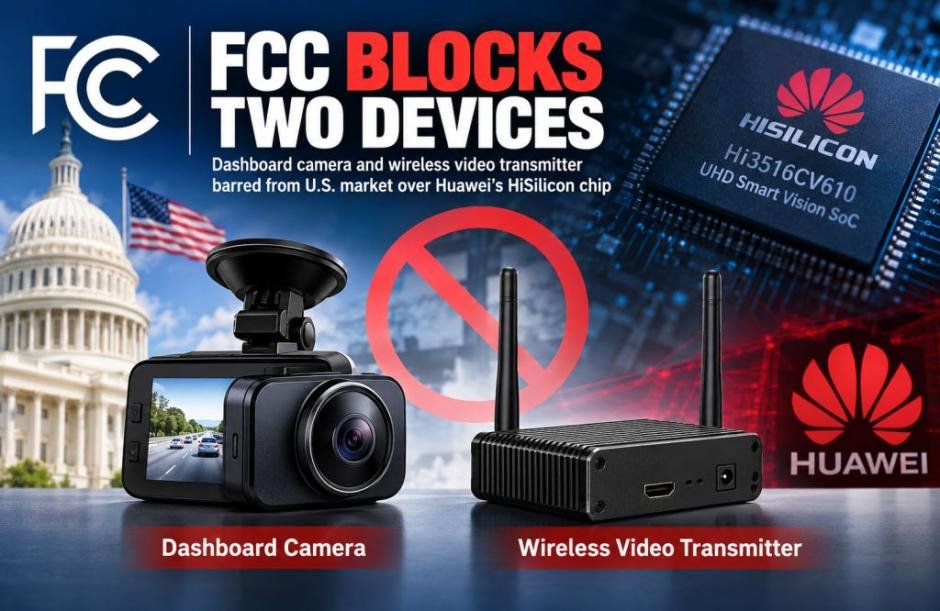
The enforcement action, announced in October 2026, marks the first application of new FCC restrictions that prohibit the authorization of electronic devices incorporating certain smart components manufactured by companies considered national security risks.
For additional regulatory context, see the FCC Covered List, the FCC equipment authorization program and the FCC’s updated component restrictions.
The rules took effect on October 13, 2026, extending restrictions beyond equipment manufactured directly by prohibited companies to products containing their restricted semiconductor components.
Two Devices Blocked by FCC
1. Dashboard Camera Featuring HiSilicon Surveillance Chip
The first device is a dashboard camera, commonly known as a dashcam, designed to capture video footage from vehicles.
Dashboard cameras typically incorporate image sensors, video processors, storage interfaces and wireless connectivity features. Advanced models may also support intelligent video analysis and object detection.
The FCC determined that the dashboard camera model under review incorporated a chip manufactured by HiSilicon, a subsidiary of Huawei.
HiSilicon markets its Hi3516CV610 UHD Smart Vision system-on-chip for surveillance applications. According to its product documentation, the processor incorporates detection algorithms for human faces.
The presence of a restricted smart component was sufficient to prevent the device from obtaining the necessary FCC equipment authorization.
However, the FCC announcement does not establish that the dashboard camera transmitted information to Huawei or engaged in unauthorized surveillance.
2. Wireless Video Transmitter Containing HiSilicon Chip
The second device is a wireless video transmitter, a category of equipment used to transmit video signals between cameras, monitors, recording systems and other connected devices.
Wireless video transmission technology is widely used in professional broadcasting, security systems, industrial monitoring and commercial video applications.
The FCC identified a HiSilicon component in the wireless video transmitter model submitted for authorization.
Because the device incorporated a restricted logic-bearing semiconductor component, it did not qualify for equipment authorization under the revised FCC rules.
The decision highlights the growing regulatory scrutiny of semiconductor components embedded in connected video equipment, rather than only the companies selling finished products.
HiSilicon Hi3516CV610 Chip Raises Surveillance Concerns
The FCC highlighted HiSilicon’s Hi3516CV610 UHD Smart Vision system-on-chip, which is marketed for video surveillance applications and supports human-face detection algorithms.
The processor’s capabilities are relevant to video surveillance and intelligent camera systems. However, the FCC announcement does not specify whether the Hi3516CV610 was installed in both rejected devices or identify the exact chip configuration of each product.
The FCC considers components produced by Covered List entities a national security concern because they may introduce risks into connected electronic equipment.
FCC Device Ban: Key Details
| Category | FCC finding |
| Device 1 | Dashboard camera |
| Device 2 | Wireless video transmitter |
| Restricted chip manufacturer | HiSilicon |
| Parent company | Huawei Technologies |
| Chip highlighted | Hi3516CV610 UHD Smart Vision SoC |
| Security-related capability | Human-face detection algorithms |
| New rule effective | October 13, 2026 |
| Regulatory outcome | Equipment authorization prevented |
Important identification detail: The FCC statement identifies the two product categories but does not disclose their commercial brands, model numbers, manufacturers or FCC application IDs. Therefore, the exact two finished products cannot be reliably named from the available information.
FCC Expands Restrictions to Semiconductor Components
Previously, the FCC restricted authorization of certain equipment manufactured by companies on its Covered List. The new rules extend the restrictions to qualifying products containing logic-bearing hardware components produced by those entities.
This change has implications for manufacturers of dashboard cameras, wireless video transmitters, IP surveillance cameras, smart home equipment and other connected devices.
Companies seeking FCC authorization must pay greater attention to semiconductor sourcing and component manufacturers, even when their finished products are sold under unrelated brands.
FCC Chairman Brendan Carr said the agency would continue enforcing its national security restrictions against devices incorporating prohibited surveillance-related components.
The latest action demonstrates how US technology restrictions are increasingly extending from finished telecommunications equipment to the chips embedded inside connected products.BABURAJAN KIZHAKEDATH