

SpaceX reported a strong second quarter for 2026, driven by expansion across its satellite broadband, AI infrastructure and launch businesses. Total revenue surged 92 percent year over year to $7.814 billion, while adjusted EBITDA nearly tripled to $3.538 billion. The company also narrowed its net loss to $541 million from $1.008 billion a year earlier.

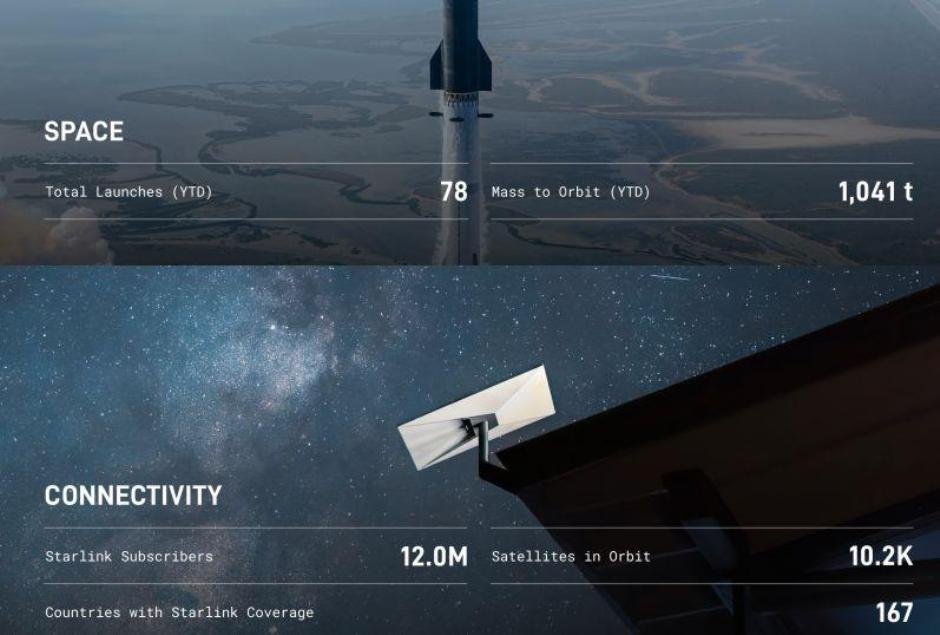
The Connectivity business remained the largest revenue contributor, generating $4.291 billion, up 66 percent. Growth was fueled by Starlink, whose subscriber base doubled to 12 million, adding 1.7 million users sequentially.
Despite the subscriber expansion, Starlink ARPU remained stable at $66 per month, compared with $85 a year earlier, reflecting the company’s focus on scaling affordable satellite broadband globally.
SpaceX said Consumer revenue reached $2.485 billion, while Enterprise and Government revenue more than doubled to $1.806 billion, supported by new airline connectivity agreements and mobile partnerships with SoftBank, NTT Docomo and Spark NZ.
SpaceX has expanded its satellite network, ending the quarter with 10,200 satellites in orbit serving customers across 167 countries and territories. The company also secured more than $6 billion in multi-year Starshield contracts from the U.S. government and received FCC approval for the EchoStar spectrum license transfer, strengthening its position in secure satellite communications.
Artificial intelligence emerged as the fastest-growing business. AI revenue climbed 247 percent to $2.561 billion, driven by cloud infrastructure services and Grok subscriptions. AI solutions and infrastructure revenue increased to $2.194 billion, while the company signed $14.1 billion in contracted Cloud Services Agreements. SpaceX expanded compute capacity from 0.4 GW a year ago to 1.4 GW, supporting deployment of Colossus II and additional AI infrastructure. The company also announced a $60 billion agreement to acquire Cursor and launched Grok 4.5, its latest large language model.
Capital expenditure accelerated significantly as SpaceX invested in AI and satellite infrastructure. Total Capex increased to $18.369 billion during the quarter from $2.825 billion a year earlier. AI accounted for $15.828 billion of quarterly Capex, while Connectivity invested $1.367 billion and the Space segment spent $1.174 billion on Starship development and launch infrastructure.
BABURAJAN KIZHAKEDATH