

The global satellite IoT communications market is entering a major growth phase as satellite operators extend connectivity to industries and locations beyond the practical reach of terrestrial mobile networks.

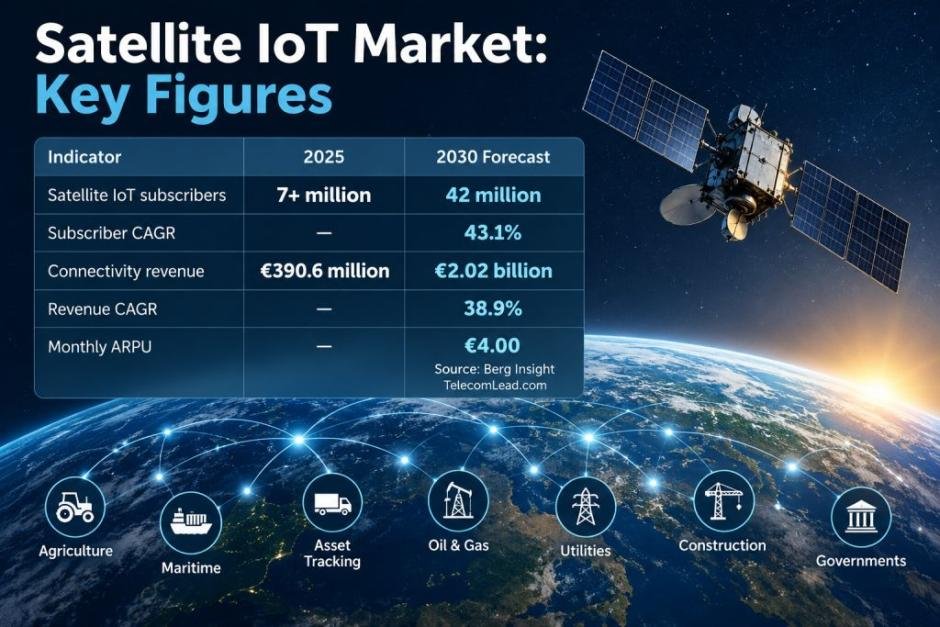
Satellite IoT connections surpassed 7 million subscribers in 2025 and are forecast to reach 42 million by 2030, representing a compound annual growth rate (CAGR) of 43.1 percent.
Global satellite IoT connectivity revenue is projected to rise from €390.6 million in 2025 to approximately €2.02 billion in 2030, equivalent to a 38.9 percent CAGR.
The expansion is attracting established satellite companies and new low-Earth orbit (LEO) players, creating a competitive market spanning traditional satellite technology, 4G/5G, LoRa and Bluetooth connectivity.
Satellite IoT Addresses Huge Terrestrial Coverage Gap
Only about 10 percent of the Earth’s surface has access to terrestrial connectivity services, leaving a large addressable market for satellite communications.
Satellite IoT complements terrestrial cellular networks by extending connectivity into locations where conventional mobile or fixed networks are unavailable, unreliable or uneconomic to deploy.
The technology is particularly relevant to agriculture, maritime operations, asset tracking, intermodal transportation, utilities, construction, oil and gas exploration and government applications.
Agricultural companies can connect sensors and equipment in remote farming areas, while logistics companies can track containers, vehicles and other assets beyond terrestrial network coverage. Maritime operators can maintain connectivity with vessels far from coastal cellular networks.
These applications are helping transform satellite IoT from a specialist connectivity service into an increasingly important component of global IoT infrastructure.
Satellite IoT Subscribers to Grow Sixfold by 2030
Satellite IoT connections are forecast to increase from more than 7 million in 2025 to 42 million in 2030, making the installed subscriber base approximately six times larger within five years.
The 43.1 percent subscriber CAGR is faster than connectivity revenue growth, indicating that falling connectivity prices will support adoption.
Average revenue per user (ARPU) is expected to decline to approximately €4 per month by 2030. Lower connectivity costs could make satellite services commercially viable for larger fleets of relatively low-bandwidth sensors and tracking devices.
Iridium Leads Satellite IoT Subscriber Market
The satellite IoT market remains concentrated among several established operators, including Iridium, ORBCOMM, Viasat and Globalstar.
Iridium is the largest operator by reported satellite IoT connections. Its subscriber base increased 6 percent over the past year to approximately 2.1 million subscribers.
ORBCOMM has evolved from a dedicated satellite operator into an end-to-end IoT solutions provider. At the end of Q4 2025, ORBCOMM served approximately 950,000 satellite IoT subscribers across its own and Viasat’s networks.
Viasat does not currently report a separate IoT subscriber figure.
Globalstar had approximately 540,000 subscribers, while smaller operators with connections numbering in the tens of thousands include Australia’s Myriota, France’s Kineis and UAE-based Thuraya.
Iridium Expands Hybrid Satellite-Cellular Strategy
Major satellite IoT operators are accelerating investment in hybrid satellite-cellular connectivity, direct-to-device services, satellites and ground infrastructure.
In June 2026, Iridium launched the Iridium 9604, a tri-mode module combining Iridium Short Burst Data satellite connectivity, LTE-M cellular connectivity and GNSS positioning.
Iridium is also preparing Iridium NTN Direct, its standards-based satellite service, with live over-the-air demonstrations involving mobile operators, semiconductor companies and technology partners.
In September, Iridium, Deutsche Telekom IoT and Toyota demonstrated voice messaging over satellite using Iridium NTN Direct, following a roaming agreement designed to extend Deutsche Telekom’s IoT coverage onto Iridium’s satellite network.
The development demonstrates how satellite IoT is becoming more closely integrated with the terrestrial mobile ecosystem.
ORBCOMM Strengthens Industrial IoT Business
ORBCOMM is expanding its hybrid satellite-cellular IoT strategy.
In July 2026, its SKYWAVE business partnered with Iridium to provide industrial IoT connectivity for heavy-equipment manufacturers, combining SKYWAVE’s network orchestration capabilities with Iridium’s global LEO network.
Earlier in 2026, ORBCOMM introduced the ST 4000 hybrid satellite-cellular module, designed to simplify the development of IoT systems requiring connectivity across terrestrial and remote environments.
ORBCOMM also secured a $460 million refinancing package in April 2026 to support growth initiatives, large customer deployments and platform expansion. The company supports more than 3 million connected assets and over 1,000 enterprise customers across transportation, maritime, logistics and industrial markets.
Viasat Targets Direct-to-Device IoT
Viasat is positioning direct-to-device satellite connectivity as an important component of industrial IoT.
A Viasat study of 600 IoT decision-makers across agriculture, energy, transport and logistics, mining and utilities found that 91 percent planned to adopt D2D IoT devices within 18 months.
The technology enables compatible devices to connect through both cellular and satellite networks without conventional dedicated satellite terminals.
Viasat’s satellite infrastructure is also expanding. In September 2026, ViaSat-3 F2 entered commercial service, adding capacity across the Americas.
Viasat and Space42 also announced a binding agreement to co-found Equatys, a shared space and ground infrastructure platform targeting global direct-to-device and advanced mobile satellite services.
Globalstar Invests in Next-Generation Network
Globalstar is investing in satellite and ground infrastructure to expand its IoT capabilities.
In August 2026, the company successfully launched and deployed eight HIBLEO-4 replacement satellites into their intended orbital planes.
Globalstar also reported record-high commercial IoT subscriber activations during Q2 2026, when company revenue reached $64.8 million. Customer interest has included its RM200M satellite communications module as Globalstar develops its third-generation satellite system.
In September, Globalstar expanded its Nemea ground station in Greece, adding three six-meter tracking antennas and doubling the site’s antenna infrastructure from three to six.
44 Satellite IoT Operators Compete for Market
Competition is increasing rapidly. The market now includes 44 satellite IoT operators, although only 17 currently provide commercial satellite IoT connectivity services.
More than two dozen initiatives are targeting satellite IoT and related direct-to-device opportunities.
Projects and companies include AST SpaceMobile, Geespace, Hubble Network, Kineis, Ligado Networks, Lynk, Myriota, Elveo Mobile, OQ Technology, Plan-S, Sateliot, Skylo and Starlink.
Many emerging operators are deploying LEO small-satellite constellations, offering lower latency and different deployment economics compared with traditional geostationary satellite architectures.
4G and 5G Standards Reshape Satellite IoT
One of the biggest changes in satellite IoT is the convergence between satellite and terrestrial wireless technologies.
A growing group of satellite companies is developing services around 3GPP 4G and 5G technologies, including OQ Technology, AST SpaceMobile, Elveo Mobile, Sateliot, Ligado Networks, Skylo, Open Cosmos, Iridium, Terrestar Solutions, Geespace and Starlink.
Standardized technologies could allow compatible devices to move between terrestrial and non-terrestrial networks depending on coverage availability, although capabilities will vary by operator, device and service.
The development of 5G non-terrestrial networks (NTN) is particularly important because it provides standardized mechanisms for integrating satellite networks into the broader mobile ecosystem.
LoRa and Bluetooth Expand Satellite Connectivity
Cellular technology is not the only terrestrial wireless standard moving into space.
EchoStar Mobile, Fossa Systems, Lacuna Space, Innova Space and Plan-S are among companies using or developing LoRa-based satellite connectivity.
Hubble Network is pursuing another model using Bluetooth technology for satellite connectivity.
The emergence of cellular, LoRa and Bluetooth satellite systems demonstrates how the market is moving beyond proprietary satellite terminals. This could be particularly important for low-cost sensors where hardware cost, power consumption and battery life are critical.
Satellite IoT Moves Toward Mass Adoption
The combination of LEO deployments, standardized wireless technologies and falling connectivity costs is expanding the addressable market for satellite IoT.
Established operators such as Iridium, ORBCOMM, Viasat and Globalstar enter this period with operational networks and enterprise customers. New entrants are competing through LEO architectures, direct-to-device capabilities and integration with mainstream wireless standards. The projected rise from 7 million satellite IoT subscribers in 2025 to 42 million in 2030, combined with revenue exceeding €2 billion, indicates that satellite IoT is moving beyond its traditional niche.