

Satellite direct-to-device (D2D) services are expanding across the Asia Pacific region, with six commercial Starlink-based services now operating across four markets such as Australia, Japan, New Zealand, and the Philippines.

The Ookla report, based on background signal scan data from January 2025 to June 2026, highlights that One NZ’s service covers around 40 percent of New Zealand’s landmass without terrestrial coverage and extends approximately 20 km offshore.
Japan now has three live Starlink operators — KDDI, SoftBank, and NTT docomo — after KDDI launched au Starlink Direct in April 2025, added app data in August 2025, and One NZ introduced app data including WhatsApp voice calls in February 2026.
Telstra launched Australia’s first satellite texting service in June 2025, while Globe introduced Southeast Asia’s first commercial D2D service in June 2026. Future expansion includes Rakuten Mobile and AST SpaceMobile, supported by ¥150 billion (approximately US$922 million) under Japan’s J-LEO program, although deployment has shifted to early 2027.
Other developments include Smart’s Lynk Global partnership, tested in January 2026, Vodafone Idea’s AST agreement in June 2025, and commercial Lynk services already operating with bmobile in the Solomon Islands and PNCC in Palau. Meanwhile, regulators including ACMA, RSM, MIC, and the Philippines’ NTC have introduced supportive licensing frameworks to accelerate satellite-to-mobile connectivity.
Australia and New Zealand Lead Satellite D2D Usage as Remote Connectivity Drives Adoption
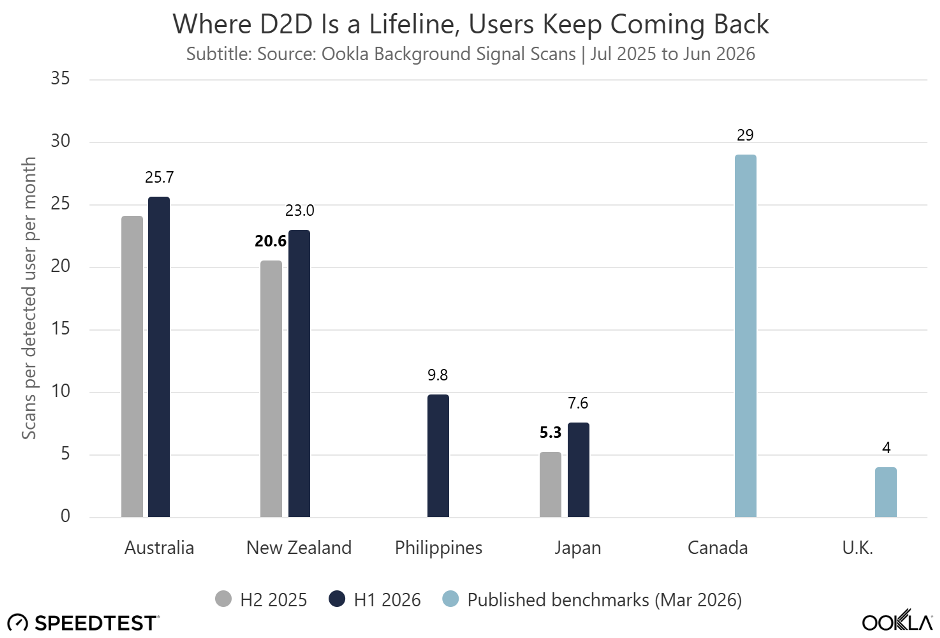
Australia and New Zealand continue to lead satellite direct-to-device (D2D) adoption in Asia Pacific, driven by extensive remote areas beyond terrestrial mobile coverage. Australia more than doubled its detected user base, reaching 215 percent of its July 2025 level by April 2026, while New Zealand, where the service launched earlier in December 2024, peaked at 192 percent. Both markets maintained elevated activity from December through April, before seasonal declines saw Australia end June 2026 at 142 percent and New Zealand at 117 percent. Between January and June 2026, detected users averaged 25.7 satellite scans per month in Australia and 23.0 in New Zealand, compared with around 4 scans per month in the U.K., while only Canada recorded a higher level at 29 scans per month. Australia is also advancing satellite connectivity through policy, with a proposed universal outdoor mobile obligation expected to add up to 5 million square kilometers of new outdoor coverage, largely using D2D technology. Introduced in November 2025, the legislation proposes a December 1, 2027 implementation date requiring Telstra, Optus, and TPG to deliver baseline outdoor mobile coverage that includes satellite D2D services.
Philippines Becomes Asia Pacific’s Largest Satellite D2D Market Ahead of Commercial Launch
The Philippines emerged as the fastest-growing satellite direct-to-device (D2D) market in Asia Pacific, with Ookla detecting devices on Starlink’s network from January 2026, months before Globe received regulatory approval from the NTC on June 29, 2026 and launched commercial service on June 30, 2026. The detected user base climbed to nearly 378 percent of its January 2026 level by May 2026 before easing in June as testing concluded. Across the four APAC markets, unique D2D devices increased by more than fivefold between July 2025 and May 2026, with the Philippines driving most of the growth, while Australia, New Zealand, and Japan recorded a combined 63.1 percent increase over the same period. Australia accounted for 79.9 percent of detected users in Q4 2025, but the Philippines expanded to 56.1 percent of the regional base in Q1 2026 and 64.0 percent in Q2 2026, compared with Australia’s 28.5 percent. Before the commercial launch, Globe activated satellite-to-mobile connectivity following the magnitude 7.8 Mindanao earthquake on June 8, 2026, offering free service to more than 700,000 affected subscribers across South Cotabato, Sultan Kudarat, and Sarangani, with more than 150,000 users connecting. The share of detected D2D devices in the three affected provinces nearly doubled from 11.6 percent in May to 21.1 percent in June. With around 20 tropical cyclones entering the Philippines’ area of responsibility each year, satellite D2D is expected to play an increasingly important role in disaster resilience and extending connectivity to remote communities.
Japan Records Lowest Satellite D2D Activity Despite Three Starlink Services and 5 Million Connected Users
Japan recorded the lowest detected satellite direct-to-device (D2D) activity in Asia Pacific despite having three active Starlink-based services and tens of millions of compatible handsets. Ookla’s Android-based data showed Japan’s detected D2D user base in June 2026 was only about 53.5 percent of its July 2025 level, while users averaged just 7.6 scans per month, compared with 25.7 scans in Australia. However, the report notes Japan’s Android sample is smaller because the market is heavily dominated by iPhones. NTT docomo reported 5 million connected users within 10 weeks of launching its service in April 2026, representing around 5 percent of its 93 million mobile subscribers across both iOS and Android. Japan’s extensive terrestrial network covers more than 99.9 percent of the population, although only about 60 percent of the country’s landmass, limiting the need for satellite connectivity. Operators are positioning D2D primarily as a customer retention tool rather than a revenue generator, aligning with Analysys Mason’s estimate of around 1 percent annual revenue uplift from D2D messaging services. Looking ahead, Rakuten Mobile and AST SpaceMobile are targeting voice and data services, with AST’s July 2026 filing shifting satellite deployment to early 2027, making a commercial launch more likely in 2027 than late 2026.
BABURAJAN KIZHAKEDATH