

India has accelerated its push to become a global electronics manufacturing hub with the approval of 29 new proposals under the Electronics Components Manufacturing Scheme (ECMS), unlocking investments worth Rs 7,104 crore, equivalent to $751.21 million. The initiative, led by the Ministry of Electronics and Information Technology, strengthens domestic production capabilities, reduces import dependence and enhances supply chain resilience across critical electronics segments.

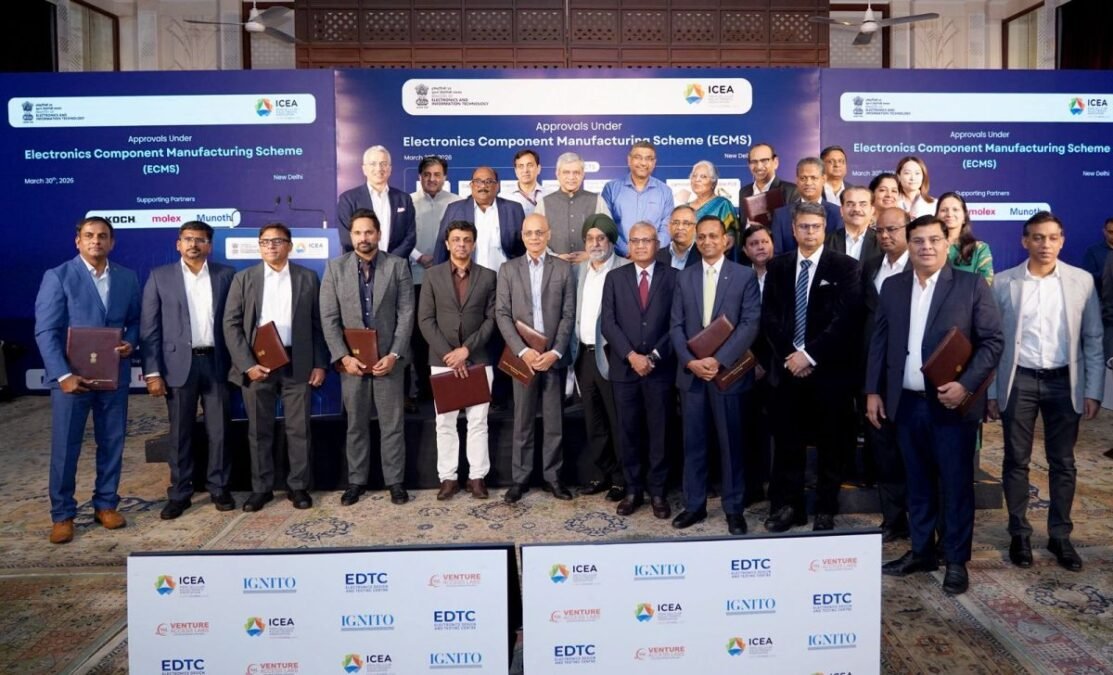
The latest approvals follow an earlier clearance of 46 applications worth Rs 54,567 crore, taking the total number of approved proposals under ECMS to 75. Combined, these projects represent expected investments of Rs 61,671 crore and are projected to generate 65,040 direct jobs, highlighting the scale of India’s manufacturing ambitions.
India’s electronics manufacturing sector produced goods worth $125 billion in the year ending March 2025. The government is targeting a fourfold expansion to $500 billion by fiscal 2031, supported by production-linked incentives and component-level manufacturing programs such as ECMS.
The newly approved projects alone are expected to deliver production output of Rs 84,515 crore and create 14,246 direct employment opportunities. These investments span 16 product categories, covering mobile manufacturing, telecom infrastructure, consumer electronics, automotive electronics, strategic electronics and IT hardware.
A key highlight is the approval granted to a unit of Dixon Technologies, specifically Dixon Display Technologies Pvt. Ltd., along with Wangda Technologies Pvt. Ltd., for manufacturing display modules. In advanced materials, Lohum Cleantech has secured approval to establish India’s first facility to manufacture rare-earth permanent magnets from rare-earth oxide, marking a strategic step in reducing dependence on imports of critical materials.
The government has also approved a wide range of component manufacturing projects involving leading domestic and global companies. VVDN Technologies will manufacture antennas and heat sinks, while Molex India, Terminal Technologies, SFO Technologies India and Amphenol FCI India will focus on connectors.
In relay manufacturing, approvals have been granted to O/E/N India, Permanent Magnets Ltd, BG Electrical and Electronics India and SFO Technologies India. Passive components production will be led by Vishay Components India, while Vishay Precision Transducers India will manufacture resistors and transducers.
In energy storage, Munoth Lithium Battery will produce lithium-ion cells for digital applications. TDK India will manufacture inductors, and Syrma Strategic Electronics will produce flexible printed circuit boards.
To strengthen upstream supply chains, laminate (copper clad) manufacturing approvals have been granted to Syrma Components and Ratnaveer Precision Engineering, while Dhruv Industries will produce metallized films for capacitors. Lohum Cleantech’s rare-earth magnet project stands out as a critical milestone in advanced materials manufacturing.
The scheme also places strong emphasis on capital equipment manufacturing, with approvals awarded to Titan Engineering & Automation, NeST Advanced Technology Development Centre, ASM Technologies, Indo-MIM, Bharat FIH and IFB Industries.
These approvals include several firsts for India’s electronics ecosystem, including the country’s first SMD passive plant for tantalum-based capacitors, the first flexible PCB manufacturing facility and the first rare-earth permanent magnet plant based on oxide processing. Together, these projects are expected to significantly improve domestic value addition and reduce reliance on imported components.
Union Minister for Electronics and Information Technology Ashwini Vaishnaw outlined four strategic priorities to sustain growth in the sector, including building domestic design capabilities, strengthening local supply chains, implementing Six Sigma quality standards and developing a skilled workforce through dedicated training centers.
S. Krishnan, Secretary at MeitY, emphasized the need for rapid implementation to match the pace of approvals, while Pankaj Mahindroo of the India Cellular and Electronics Association highlighted that the increased ECMS outlay of Rs 40,000 crore in the Union Budget reinforces confidence in India’s electronics manufacturing growth trajectory.
The expansion of ECMS aligns with India’s broader industrial strategy to attract global investments and capitalize on shifting supply chains. The government is also expected to introduce fresh incentives for mobile phone manufacturing after the current flagship program expires, a move likely to benefit global giants such as Apple and Samsung.
With strong policy support, rising investments and participation from a diverse ecosystem of companies, India is steadily positioning itself as a critical node in the global electronics supply chain.
SHAFANA FAZAL