

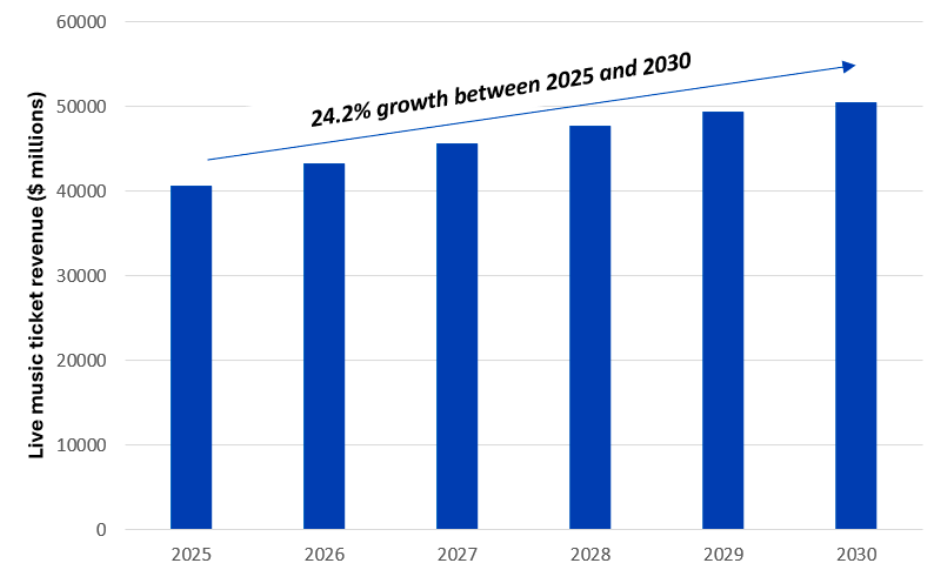
Global ticket sales revenue from concerts and music festivals exceeded $40 billion in 2025 and is projected to reach $50 billion by 2030, signaling sustained expansion despite a moderation in annual growth. The 2.5 percent year-on-year increase in 2025 reflects market stabilization following the sharp post-pandemic rebound, when revenue surged from $8.8 billion in 2021, Omdia’s inaugural Live Music Forecast shows.

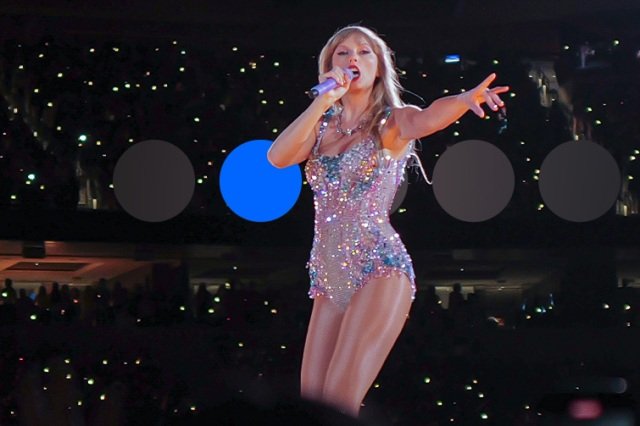
Here are five of the biggest global artists known for conducting live music shows that attract massive audiences and viewership:
Taylor Swift – Her Eras Tour has drawn record-breaking global crowds and billions in ticket sales.
Beyonce – Renowned for high-production stadium tours like the Renaissance World Tour with huge global attendance.
Ed Sheeran – His Mathematics Tour consistently ranks among the highest-attended tours worldwide.
Coldplay – Famous for immersive stadium concerts, their Music of the Spheres Tour attracts millions of fans globally.
Bad Bunny – One of the biggest touring acts, especially across the Americas, with record-breaking attendance figures.
These artists dominate live music through a combination of global fan base, large venues, and high-frequency touring.
The Omdia report, covering 51 markets and additional regional clusters, highlights strong underlying demand with total paid attendance expected to surpass 500 million by 2027. Growth is being driven by a combination of rising ticket prices and increasing consumer appetite for live experiences, reinforcing long-term revenue momentum.
The United States remains the largest and most premium market, with average concert ticket prices forecast to exceed $100 by 2030 and accounting for more than 30 percent of global revenue. High-profile global tours continue to anchor market expansion, with multiple record-breaking tours contributing to 2025 performance.

Omdia analysts Omdia Research Analyst Tav Aujla and Simon Dyson, Omdia Senior Principal Analyst, Music and Digital Audio note that consumers are increasingly willing to pay for premium experiences, while globally expanding genres such as K-pop and Latin music are broadening audience reach.
Demand continues to outpace supply, with major tours selling out rapidly. At the same time, emerging markets in Southeast Asia and Latin America are creating new growth opportunities, positioning the live music sector for sustained global expansion through the end of the decade.
The digital and technology layer is becoming central to how the live music industry scales revenue and manages demand. Platforms such as Live Nation and Ticketmaster play a dominant role in ticket pricing, inventory control, and global distribution, enabling large-scale event monetization while shaping market dynamics.
AI-driven dynamic pricing is increasingly being deployed to adjust ticket prices in real time based on demand signals, helping maximize revenue and reduce underpricing. At the same time, mobile ticketing systems and anti-scalping technologies are improving security, limiting fraud, and enhancing the consumer purchase experience.
Emerging technologies such as AR and VR are also expanding the addressable audience through hybrid concert formats that combine physical and digital participation. In parallel, data monetization is becoming a key growth lever, with organizers leveraging fan engagement analytics and targeted marketing to drive higher conversion rates, personalized offers, and increased lifetime value per attendee.
Demand-side trends in the live music market reflect a structural shift in consumer spending patterns, with audiences increasingly favoring experiences over digital content. While streaming platforms continue to dominate music consumption, consumers are allocating a larger share of discretionary budgets to concerts and festivals, viewing live events as high-value, memorable experiences that digital formats cannot replicate.
Younger demographics, particularly Gen Z and millennials, are at the center of this shift. This cohort is prioritizing live events over subscription-based streaming services, driving strong ticket demand and faster sell-outs for major tours and festivals. Social media amplification and the cultural value of shared experiences are further accelerating this trend.
At the same time, premium ticket tiers and VIP packages are significantly boosting average revenue per user. High-priced offerings, including exclusive access, meet-and-greet opportunities, and enhanced venue experiences, are enabling organizers and artists to monetize demand more effectively, contributing to sustained revenue growth in the live music industry.
BABURAJAN KIZHAKEDATH