

YouTube continues to cement its position as the world’s most powerful video platform, reaching an estimated 29 billion videos by December 2025. New research from Omdia shows that YouTube’s ability to attract and retain video viewers is being fueled by rapid growth in Shorts, expanding creator activity in high-growth markets such as India, and the rising role of AI-generated and professional content.

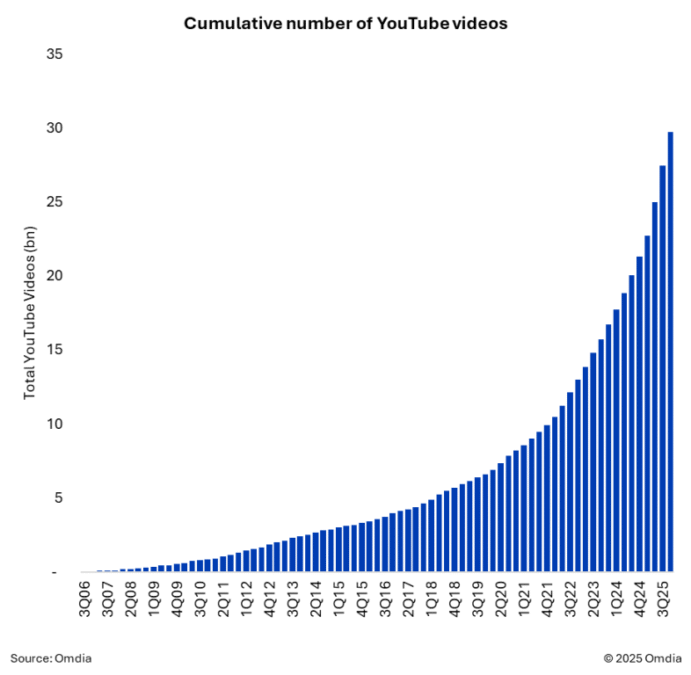
The latest Omdia report predicts that Google’s YouTube is on track to surpass 30 billion videos in early 2026, highlighting the scale and momentum of its global video ecosystem.
“YouTube is the most popular video service globally and is on track to reach 30 billion videos in early 2026,” said Daoud Jackson, Senior Analyst at Omdia.
Omdia research shows the least-watched 99 percent of videos account for just 9 percent of total viewing time. YouTube continues to host the equivalent of 280,000 years of video content, most of which is rarely watched.
Shorts and Emerging Markets Accelerate Viewer Growth
YouTube’s video expansion is accelerating sharply. Omdia estimates that 25 percent of all videos uploaded in 2025 were created in just the first ten months of the year. This surge is overwhelmingly driven by short-form video, with Shorts accounting for more than 90 percent of all new uploads.
Shorts have become a critical driver of viewer engagement, enabling rapid content discovery, higher upload frequency, and stronger participation from creators in emerging markets, particularly India. This short-form strategy has helped YouTube attract new audiences while increasing daily viewing time across mobile devices.
Concentrated Viewing Powers the Platform
Despite the massive volume of content, YouTube viewing remains highly concentrated. The top 1 percent of videos generate 91 percent of total viewing time, while the remaining 99 percent contribute just 9 percent. Even so, this long tail of lightly viewed content plays an essential role in sustaining creator diversity and supporting Google’s broader AI ambitions.
Jackson noted that this vast library of user-generated video also underpins Google’s AI development. “This content forms the backbone of Google’s video training data for Gemini. While user-generated content drives perceptions of success, our research shows the reality is more complex,” he said.
Music, Professional Video, and News Shape Viewing Patterns
YouTube’s success in driving video viewers is also tied to the mix of content formats dominating watch time. Omdia’s research highlights a clear shift toward professionally produced and premium-style video.
Music remains the single largest category, accounting for 33 percent of total YouTube viewing time. Professionally filmed content represents an even larger share at 46 percent, reinforcing YouTube’s evolution from a purely user-generated platform into a hybrid video service competing with traditional media.
News content continues to play a major role, capturing 10 percent of total viewing and ranking as the third most popular category. Meanwhile, video podcasts are emerging as a fast-growing format, now accounting for 5 percent of overall viewing time.
A More Diverse YouTube in 2026
By 2026, YouTube has become a highly diversified video platform where Shorts drive scale, music and professional content deliver sustained engagement, and news and podcasts deepen viewer loyalty. This combination of short-form discovery, premium viewing, and AI-enabled growth is central to how YouTube continues to achieve massive global video viewership.
BABURAJAN KIZHAKEDATH