

Global music publishing revenue is set to cross the $10 billion milestone in 2025 for the first time, according to a new analysis from Omdia. The research firm forecasts steady annual growth for the music publishing industry over the next five years, driven primarily by the continued expansion of music streaming services and rising digital income.

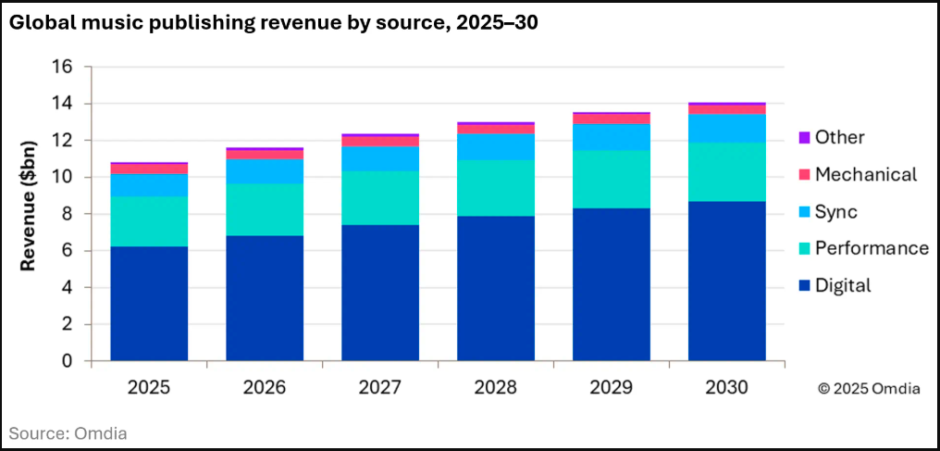
By 2029, total global music publishing income is expected to exceed $13 billion, before reaching $14 billion in 2030. This sustained growth signals a new era of stability and profitability for music publishers worldwide.
Key Insights from Omdia’s Forecast (2025–2030)
Global publishing revenue (2025): $10+ billion (first-time milestone)
Projected revenue (2029): $13+ billion
Projected revenue (2030): $14.04 billion
Publishing CAGR (2025–2030): 5.4 percent
Digital publishing CAGR (2025–2030): 6.7 percent
Digital receipts (2030): $8.67 billion
Publishing share of total music revenue (2030): 21 percent
Streaming Fuels Music Publishing Boom
Music streaming platforms such as Spotify, Apple Music, and YouTube Music are the largest sources of revenue for music publishers, and their share of income is expected to increase significantly throughout the forecast period.
Spotify is the world’s leading music streaming platform with over 240 million premium subscribers and more than 600 million total users as of 2025. The company has been investing in AI-driven personalization, discovery algorithms, and audiobooks integration, alongside partnerships with major record labels to enhance artist monetization and fan engagement.
Apple Music, with an estimated 110 million subscribers, is strengthening its ecosystem integration by focusing on high-fidelity audio, spatial sound, and exclusive artist content. Apple has invested heavily in music curation technology and partnerships to enhance user retention within its iOS and device ecosystem.
YouTube Music has surpassed 100 million premium subscribers, driven by its integration with YouTube Premium and strong appeal among younger audiences. Google’s investment in AI music recommendations, short-form content synergy, and international market expansion has positioned the platform as a powerful competitor in ad-supported and subscription streaming.
Amazon Music, serving over 80 million subscribers, continues to benefit from its inclusion in Amazon Prime bundles. The company has invested in voice integration through Alexa, high-resolution audio, and global licensing agreements to strengthen its digital music footprint.
Tencent Music Entertainment (TME), China’s dominant streaming provider operating platforms such as QQ Music, Kugou, and Kuwo, reported over 100 million paying users and a total of over 600 million active listeners. TME’s recent investments focus on social music features, live streaming, and AI-generated content tools aimed at boosting engagement and artist revenue.
Meanwhile, ByteDance’s Resso and Apple-owned Shazam integrations continue to strengthen the mobile discovery experience, especially in emerging markets like India, Indonesia, and Brazil. Deezer and Pandora maintain niche positions with regional strengths in Europe and the U.S., respectively, investing in podcast distribution, personalization, and advertising technology.
Music streaming companies are increasingly channeling funds toward AI innovation, global licensing, and multi-format content strategies to retain users and expand monetization. The competition among Spotify, Apple, YouTube, Amazon, and Tencent is intensifying as the sector moves toward maturity with over 700 million paying subscribers worldwide and an ever-growing appetite for personalized, cross-platform music experiences.
Omdia projects that global publishing revenue will register a compound annual growth rate (CAGR) of 5.4 percent between 2025 and 2030, reaching $14.04 billion by the end of the decade. Digital music publishing will expand even faster, with a CAGR of 6.7 percent, as total digital receipts are forecast to surpass $8 billion in 2029 and rise to $8.67 billion by 2030.
Publishing Outpaces Recorded Music in Growth
While both music publishing and recorded-music sectors will continue to grow, publishing is expected to outperform recorded-music revenue growth toward the end of the forecast period. Omdia estimates that by 2030, publishing revenue will increase by 3.7 percent, compared to 2.3 percent growth for recorded-music.
Combined publishing and recorded-music revenues will see publishing’s share rise to 21 percent in 2030, up from 20.8 percent in 2029 and 18.9 percent in 2024. This steady climb underlines the sector’s growing importance as digital platforms and licensing models evolve.
Long-Term Outlook Remains Positive
According to Simon Dyson, Senior Principal Analyst at Omdia, the music publishing industry is currently performing exceptionally well and has maintained strong momentum over the past few years. He noted that although the slowing growth of music streaming may limit some future gains, the music publishing sector will continue to achieve new revenue milestones in the coming years. Dyson added that the long-term prospects for the industry remain highly positive, as digital distribution, synchronization licensing, and global rights management continue to expand and strengthen revenue streams.
Fasna Shabeer