

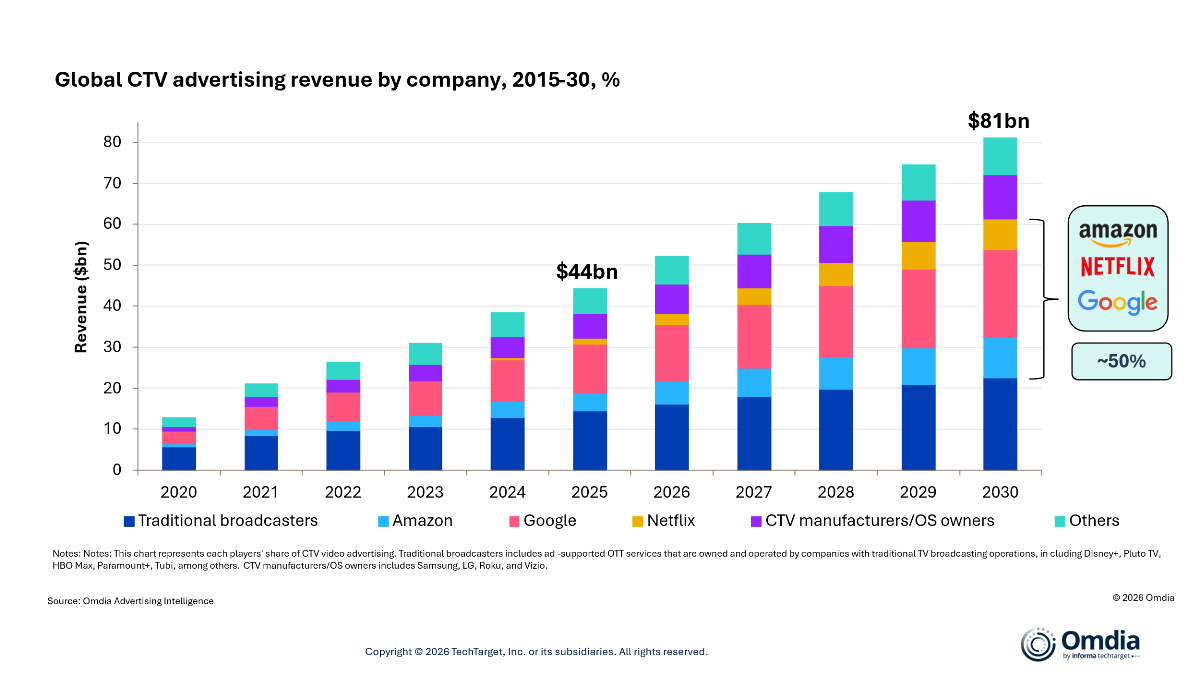
Global connected TV (CTV) advertising revenue is projected to surge from $44 billion in 2025 to $81 billion by 2030, according to new research from Omdia, highlighting the rapid transformation of the television advertising ecosystem as streaming platforms, smart TV operating systems, and digital advertising giants reshape the future of media consumption.

The report indicates that connected TV advertising revenues are expected to surpass traditional linear television advertising during the 2030s, marking a major structural shift in the global television industry. The transition is being driven by the growing adoption of ad-supported streaming services, increasing smart TV penetration, and the integration of advanced advertising technologies across digital entertainment platforms.
Google, Amazon and Netflix Capture Half of Global CTV Advertising Market
The battle to control the global living room is intensifying, with Google, Amazon, and Netflix forecast to collectively capture 50 percent of the worldwide connected TV advertising market by 2030, Omdia report said.
Omdia forecasts show:
Google will command 26 percent of global CTV advertising revenue
Amazon will account for 13 percent
Netflix will represent 9 percent
The research highlights how power within the television industry is shifting away from traditional broadcasters toward streaming ecosystems, digital advertising infrastructure providers, and smart TV platform operators.
Google continues to dominate the connected TV ecosystem through YouTube’s massive global reach and its integrated digital advertising platform. Amazon is aggressively expanding its TV advertising business by combining Prime Video with retail media capabilities and commerce data integration. Netflix, meanwhile, is rapidly scaling its global advertising-supported subscription tier as it seeks new revenue growth opportunities beyond traditional subscriptions.
Ad-Supported Streaming and Retail Media Fuel CTV Growth
Omdia expects several major industry trends to accelerate connected TV advertising growth over the next five years. The rapid expansion of ad-supported streaming services is creating new inventory for advertisers seeking premium video audiences across smart TVs and streaming devices.
The convergence of retail media and television advertising is also becoming a critical growth driver. Companies such as Amazon are increasingly linking shopping behavior, consumer data, and video advertising into a unified commerce ecosystem, enabling advertisers to target audiences more precisely.
The report also points to the continued rise of programmatic advertising and targeted TV advertising, allowing brands to deliver personalized campaigns across connected households while improving advertising measurement and return on investment.
Smart TV Operating Systems Become Strategic Digital Platforms
The connected TV ecosystem is also being reshaped by the growing importance of TV operating systems and smart TV software platforms. Omdia revealed that the European TV operating system market is evolving rapidly, with VIDAA emerging as Europe’s third-largest TV operating system this year after Android TV and Tizen.
Manufacturers are increasingly seeking greater ownership of the smart TV experience as hardware profitability declines and advertising, data monetization, and commerce integration become more strategically important.
According to Maria Rua Aguete, Head of Media & Entertainment at Omdia, the competition for the living room is no longer focused solely on streaming content.
She noted that the industry battle increasingly centers on controlling the platform, advertising layer, operating system, consumer data, and long-term customer relationship. Television is becoming one of the most valuable gateways for digital advertising, retail media, and commerce integration.
David Tett, Principal Analyst at Omdia, warned that connected TV companies risk losing valuable strategic ground to technology giants such as Google and Amazon unless they develop stronger advertising and platform ownership strategies.
Television, Commerce and Digital Advertising Converge
The findings underscore how television, digital commerce, and advertising are converging into a unified ecosystem where connected TV platforms serve as both entertainment hubs and commerce gateways.
As streaming services continue expanding globally and advertisers shift budgets toward measurable digital platforms, connected TV is emerging as one of the most strategically important segments in the global media and advertising industry.
The rapid growth in connected TV advertising also signals increasing competition among technology companies, streaming providers, TV operating system vendors, retailers, and media companies seeking to secure direct access to consumers, advertising revenue, and audience data across connected households worldwide.
SHAFANA FAZAL