

Singapore has emerged as the global leader in Wi-Fi 7 adoption, according to Ookla’s Global State of Wi-Fi 2026 report. The country recorded the highest share of Wi-Fi 7 users worldwide at 25.1 percent, significantly ahead of other markets.

The rapid adoption has been driven by the Singapore government’s push to encourage households to upgrade to 10 Gbps broadband services, highlighting that older Wi-Fi 6 and Wi-Fi 6E routers cannot fully utilize such speeds. Wi-Fi 7’s support for 320 MHz channels and Multi-Link Operation (MLO) enables faster and more efficient wireless connectivity required for multi-gigabit broadband services, the Ookla report said.
Singapore also leads the Asia-Pacific region in the use of the 6 GHz spectrum band, with 13.3 percent of Wi-Fi traffic operating on 6 GHz in Q1 2026. The majority of Wi-Fi traffic in Singapore, however, remains on the 5 GHz band, accounting for 70.8 percent of usage. Singapore outperformed regional peers such as Hong Kong (5.0 percent 6 GHz usage), Japan (4.2 percent) and Australia (3.6 percent).
A major factor behind Singapore’s leadership is the proactive role of telecom operators, which have bundled Wi-Fi 7 routers with premium broadband packages. According to Ookla’s Speedtest data, 27 percent of MyRepublic users connect via Wi-Fi 7, followed by 22 percent for ViewQwest, 21 percent each for StarHub and Singtel, and 20 percent for M1.
North America Leads Global Adoption of 6 GHz Wi-Fi Spectrum
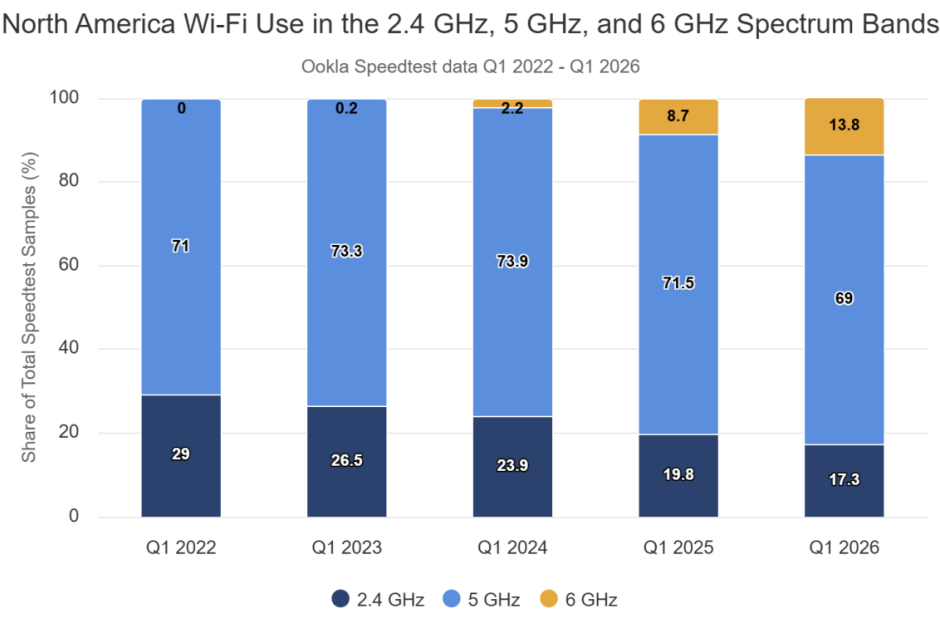
North America has established itself as the global leader in 6 GHz Wi-Fi adoption, driven by early spectrum allocation, aggressive deployment of next-generation customer premises equipment (CPE), and strong support from internet service providers. According to Ookla, the share of Wi-Fi users connecting via the 6 GHz band in North America surged from 2.2 percent in Q1 2024 to 13.8 percent in Q1 2026, representing a sixfold increase in just two years.
The region benefited from the early decision by the U.S. Federal Communications Commission (FCC) to allocate 1,200 MHz of 6 GHz spectrum (5925-7125 MHz) for unlicensed use in 2020. Canada followed a similar approach, enabling the deployment of advanced Wi-Fi technologies across both countries.
The availability of 6 GHz spectrum encouraged significant investment in Wi-Fi infrastructure. According to ABI Research, shipments of 6 GHz-enabled Wi-Fi chipsets in North America increased from 41.8 million units in 2022 to 202.8 million units in 2025, a growth of nearly 500 percent. Shipments are forecast to reach 515.2 million units by 2030, reflecting continued momentum in the market.
As 6 GHz adoption expanded, usage of older Wi-Fi bands declined. By Q1 2026, the 6 GHz band accounted for 13.8 percent of Wi-Fi usage in the United States and 13.7 percent in Canada. In the U.S., the 5 GHz band represented 69.0 percent of Wi-Fi traffic, while the 2.4 GHz band accounted for 17.2 percent. In Canada, 68.5 percent of Wi-Fi traffic used the 5 GHz band and 17.8 percent used the 2.4 GHz band.

North America also leads the world in advanced Wi-Fi adoption. As of Q1 2026, Wi-Fi 6 accounted for 57.5 percent of users in the region, up from 20.9 percent in Q1 2022, while Wi-Fi 7 reached 6.8 percent of samples, the highest regional share globally. The share of legacy Wi-Fi 4 declined to just 10.0 percent.
Major broadband providers accelerated adoption by bundling advanced Wi-Fi equipment with broadband plans. Early adopters included Charter Communications and Frontier Communications in the U.S., as well as Rogers and Telus in Canada. Among U.S. operators, CenturyLink recorded the highest Wi-Fi 7 penetration at 14.7 percent, followed by AT&T Fiber at 10.5 percent and Spectrum at 6.6 percent.
Ookla said North America’s leadership in 6 GHz Wi-Fi adoption reflects a combination of proactive spectrum policy, strong ISP investment, rapid deployment of Wi-Fi 6E and Wi-Fi 7 hardware, and growing consumer demand for higher-capacity wireless connectivity.
Europe Sees Slow Adoption of 6 GHz Wi-Fi Despite Early Spectrum Allocation
Europe has been slower than North America in adopting the 6 GHz spectrum band for Wi-Fi, despite being among the first regions to make spectrum available for unlicensed use. According to Ookla’s Global State of Wi-Fi 2026 report, the 6 GHz band accounted for just 1.6 percent of total Wi-Fi samples across Europe in Q1 2026, highlighting the region’s relatively limited uptake of next-generation Wi-Fi technologies.
The European Union allocated the lower 500 MHz of the 6 GHz spectrum band (5945-6425 MHz) for unlicensed Wi-Fi use, compared with the full 1,200 MHz allocation in the United States and Canada. The UK also opened the lower portion of the 6 GHz band in 2020. However, the upper half of the spectrum (6425-7125 MHz) remains under debate, with mobile operators advocating its use for 5G and future 6G services, while the Wi-Fi industry continues to push for broader unlicensed access.
Despite these regulatory efforts, Europe trails North America in real-world deployment. The majority of European Wi-Fi traffic, 66 percent, continues to run on the 5 GHz band, up from 45.7 percent in Q1 2022, while 6 GHz adoption remains limited.
Adoption varies significantly across countries. France leads Europe with 8.6 percent of Wi-Fi usage on the 6 GHz band, followed by Norway at 6.5 percent. In contrast, major markets such as Germany recorded just 1.1 percent, while Italy reached only 0.4 percent. Countries with extensive fiber coverage, such as Spain, have also shown relatively low 6 GHz adoption due to stronger focus on price competition rather than premium customer premises equipment and in-home Wi-Fi experience.
The report notes that Europe’s slow migration to 6 GHz reflects fragmented market conditions, varying ISP strategies, and ongoing spectrum policy debates. While advanced markets are gradually deploying Wi-Fi 6E and Wi-Fi 7 equipment, the region remains well behind North America, where 6 GHz Wi-Fi usage reached 13.8 percent by Q1 2026.
Wi-Fi 7 Emerges but Remains in Early Adoption Stage
Wi-Fi 7 is beginning to gain traction globally, but it remains at an early stage of adoption. According to Ookla’s Global State of Wi-Fi 2026 report, Wi-Fi 7 accounted for only 1.8 percent of global Wi-Fi samples in Q1 2026, despite the first commercial Wi-Fi 7 routers becoming available in 2023. The technology received official certification from the Wi-Fi Alliance in 2024, while the final Wi-Fi 7 standard (802.11be) was published in July 2025.
The report indicates that Wi-Fi 7 adoption has been influenced by the availability of the 6 GHz spectrum band, which provides much of the technology’s performance advantage. Globally, Wi-Fi 6 held 26.7 percent of samples in Q1 2026, compared with 38.3 percent for Wi-Fi 5 and 33.2 percent for Wi-Fi 4, highlighting that legacy technologies still dominate many markets.
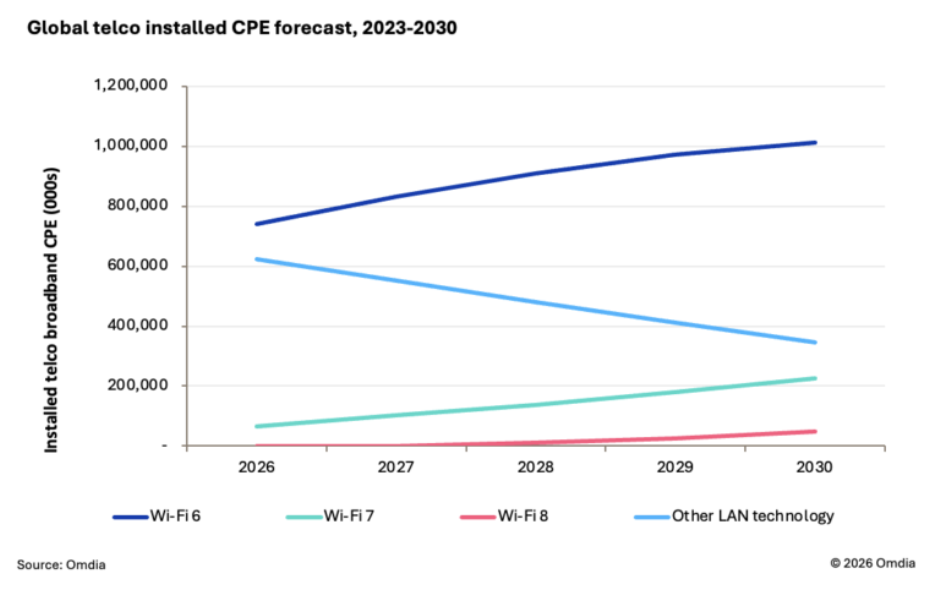
Omdia forecasts strong growth ahead, predicting that Wi-Fi 7’s share of the global consumer broadband CPE installed base will increase from 3.6 percent in 2025 to 13.8 percent by 2030, representing a 35.2 percent CAGR.
Among regions, North America leads Wi-Fi 7 adoption with 6.8 percent of samples using the technology in Q1 2026, the highest regional share worldwide. In the U.S., Wi-Fi 7 accounted for 7.2 percent of samples.
Singapore is the global leader at the country level, with 25.1 percent of Wi-Fi users connecting through Wi-Fi 7. The adoption has been driven by government-backed 10 Gbps broadband initiatives and telecom operators bundling Wi-Fi 7 routers with premium broadband services. Other notable markets include China with 7.5 percent Wi-Fi 7 usage, and Japan and South Korea at 4.1 percent each. Europe remains in the early stages, with Wi-Fi 7 accounting for only 2.5 percent of samples.
Wi-Fi 7 is also increasingly driving 6 GHz spectrum usage. In Q1 2026, 33.7 percent of all 6 GHz Wi-Fi samples came from Wi-Fi 7 devices, up from 16.5 percent in Q1 2025, reflecting the growing role of the technology in next-generation wireless connectivity.
The report notes that Wi-Fi 7 delivers significant performance improvements through 320 MHz channels, 4096 QAM modulation, theoretical speeds of up to 46 Gbps, and Multi-Link Operation (MLO), which allows devices to connect across multiple frequency bands simultaneously for higher speeds, lower latency, and improved reliability.
5 GHz Remains the Dominant Wi-Fi Spectrum Band Globally
The 5 GHz spectrum band continues to be the backbone of global Wi-Fi connectivity, accounting for 59.8 percent of all Wi-Fi usage worldwide in Q1 2026, up from 49.4 percent in Q1 2022, according to Ookla’s Global State of Wi-Fi 2026 report. The band remains the preferred choice for wireless connectivity because the lower portion of the 5 GHz spectrum (5150-5250 MHz) is available for unlicensed use in nearly every country, enabling widespread deployment of compatible routers and devices.
As 5 GHz adoption has increased, reliance on the legacy 2.4 GHz band has steadily declined. The share of Wi-Fi users operating on 2.4 GHz fell from 50.6 percent in Q1 2022 to 38.5 percent in Q1 2026, reflecting the migration toward faster and less congested wireless technologies.
Despite growing interest in the newer 6 GHz band, its global footprint remains relatively small at 1.7 percent of Wi-Fi samples in Q1 2026. As a result, 5 GHz continues to serve as the primary workhorse for residential, enterprise, and public Wi-Fi networks worldwide.
Regional data reinforces the dominance of 5 GHz. In North America, 69.0 percent of Wi-Fi traffic in the U.S. and 68.5 percent in Canada used the 5 GHz band in Q1 2026. Across Europe, the 5 GHz band handled 66 percent of Wi-Fi usage, while in Latin America it accounted for 63.3 percent of total Wi-Fi traffic. Singapore, one of the most advanced Wi-Fi markets globally, recorded 70.8 percent of Wi-Fi usage on the 5 GHz band despite rapid growth in 6 GHz adoption.
Wi-Fi Investment Trends and Market Share Shift Toward Wi-Fi 6 and Wi-Fi 7
Global investment in Wi-Fi infrastructure is increasingly focused on Wi-Fi 6, Wi-Fi 6E, Wi-Fi 7, and 6 GHz-enabled equipment, driven by demand for multi-gigabit broadband, AI-powered applications, smart homes, enterprise IoT, and cloud services. Internet service providers are accelerating investments in next-generation customer premises equipment (CPE), while governments and regulators continue to expand access to 6 GHz spectrum.
One of the strongest indicators of investment momentum comes from the Wi-Fi 7 market. According to Omdia, Wi-Fi 7 consumer broadband CPE will grow from 3.6 percent of the global installed base in 2025 to 13.8 percent by 2030, representing a 35.2 percent CAGR. Wi-Fi 6 is expected to remain the dominant technology, reaching 62 percent of the installed base by 2030 with a 9.7 percent CAGR.
North America has seen the largest investment wave in 6 GHz Wi-Fi infrastructure. According to ABI Research, shipments of 6 GHz-enabled Wi-Fi chipsets increased from 41.8 million units in 2022 to 202.8 million units in 2025, a nearly 500 percent increase. Shipments are forecast to reach 515.2 million units in 2030, reflecting continued investments by chipset vendors, router manufacturers, and broadband operators.
Large broadband providers have also invested heavily in Wi-Fi 7 deployments. Operators including Charter Communications, Frontier Communications, Rogers, Telus, Swisscom, Singtel, StarHub, MyRepublic and ViewQwest have bundled Wi-Fi 7 routers with premium broadband services to accelerate adoption.
The market share of Wi-Fi technologies is shifting rapidly. Globally, Wi-Fi 6 increased from 6 percent of samples in Q1 2022 to 26.7 percent in Q1 2026, while Wi-Fi 7 reached 1.8 percent. Meanwhile, Wi-Fi 5 accounted for 38.3 percent of global samples and Wi-Fi 4 represented 33.2 percent, reflecting the gradual transition away from legacy technologies.
The smartphone ecosystem is already prepared for this transition. As of Q1 2026, 61.4 percent of global Android Speedtest samples came from devices supporting Wi-Fi 6 or newer standards, indicating that consumer devices are not the primary bottleneck for advanced Wi-Fi adoption. However, rising costs of AI-related semiconductors and memory components are increasing equipment costs for both smartphone and router manufacturers, creating additional investment challenges for ISPs deploying next-generation Wi-Fi infrastructure.
Overall, the Wi-Fi market is moving toward a new investment cycle centered on Wi-Fi 7 and 6 GHz technologies, while Wi-Fi 6 continues to capture the largest share of new deployments and Wi-Fi 5 remains the largest installed generation globally.
BABURAJAN KIZHAKEDATH