

Internet speeds across the United States have improved in 2026 as fiber expansion, cable-network upgrades and rising broadband capacity pushed download performance higher. The national download speed reached 131.94 Mbps, increasing 5.26 percent from 125.35 Mbps in 2025.

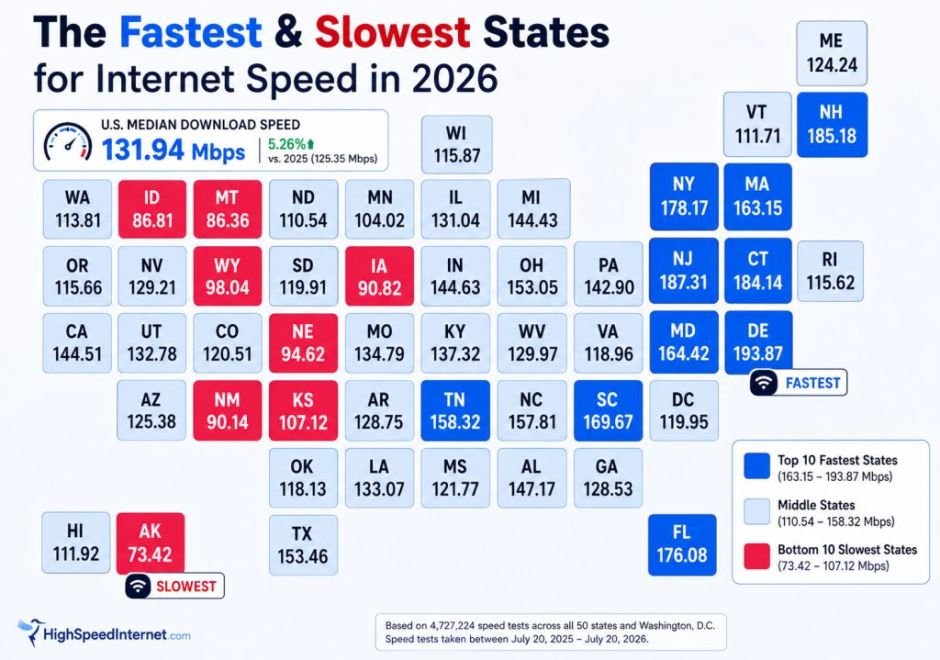
HighSpeedInternet.com’s annual The 10 Fastest and Slowest States for Internet Speeds report analyzed 4,727,224 speed tests across all 50 states and Washington, D.C. download speeds increased in 38 states, although 13 states recorded slower speeds than a year earlier.
The data also reveals a significant geographic broadband divide. All 10 fastest states are located in the Northeast or South, while states with large rural populations across the Mountain West and Midwest remain concentrated near the bottom of the rankings.
Delaware Tops US Internet Speed Ranking at 193.87 Mbps
Delaware remained America’s fastest state for internet speeds for the second consecutive year, delivering a download speed of 193.87 Mbps.
New Jersey ranked second at 187.31 Mbps, while New Hampshire took third place with 185.18 Mbps.
The rest of the top 10 comprised Connecticut at 184.14 Mbps, New York at 178.17 Mbps, Florida at 176.08 Mbps, South Carolina at 169.67 Mbps, Maryland at 164.42 Mbps, Massachusetts at 163.15 Mbps and Tennessee at 158.32 Mbps.
Delaware’s performance demonstrates the scale of the broadband-speed divide across the country. Its 193.87 Mbps median download speed is 120.45 Mbps higher than the 73.42 Mbps recorded in Alaska, making Delaware approximately 2.64 times faster.
Alaska Records Slowest Internet Speed at 73.42 Mbps
Despite a significant improvement from 2025, Alaska remained the slowest state for internet performance, recording a median download speed of 73.42 Mbps.
Montana ranked second from the bottom at 86.36 Mbps, followed closely by Idaho at 86.81 Mbps.
Other states in the bottom 10 were New Mexico at 90.14 Mbps, Iowa at 90.82 Mbps, Nebraska at 94.62 Mbps, Wyoming at 98.04 Mbps, Minnesota at 104.02 Mbps, Kansas at 107.12 Mbps and North Dakota at 110.54 Mbps.
Broadband deployment becomes more challenging in markets with low population density, difficult terrain and long distances between communities. These factors can raise the cost of extending high-capacity fiber and other fixed broadband infrastructure to rural households.
West Virginia Internet Speed Surges 51.64 Percent
While Delaware leads on absolute speed, West Virginia recorded the biggest improvement in the United States. Its median download speed jumped 51.64 percent year over year to 129.97 Mbps.
Alaska achieved the second-largest increase, with median speed climbing 42.81 percent to 73.42 Mbps. Vermont ranked third for improvement after speeds increased 27.98 percent to 111.71 Mbps.
The gains translate into substantial improvements for data-intensive applications.
At West Virginia’s new median speed, HighSpeedInternet.com estimates that completing a 1TB cloud backup would take approximately 17 hours, compared with nearly 26 hours previously.
In Alaska, downloading a 128GB photo library would now require less than four hours, down from around five and a half hours.
Broadband Speed Gap Impacts Streaming, Gaming and Remote Work
The difference between Alaska’s 73.42 Mbps and Delaware’s 193.87 Mbps can become particularly noticeable in households simultaneously using multiple connected devices.
Download speed, however, does not provide a complete picture of broadband quality. Upload speeds, latency, network congestion, reliability and in-home Wi-Fi performance can significantly influence the actual customer experience. Individual users may therefore receive speeds above or below their state’s median.
Nokia 25G PON and DOCSIS 4.0 Push Broadband Toward Multi-Gigabit Era
Network technology vendors are raising the potential speed ceiling for US broadband providers through next-generation fiber and cable technologies.
Nokia was selected by altafiber in January 2026 to support a multi-gigabit network expansion across Ohio and Hawaii using 25G PON, IP routing and optical networking technologies.
Nokia’s broadband platform supports 10G, 25G and 50G PON, giving operators an upgrade path toward substantially higher fiber capacity as residential and enterprise bandwidth requirements increase.
Cable broadband is also moving toward multi-gigabit performance. Vecima announced in March 2026 that Spectrum would deploy its DOCSIS 4.0 technology while continuing to expand fiber access through its PON platform.
DOCSIS 4.0 can support capacity of up to 10 Gbps downstream and 6 Gbps upstream, according to CableLabs, enabling cable operators to compete more aggressively in the multi-gigabit broadband market.
Fiber availability is also expanding. HighSpeedInternet.com estimates that fiber broadband now reaches more than 60 percent of US homes, creating additional opportunities for providers to offer higher-speed internet packages.
4.7 Million Speed Tests Reveal Real-World US Broadband Performance
HighSpeedInternet.com’s 2026 analysis is based on 4,727,224 internet speed tests conducted between July 20, 2025 and July 20, 2026 across all 50 states and Washington, D.C.
Rather than ranking states according to advertised maximum broadband speeds, the study uses download speed, providing an indication of the performance typically experienced by users.
The results show a US broadband market that is getting faster but remains geographically uneven. The national median increased 5.26 percent to 131.94 Mbps, Delaware retained the top position at 193.87 Mbps, and Alaska remained last at 73.42 Mbps.
At the same time, West Virginia’s 51.64 percent increase to 129.97 Mbps and Alaska’s 42.81 percent improvement demonstrate that states starting from lower speed levels can make substantial gains.
As fiber coverage expands beyond 60 percent of US homes and operators deploy technologies including DOCSIS 4.0, 10G PON, 25G PON and 50G PON, the next phase of broadband investment will determine whether America’s fastest states extend their lead or the country’s remaining digital speed gap begins to narrow.
FASNA SHABEER