

SpaceX’s Starlink satellite broadband service reached 13.6 million consumer subscribers worldwide in the third quarter of 2026, while its median upload speeds in the United States increased 42 percent year-over-year, according to data from Ookla Speedtest. The satellite internet provider is attracting customers from cable broadband, DSL and fixed wireless access (FWA) networks, supported by discounted residential plans and improvements in satellite network capacity.

Starlink added 1.6 million consumer subscribers during Q3 2026, compared with 12 million subscribers in Q2 2026. The company does not disclose country-level subscriber figures, but Ookla estimates that approximately 22 percent of Starlink customers are based in the United States, making it the company’s largest market.
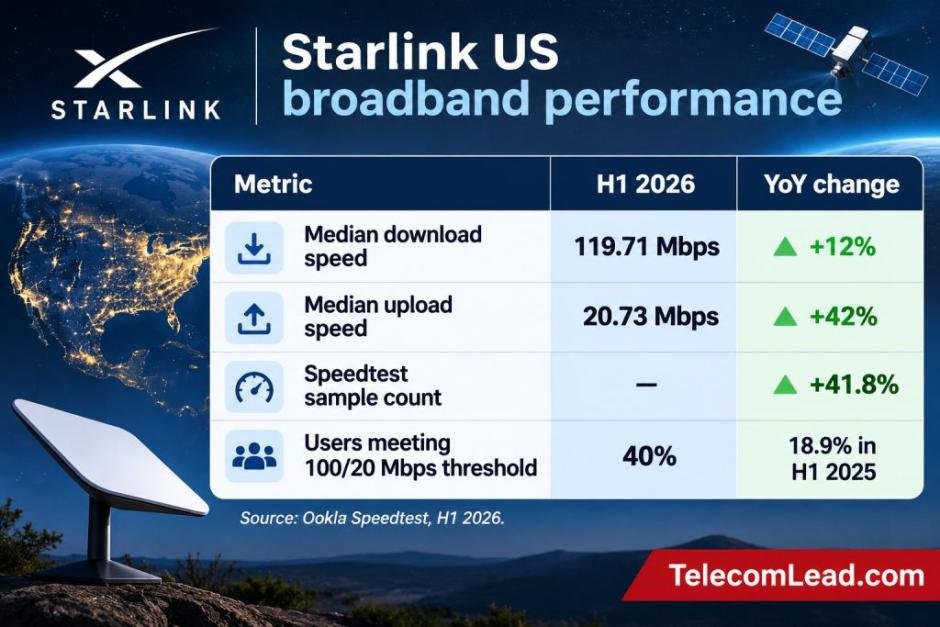
Ookla’s analysis of Speedtest data shows that Starlink Speedtest sample counts in the United States increased 41.8 percent between the first half of 2025 and the first half of 2026. Although Speedtest sample growth does not directly represent subscriber growth, it indicates increasing usage of Starlink’s satellite broadband network.
Starlink Download Speeds Rise 12%, Upload Speeds Increase 42%
Starlink’s median download speed in the United States increased 12 percent year-over-year to 119.71 Mbps in the first half of 2026. However, download performance declined in 16 states and Washington, D.C., highlighting differences in network capacity and subscriber demand.
Median upload speeds increased from 14.63 Mbps in H1 2025 to 20.73 Mbps in H1 2026, representing growth of approximately 42 percent. Upload speeds improved in all 50 states and Washington, D.C., with increases ranging from 25 percent to 70 percent.
Starlink’s improving broadband performance is also reflected in the proportion of users meeting the US Federal Communications Commission’s 100 Mbps download and 20 Mbps upload broadband benchmark.
Approximately 40 percent of US Starlink Speedtest users achieved this performance threshold in H1 2026, compared with 18.9 percent in H1 2025.
Starlink Competes With T-Mobile, Verizon and Other 5G FWA Providers
Starlink is increasingly competing with terrestrial broadband providers for residential customers.
According to Ookla’s analysis of Speedtest data covering Q4 2025 through Q3 2026, approximately nine out of 10 new US Starlink customers switched from non-fiber connections, including DSL, cable broadband and FWA.
However, Starlink’s median download speed of 119.71 Mbps remained below the speeds recorded by all three major US 5G FWA providers.
T-Mobile’s 5G FWA median download speed was nearly twice Starlink’s performance, while Verizon and the third major FWA provider also delivered higher median download speeds.
Starlink’s lower median performance may partly reflect the introduction of residential broadband plans with download speed caps of 100 Mbps and 200 Mbps.
The results indicate that Starlink is attracting customers despite facing faster competing broadband services, particularly where availability, pricing or service quality influence consumer decisions.
Starlink Reduces Residential Broadband Prices to $29
Starlink introduced discounted residential broadband plans in selected US markets during the first half of 2026.
The Residential 100 Mbps plan, originally priced at $50 per month, received several promotional discounts.
| Promotional period | Monthly price | Promotional duration |
| March 2026 | $39 | First 6 months |
| April 2026 | $35 | First 4 months |
| May 2026 | $29 | First 3 months |
These promotions were offered in selected locations with available network capacity rather than nationwide.
Ookla found that the proportion of Starlink users recording average download speeds between 100 Mbps and 109 Mbps increased from 3.5 percent in Q3 2025 to 5.9 percent in Q3 2026.
The increase suggests that the 100 Mbps residential plan helped attract subscribers to Starlink’s network.
Starlink Urban Broadband Usage Grows 73%
Starlink’s expansion is no longer concentrated exclusively in rural broadband markets.
Ookla reported that the number of Starlink Speedtest users in urban areas increased 73 percent year-over-year during H1 2026, compared with 33 percent growth in rural areas.
Urban Starlink users grew faster than rural users in every state except Alaska and Hawaii.
New Jersey, Ohio, Pennsylvania, Illinois and Michigan recorded more than 100 percent growth in urban Starlink Speedtest users.
In Florida, Nevada, Massachusetts, Connecticut, Hawaii and New Jersey, Starlink users conducting Speedtests from urban locations outnumbered those testing from rural areas.
The findings indicate growing adoption of satellite broadband in markets traditionally served by cable, fiber and 5G FWA networks.
Starlink Network Latency Improves Across 49 US States
Starlink reduced median multi-server latency in 49 states and Washington, D.C., between H1 2025 and H1 2026.
Illinois was the only state without improvement, maintaining latency of 37 milliseconds.
Alaska recorded a significant improvement, with median latency declining from 105 milliseconds to 84 milliseconds. Missouri and Kansas also improved, with latency declining from approximately 50 milliseconds to 38 milliseconds.
The number of states recording median latency below 40 milliseconds increased from 10 states and Washington, D.C., in H1 2025 to 24 states and Washington, D.C., in H1 2026.
The improvements are consistent with Starlink’s investments in satellite capacity, ground infrastructure and lower-orbit operations.
Starlink Network Performance Varies Across US States
Utah recorded Starlink’s fastest median download speed at approximately 165 Mbps in H1 2026. North Dakota, Wyoming, South Dakota, Colorado and Nevada also recorded speeds near 160 Mbps.
Florida reported the lowest median download speed at 89 Mbps, despite achieving a 50 percent year-over-year improvement.
Arkansas recorded an 8.3 percent decline in median download speed, from 103.2 Mbps to 94.7 Mbps. Rhode Island experienced an 8 percent reduction, from 147.3 Mbps to 135.5 Mbps.
For upload performance, South Dakota led with 27.4 Mbps, followed by Minnesota at 27 Mbps and Nebraska and Wyoming at 26.8 Mbps each.
Illinois recorded nearly 70 percent upload speed growth, reaching 25.5 Mbps, while New Jersey achieved 69.5 percent growth to 25.1 Mbps.
SpaceX Expands Starlink Satellite Capacity With V2 Mini and V3 Satellites
Starlink’s network improvements coincide with the deployment of higher-capacity V2 Mini satellites.
According to satellite tracking data cited by Ookla, SpaceX had launched approximately 7,550 V2 Mini broadband satellites by early October 2026, representing roughly two-thirds of Starlink’s operational satellites.
SpaceX is also expanding its next-generation V3 satellite network, designed to deliver substantially greater broadband capacity.
According to Light Reading’s analysis of Starlink’s V3 deployment, SpaceX expects its higher-capacity satellites to improve broadband performance as deployments expand. The company has indicated that several hundred V3 satellites may be needed before customers experience substantial performance improvements.
Starlink’s expansion also comes amid growing network congestion in heavily subscribed markets. Texas, Florida and Washington ranked among the states with the highest Starlink Speedtest activity but also among the bottom 10 for median download speeds.
The official Starlink network update provides additional information on the company’s satellite capacity, broadband speeds and ground-network investments.
Starlink’s 13.6 million global consumer subscribers, 42 percent improvement in US upload speeds and 73 percent growth in urban Speedtest users demonstrate the expanding reach of satellite broadband. However, its slower median download speeds compared with major 5G FWA and fiber providers show that continued network capacity investment remains important as subscriber demand increases.
BABURAJAN KIZHAKEDATH