


Starlink is rapidly strengthening its position in Europe’s broadband market as rural connectivity gaps, uneven fiber deployment, and geographically challenging regions continue driving demand for low Earth orbit satellite internet services, according to a new report from Ookla.


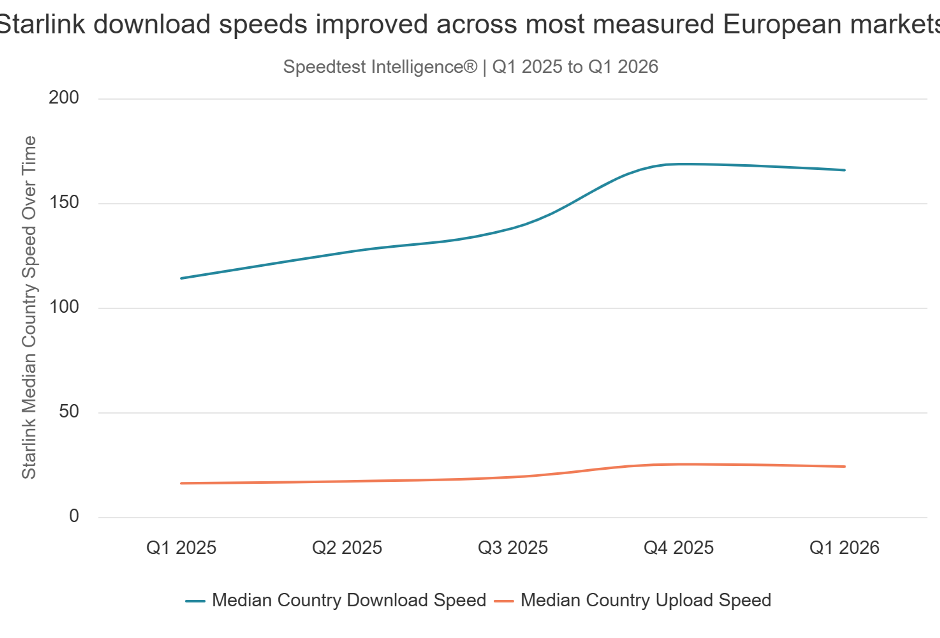
Starlink’s download speed across 27 European countries increased from 114.05 Mbps in Q1 2025 to 165.71 Mbps in Q1 2026, representing a 45 percent increase. Download speeds improved in 26 of 27 European markets as SpaceX accelerated satellite deployment, expanded broadband infrastructure investment, optimized network efficiency, and scaled its low Earth orbit satellite constellation strategy.
Across all 27 European markets covered in the study, Starlink delivered download speeds of 165.71 Mbps, upload speeds of 24.10 Mbps, and latency of 49 ms.
Ookla said Starlink is gaining its strongest market traction in regions where terrestrial broadband infrastructure remains expensive, difficult, or economically unattractive to deploy. Starlink’s architecture is built around low Earth orbit satellite technology, advanced gateway infrastructure, spectrum optimization, beam-forming systems, software-driven traffic management, and broadband expansion into underserved areas.
Unlike traditional geostationary satellite systems operating at much higher orbital altitudes, Starlink’s low Earth orbit design significantly reduces latency and improves responsiveness for broadband consumers, enterprises, cloud services, and digital applications.
SpaceX Expands Satellite Infrastructure and Broadband Investment
Starlink’s improving broadband performance is closely tied to SpaceX’s continued satellite deployment and network expansion strategy.
SpaceX added more than 4.6 million active customers globally during 2025 while operating over 9,000 active satellites by year-end.
The expansion reflects SpaceX’s long-term broadband growth strategy focused on increasing network capacity, reducing congestion, improving rural broadband coverage, enhancing customer experience, and extending connectivity into underserved regions across Europe and other global markets.
Higher satellite density is helping Starlink improve capacity management, broadband consistency, and network efficiency across Europe.
The report also highlighted growing adoption of satellite broadband among residential households, enterprises, maritime operators, remote workers, seasonal homes, and rural communities seeking alternatives to traditional fixed broadband infrastructure.
Latvia, Greece and Croatia Lead Starlink Broadband Performance
Among European markets, Latvia emerged as Starlink’s fastest-performing country in Q1 2026 with median download speeds reaching 232.51 Mbps.
Latvia was followed by Greece at 196.31 Mbps and Croatia at 188.02 Mbps.
The report also identified some of Europe’s strongest annual speed improvements:
Cyprus recorded a speed increase of 159.53 Mbps
Poland improved by 134.31 Mbps
Latvia gained 104.38 Mbps
Ookla attributed these gains to continued satellite infrastructure investment, constellation expansion, gateway modernization, spectrum efficiency improvements, and network optimization systems.
The findings suggest that sustained infrastructure investment is becoming critical as satellite subscriber demand rises across Europe.
Bulgaria Highlights Satellite Capacity Constraints
Bulgaria emerged as Starlink’s weakest-performing market in Europe despite recording the continent’s highest usage share.
According to Ookla, Bulgaria recorded:
Starlink sample share: 8 percent
Median download speed: 61.06 Mbps
Annual speed decline: 5 percent
Bulgaria was the only European market where Starlink download speeds declined year-over-year.
Findings demonstrate how concentrated subscriber demand can still create satellite capacity pressure in specific regions. The report highlighted one of the key operational challenges facing satellite broadband providers – balancing rapid subscriber growth with available orbital and spectrum capacity through ongoing infrastructure expansion and more efficient traffic engineering.
Rural Broadband Gaps Continue Fueling Starlink Adoption
One of the strongest conclusions from the Ookla study is that Starlink adoption remains highest in regions where fixed broadband infrastructure leaves major coverage gaps.
The report highlighted strong demand from:
Rural communities
Islands
Mountain regions
Seasonal homes
Farms
Remote enterprises
Countries with the highest Starlink usage share included:
Bulgaria: 8 percent
Greece: 6 percent
Croatia: 6 percent
Ireland: 4 percent
Latvia: 4 percent
These markets typically face geographic deployment challenges, slower nationwide fiber rollout, or uneven rural infrastructure development.
The report’s comparison of Starlink usage share against national broadband quality showed that countries with weaker terrestrial infrastructure generally experienced stronger satellite broadband adoption.
Greece Emerges as a Key Starlink Growth Market
Greece is one of Europe’s most important Starlink growth markets due to its island-heavy geography and dispersed population distribution.
According to the report:
Starlink download speed in Greece reached 196.31 Mbps
Greece’s national fixed broadband median reached 94.29 Mbps
Starlink sample share reached 6 percent
Greece’s geography makes universal terrestrial broadband deployment more expensive and slower despite major national broadband investment programs.
Findings demonstrate how satellite broadband investment and innovation can complement national fiber and 5G expansion strategies in geographically complex markets.
Latvia Demonstrates Strong Satellite Broadband Advantage
Latvia recorded Europe’s fastest Starlink performance in Q1 2026.
According to Ookla:
Starlink median download speed reached 232.51 Mbps
Starlink maintained an 85.64 Mbps performance advantage over Latvia’s national fixed broadband median
Starlink usage share reached 4 percent
Latvia’s digital connectivity strategy focuses on delivering equal high-quality broadband access nationwide while public investment support targets regions where fiber deployment remains economically unattractive for telecom operators.
Ookla linked Latvia’s strong Starlink performance to broadband gaps in areas lacking sufficient incentives for large-scale FTTH investment.
Ireland and UK Advance Hybrid Broadband Models
Ookla said Ireland and the United Kingdom demonstrate how satellite broadband can complement fiber infrastructure rather than replace it.
Ireland’s National Broadband Plan covers:
More than 560,000 premises
1.1 million people
More than 65,000 farms
44,000 non-farm businesses
679 schools
Despite this large-scale rural broadband initiative, Ireland ranked fourth for Starlink adoption during Q1 2026. Ookla said this reflects ongoing demand in areas still awaiting fiber rollout as well as rising interest in resilient backup connectivity following recurring fiber outages during winter storms.
The UK is also moving toward a hybrid broadband model through Project Gigabit, government-backed low Earth orbit satellite trials, and a broadband agreement between BT Group and Starlink targeting hard-to-reach areas.
The UK ranked tenth in Europe for Starlink sample share and recorded one of Europe’s strongest responsiveness metrics with median multi-server latency of 37 ms, supported by dense ground station infrastructure and advanced traffic breakout systems.
Fiber-Dominant Markets Show Lower Starlink Dependence
The report found that mature FTTH markets recorded significantly lower Starlink adoption.
Countries including:
Denmark
Malta
Finland
Romania
Luxembourg
Netherlands
Slovenia
all recorded Starlink sample share below 1 percent.
Across these fiber-heavy markets, Starlink trailed national fixed broadband download speeds by an average of 81.82 Mbps.
Findings reinforce that Starlink performs best where fiber economics remain difficult rather than in highly mature broadband markets.
Romania and Spain Showcase Fiber Broadband Leadership
Romania and Spain were highlighted as examples of aggressive FTTH deployment reducing the need for satellite broadband alternatives.
Romania recorded:
National fixed broadband median speed: 283.06 Mbps
Starlink sample share: Below 1 percent
Ookla attributed Romania’s broadband leadership to strong fiber penetration, extensive gigabit infrastructure, and investment from DIGI.
Spain recorded:
National fixed broadband median speed: 277.98 Mbps
Performance advantage over Starlink: 110.24 Mbps
Ookla said Spain’s broadband strength reflects nationwide FTTH deployment, strong telecom competition, continued broadband investment, and long-term fiber expansion planning.
Fixed Broadband Retains Key Performance Advantages
Despite Starlink’s rapid performance gains, Ookla emphasized that terrestrial broadband still dominates several critical performance categories.
According to the report:
Starlink exceeded national fixed broadband download speeds in 11 of 27 markets
Fixed broadband delivered lower latency in all 27 markets
Fixed broadband provided stronger upload performance in 26 markets
Fiber broadband continues to maintain advantages for:
Enterprise workloads
Cloud computing
Gaming
Video conferencing
AI applications
Upload-intensive services
Long-term scalability
Ookla said fiber infrastructure remains the preferred technology for high-capacity urban and enterprise broadband networks despite rapid advances in low Earth orbit satellite innovation.
Europe Expands Hybrid Connectivity and Satellite Broadband Strategy
The report said Europe is entering a broader satellite broadband expansion phase beyond Starlink.
Ookla highlighted growing momentum around:
Eutelsat OneWeb
Amazon Kuiper
IRIS²
The study linked satellite broadband growth with rural broadband expansion, enterprise continuity, aviation connectivity, maritime communications, emergency response infrastructure, and non-terrestrial network strategies.
Ookla said Europe’s IRIS² initiative reflects growing interest in digital sovereignty and secure regional satellite communications infrastructure.
Starlink is not replacing Europe’s fiber broadband ecosystem but increasingly filling connectivity gaps where terrestrial deployment remains difficult or uneconomical. Satellite broadband is evolving into a complementary connectivity layer supporting rural broadband access, enterprise backup connectivity, hybrid telecom infrastructure, and long-term digital inclusion strategies across Europe.
FASNA SHABEER