

Starlink has emerged as a significant broadband competitor in Brazil, combining rapid subscriber growth with a nationwide satellite footprint that extends from major cities to remote rural communities.

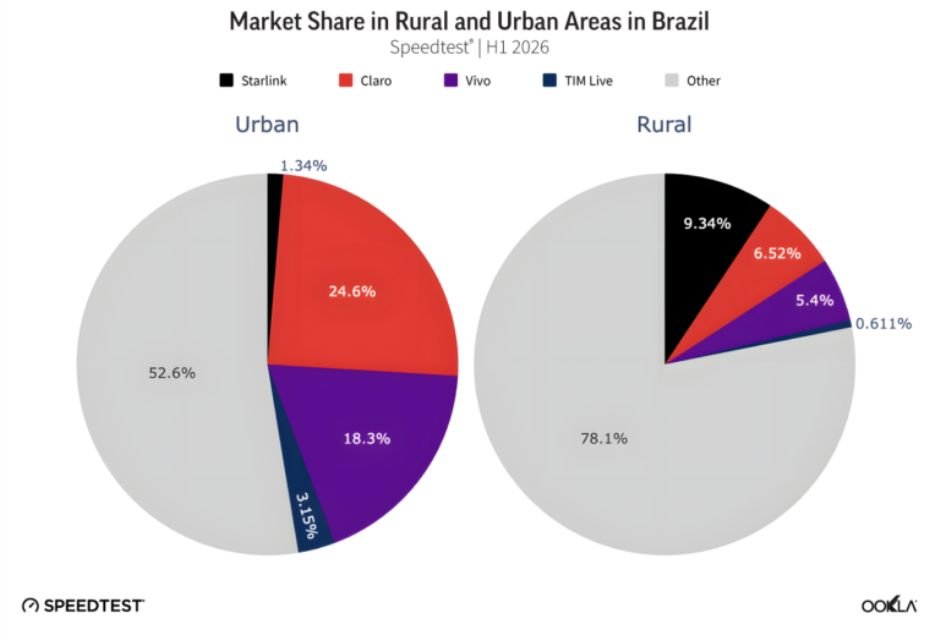
New network data shows Starlink reached 791,052 fixed broadband subscriptions in May 2026, making it Brazil’s 13th-largest fixed broadband provider and giving the satellite operator around 1.4 percent of the national market, Ookla report said.
Brazil has become Starlink’s second-biggest market globally and hosts more than a dozen ground stations, highlighting the strategic importance of the country to the satellite broadband provider.
Starlink’s expansion is particularly significant because it is competing not only in underserved rural locations but also in highly urbanized markets such as São Paulo, Rio de Janeiro, Recife and Brasília.
Starlink Brazil Subscribers Jump Around 20 Percent in Four Months
Starlink recorded one of the strongest growth rates among Brazil’s major broadband providers between January and May 2026.
According to Anatel data, Starlink subscriptions increased from 656,413 in January 2026 to 791,052 in May 2026, representing growth of around 20 percent in just four months.
Starlink therefore added 134,639 net fixed broadband subscriptions during the period. That was second only to Vivo, which added 253,974 subscriptions, and was ahead of Claro, which gained 128,826 subscriptions.
By May 2026, Vivo had 8.4 million fixed broadband subscriptions, while market leader Claro had 10.8 million.
Starlink itself reported reaching 1 million subscribers in Brazil in January 2026, higher than Anatel’s subscription count. Differences in how paying customers, subscriptions and individual users are classified may help explain the gap.
Brazil Satellite Broadband Connections Surge From 43,164 to 960,759
Brazil’s geography provides a substantial opportunity for satellite broadband. Around 26 million Brazilians live in rural areas, representing approximately 12 percent of the country’s population.
Connectivity gaps are particularly pronounced in the Amazon. Fixed or mobile broadband is available across only 3.5 percent of the Amazon biome, while availability falls to just 0.69 percent across indigenous territories.
Against this backdrop, Brazil’s total satellite internet subscriptions increased dramatically from 43,164 in February 2011 to 960,759 in May 2026.
Growth accelerated following Starlink’s commercial launch in Brazil in May 2022, while subscriptions on legacy copper and cable networks have declined. Fiber remains the only broadband access technology growing faster than satellite in Brazil.
Starlink Builds Bigger Customer Base in Urban Brazil
Despite satellite broadband’s traditional association with remote locations, Starlink has developed a substantial urban presence.
In areas classified as having a “high degree” of urbanization, Starlink recorded 347,990 subscriptions in May 2026. Locations with a “low degree” of urbanization accounted for 213,291 subscriptions.
The figures mean Starlink actually has more subscriptions in highly urbanized Brazilian locations than in low-urbanization areas.
However, Starlink’s relative market strength remains much greater in rural areas, where its share is approaching 10 percent and limited fiber availability creates a stronger opportunity for satellite connectivity.
From May 2025 to May 2026, Starlink recorded an 8.3 percent increase in net customers in rural areas.
Urban growth was much slower at 1.32 percent during the same 12-month period, reflecting tougher competition from Brazil’s extensive and often faster fiber broadband networks.
Starlink Speeds Concentrated Between 50 Mbps and 200 Mbps
Starlink’s broadband performance profile differs substantially from Brazil’s large fiber and fixed-network providers.
Starlink users are heavily concentrated at speeds below 300 Mbps, with the largest proportion receiving between 50 Mbps and 200 Mbps in both urban and rural locations.
Speeds above 400 Mbps remain uncommon on Starlink, while virtually no users consistently achieve gigabit speeds.
In contrast, Claro, Vivo and TIM Speedtest results show performance peaks associated with commercial broadband tiers offering up to 300 Mbps, 500 Mbps, 600 Mbps and 1 Gbps.
However, Starlink’s urban and rural speed distributions are remarkably similar, indicating relatively consistent performance regardless of geography. Satellite capacity rather than conventional wired last-mile infrastructure plays the central role in determining network performance.
Starlink Speed Peaks at 149.5 Mbps but Falls to 90.6 Mbps Under Load
Network congestion remains an important factor affecting Starlink performance in Brazil.
During the first quarter of 2026, Starlink’s median download speed peaked at 149.5 Mbps at around 2 a.m., when network usage was relatively low.
Performance fell to a daily trough of 90.6 Mbps by around 1 p.m., representing a decline of nearly 40 percent during busy business hours. On weekdays, the decline reached as much as 43 percent.
The performance analysis covers multiple speed percentiles, ranging from P10, representing the slowest 10 percent of Speedtest results, to P90, the level at or below which 90 percent of users perform, with the fastest 10 percent exceeding it.
Starlink’s median download speeds have dipped in Brazil in recent months, following a period in which the company almost doubled its global customer base during 2025.
Starlink Congestion Gap Improves From 48.9 Percent to 29.6 Percent
Despite subscriber growth and daytime congestion, the underlying congestion trend is improving.
Starlink’s peak-to-trough download speed gap fell from 48.9 percent in the third quarter of 2025 to 29.6 percent in the second quarter of 2026.
A broader analysis covering the first quarter of 2024 through the second quarter of 2026 also showed improving network conditions after congestion appeared to reach its highest level toward the end of 2025.
Importantly, the improvement occurred during a period when the number of Speedtest samples in Brazil doubled, indicating substantial growth in observed network activity.
Starlink Jitter Rises From 6.5 ms Overnight to 9 ms During Day
Network load also affects connection consistency.
In the first quarter of 2026, median jitter was around 6.5 milliseconds overnight, increasing to approximately 9.0 milliseconds between 9 a.m. and 5 p.m.
Earlier measurements showed a larger time-of-day variation. During the first quarter of 2025, the difference between overnight and daytime jitter was around 2–3 milliseconds.
By the third quarter of 2025 and onward, the gap had largely disappeared, with most hourly jitter readings ranging between 7 and 9 milliseconds regardless of the time of day.
More Than 12 Percent of Starlink Customers Use Service Across Multiple Locations
Portability represents another significant differentiator for Starlink compared with conventional fixed broadband.
During the first half of 2026, more than 12 percent of Starlink customers generated Speedtest results from more than two locations, while almost 5 percent appeared in more than three locations.
The comparable figures for Brazil’s other major fixed broadband providers were lower, highlighting a fundamental advantage of satellite broadband: customers can move their equipment and connectivity between locations in a way that conventional fixed fiber connections cannot easily replicate.
Starlink, Vivo, Claro and TIM Wi-Fi Usage Compared
Analysis of unique identifiers connected through Wi-Fi access points also provides insight into how broadband connections are shared.
For Starlink, 90.29 percent of measured Wi-Fi access points showed 1 user, 9.71 percent showed 2 users, 1.41 percent showed 3 users, and 0.08 percent showed 5 or more users.
Vivo recorded 90.28 percent with 1 user, 9.72 percent with 2 users, 1.53 percent with 3 users and 0.11 percent with 5 or more users.
Claro recorded 88.80 percent, 11.20 percent, 1.85 percent and 0.13 percent, respectively.
TIM recorded 88.41 percent with 1 user, 11.59 percent with 2 users, 2.09 percent with 3 users and 0.20 percent with 5 or more users.
Each radio associated with a Wi-Fi access point has its own Basic Service Set Identifier, or BSSID, corresponding to the physical address of the wireless network signal.
Fiber Expansion Remains Starlink’s Biggest Competitive Challenge
The Brazilian data reveals a strong inverse relationship between Starlink adoption and fiber availability. Locations with greater Starlink penetration generally have less fiber infrastructure, while areas with extensive fiber availability tend to show lower Starlink market share.
This helps explain why Starlink’s rural net customer growth of 8.3 percent between May 2025 and May 2026 substantially exceeded its 1.32 percent urban growth.
Starlink nevertheless has demonstrated that satellite broadband is no longer exclusively a solution for isolated communities. With 791,052 Anatel-reported subscriptions, a 1.4 percent national fixed broadband share, rural market share approaching 10 percent, more than a dozen Brazilian ground stations and peak median download speeds of 149.5 Mbps, Starlink is increasingly operating as a nationwide broadband competitor.
The key competitive divide is becoming clearer. Fiber providers such as Claro, Vivo and TIM retain an advantage in very high-speed packages reaching 300 Mbps, 500 Mbps, 600 Mbps and 1 Gbps, while Starlink’s strengths are nationwide availability, relatively consistent urban and rural performance and portability.
For Starlink, Brazil’s combination of dense cities, enormous rural territories and major broadband coverage gaps provides a test of whether satellite connectivity can grow beyond its underserved-market origins and become a mainstream alternative in one of the world’s largest broadband markets.
BABURAJAN KIZHAKEDATH