

Spectrum allocation is emerging as one of the most powerful levers for expanding mobile connectivity in rural regions, where coverage challenges, sparse populations and affordability barriers continue to limit digital inclusion. Low-band spectrum, particularly frequencies below 1 GHz, plays a central role in delivering wide-area coverage and improving user experience outside cities.

Low-band spectrum drives rural coverage
Mobile usage patterns in rural areas differ significantly from urban environments. Rural users spend more than twice as much time connected to low-band spectrum on 4G and 5G networks compared with urban users. In countries such as Australia and the UK, more than half of rural connection time relies on sub-1 GHz spectrum.
The reason is simple: low-band frequencies travel farther and penetrate obstacles better. A single base station operating at 700 MHz can cover up to 10 times the area of one using 2.6 GHz spectrum. This extended reach reduces infrastructure costs while improving signal strength and reliability across large geographic areas.
Every additional 50 MHz of sub-1 GHz spectrum is linked to measurable improvements in coverage:
Around 7 percentage-point increase in 4G coverage
Around 11 percentage-point increase in 5G coverage
These gains are significantly larger than those delivered by higher frequency bands, highlighting the critical importance of low-band spectrum for rural networks, GSMA Intelligence said in a report.
Mid-band spectrum complements rural deployments
While low-band spectrum provides coverage, mid-band frequencies such as 3.5–3.8 GHz add capacity in populated pockets of rural areas. Deploying mid-band near base stations allows operators to handle higher traffic demand and free up low-band spectrum for users at the edge of cells.
This combination of coverage and capacity is increasingly essential as rural data demand grows.
Spectrum levels linked to rural speed performance
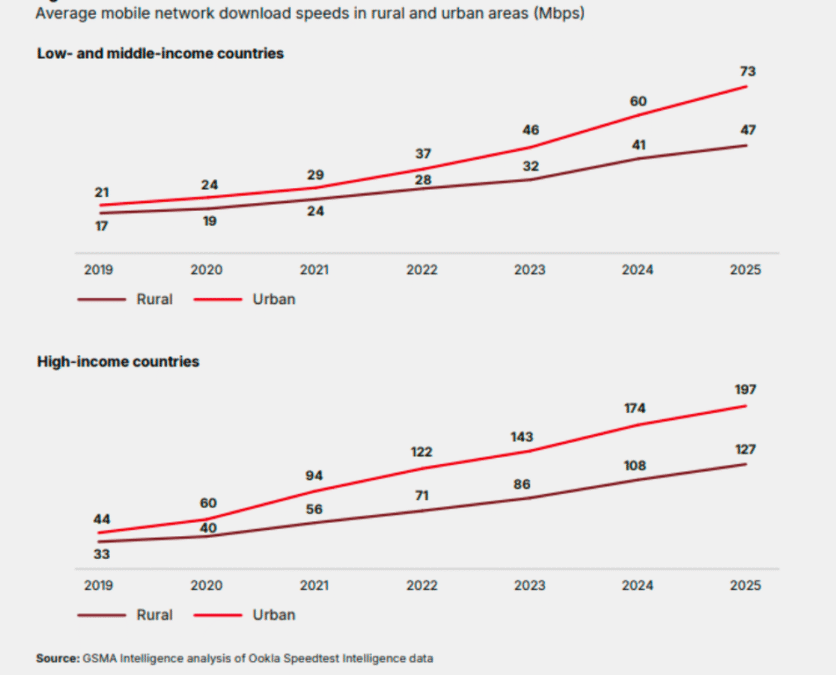
Despite lower population density, rural networks face capacity constraints, particularly at cell edges where only low-band signals are effective. Spectrum availability directly influences real-world performance.
Countries that have assigned more than 130 MHz of sub-1 GHz spectrum typically achieve average rural download speeds above 50 Mbps. In contrast, markets with less than 100 MHz of low-band spectrum often fall below this benchmark.
Additional low-band spectrum helps compensate for weaker signal strength over long distances, reduces congestion and improves overall user experience.
Rural connectivity gap remains significant
The connectivity divide between rural and urban populations remains especially pronounced in low- and middle-income countries (LMICs).
Key trends include:
Rural adults are 25 percent less likely to use mobile internet than urban residents.
Rural users are 30 percent less likely to rely on services such as messaging, online calls, banking and education.
Even in high-income countries, rural users are up to 20 percent less likely to regularly use digital services like video calls and online maps.
Lower usage intensity reflects both network and non-network barriers.
Adoption barriers go beyond coverage
The rural connectivity gap is shaped by multiple factors. For first-time adoption, the biggest obstacles are:
Limited digital skills and device literacy
Handset and data affordability
For people already using mobile internet, the main barriers to greater usage include:
Concerns about scams and online safety
Inconsistent coverage and slow speeds
Coverage and speed are particularly important for rural users. About 18 percent of rural mobile internet users cite network performance as the primary barrier to increased usage, compared with 12 percent of urban users.
Spectrum policy critical to closing the gap
Improving rural connectivity requires a combined focus on affordability and network quality. Spectrum policy can accelerate both by:
Ensuring sufficient sub-1 GHz spectrum is available
Supporting cost-efficient rural network deployment
Enabling a balanced mix of low-band and mid-band spectrum
CASE STUDY
Expansion of 3G coverage in Tanzania delivered measurable economic and social benefits within one year of rollout. Households in newly covered areas saw total per-capita consumption rise by about 7 to 11 percent, with the strongest gains among poorer families through higher food and non-food spending. The share of households living below the national poverty line fell by roughly 5 to 7 percentage points. Connectivity also boosted employment outcomes, with labour force participation rising by 4 to 6 percentage points, wage and salaried jobs increasing by 2 to 4 percentage points, and non-farm self-employment growing by 3 to 5 percentage points, helping diversify and strengthen local economies.
Mobile internet access in Nigeria generated rapid economic gains for connected households. Within one year, total household consumption rose by about 5.8 percent, increasing further to around 7 to 9 percent after two to three years. Food and non-food spending both grew, with food consumption rising by up to 9 percent. Connectivity also reduced poverty, with extreme poverty falling by up to 8 percentage points and moderate poverty declining by up to 5 percentage points, with stronger effects over time. Labour force participation increased by about 3.3 percentage points, while a slight decline in farm self-employment suggests a shift toward non-farm income opportunities.
As governments and regulators refine spectrum strategies, prioritizing low-band allocations could significantly expand rural coverage, improve speeds and help narrow the digital divide.
BABURAJAN KIZHAKEDATH