

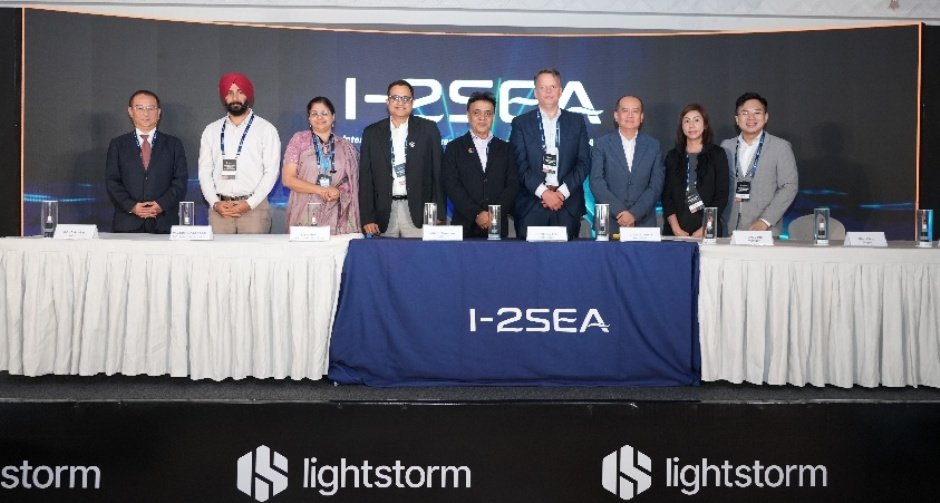
NEC has secured a supply contract for the India-Southeast Asia (I-2SEA) submarine cable system, joining a consortium comprising Lightstorm, Microsoft, Singtel, and Tata Communications to strengthen digital infrastructure connecting India, Malaysia, and Singapore. The new subsea cable is designed to support the rapidly increasing demand for AI, hyperscale cloud services, and enterprise connectivity across one of Asia’s fastest-growing digital corridors.

The I-2SEA submarine cable system will span approximately 3,600 km, directly linking India’s major AI and hyperscale data center hubs in Hyderabad and Chennai with Singapore, the region’s leading cloud interconnection and AI hub, and Kuala Lumpur, Malaysia’s rapidly expanding data center corridor. Commercial operations are targeted for Q4 2029, with the overall system expected to enter service in 2029.
The project features dual landing stations in India. One landing point at Machilipatnam will provide the shortest subsea route to Hyderabad, while the second will be located at a new diverse landing site in South Chennai. Through integration with Lightstorm’s 30,000+ km terrestrial fiber network, customers will gain seamless connectivity to Hyderabad, Mumbai, and more than 80 data centers across India.
The cable has been engineered specifically for AI-era networking requirements. By combining the 3,600-km subsea route with Lightstorm’s low-latency terrestrial backhaul, the consortium expects to deliver the fastest transmission on the Singapore/Malaysia-Hyderabad corridor, a strategically important route for AI model training and inference workloads. The network will support hyperscalers, GPU infrastructure providers, cloud companies, and enterprises deploying generative AI applications.
Lightstorm will integrate the new cable into its SmartNet AI Fabric, enabling low-jitter and loss-optimized transport across cloud regions, GPU clusters, data centers, and distributed AI infrastructure. Customers will also benefit from the company’s Polarin platform, offering on-demand provisioning, unified network management, real-time visibility, and flexible capacity scaling. The system incorporates interoperable cable architecture and carrier-neutral landing infrastructure at both Indian landing stations.
To improve reliability, the consortium has designed the cable with optimal routing and a three-meter-deep burial strategy across buried sections of the network, enhancing protection against external damage while maximizing network availability and resilience.
NEC brings more than 60 years of submarine cable expertise to the project. The company has deployed over 450,000 km of submarine cable worldwide — equivalent to approximately 11 times the Earth’s circumference — and has established a strong presence across the Asia-Pacific submarine cable market.
The I-2SEA consortium operates under a Joint Build Agreement involving Lightstorm, Microsoft, Singtel, and Tata Communications. NEC will serve as the system supplier, while ASEAN Cableship Pte Ltd (ACPL) has been appointed as the marine installation partner. The consortium has already opened the system for capacity commitments as it prepares for deployment.