

Morocco’s fixed broadband market is rapidly transforming in 2026 as the country accelerates its transition from legacy copper infrastructure to high-speed Fiber-to-the-Home (FTTH) connectivity. Backed by the ambitious Maroc Digital 2030 strategy and an 80 billion MAD national investment roadmap, Morocco is positioning itself as one of Africa’s leading gigabit-ready digital economies.

For internet customers searching for the best ISPs in Morocco, the market is increasingly defined by fiber broadband performance, symmetrical upload speeds, converged entertainment bundles, low-latency gaming, and smart-home connectivity. With fixed broadband subscriptions surpassing 2.75 million, Moroccan operators are now competing on network quality, fiber reach, and premium digital services rather than simply basic internet access.
Morocco’s Broadband Market Shifts Toward Fiber Dominance
Fiber connectivity is becoming the defining technology across Morocco’s broadband industry.
FTTH connections now represent approximately 48 percent of all fixed broadband lines, compared with only 30 percent two years ago. At the same time, legacy copper-based ADSL subscriptions are declining at an annual rate of 8.5 percent.
A major catalyst for this transformation was the November 2025 decree requiring all new residential and commercial buildings in Morocco to include fiber-optic pre-installation.
The government’s 80 billion MAD infrastructure roadmap, coordinated through the National Telecommunications Regulatory Agency (ANRT), is accelerating fiber deployment while targeting underserved “white zones” across the country.
These investments are also tied to Morocco’s preparations for major global events including the 2025 Africa Cup of Nations and the 2030 FIFA World Cup.
Morocco Internet Speeds Continue to Improve
Morocco’s broadband performance has improved significantly thanks to aggressive FTTH expansion.
The country’s national median fixed broadband download speed has now reached approximately 78.70 Mbps, while median upload speeds have climbed to 71.69 Mbps.
The near-symmetrical performance reflects the growing dominance of all-fiber infrastructure.
Network latency has also improved substantially:
National median latency stands at approximately 23 milliseconds
Latency can drop as low as 9 milliseconds in Casablanca and Rabat
Urban areas continue to outperform rural regions significantly, with city-based broadband speeds averaging around 40 percent higher than the national median.
Meanwhile, rural ADSL connections in some provinces still struggle to exceed actual speeds of 12 Mbps because of physical copper-line limitations.
Maroc Telecom Remains Morocco’s Largest ISP
Maroc Telecom, also known as IAM, remains the dominant broadband provider in Morocco.
The operator currently serves approximately 1.42 million fixed broadband subscribers, representing nearly 68 percent of the market.
Historically dominant because of its nationwide ADSL infrastructure, Maroc Telecom is now aggressively transitioning customers toward FTTH connectivity under a large-scale “ADSL-to-FTTH” migration strategy.
The company is also positioning itself as a regional digital infrastructure leader connecting Europe and Africa through upgraded submarine cable capacity and broader digital sovereignty initiatives.
For internet customers seeking broad nationwide availability and legacy network coverage, Maroc Telecom remains the strongest option in Morocco.
However, the operator continues to face criticism regarding bureaucratic migration delays from copper to fiber. Customers also report ongoing problems involving ADSL hardware return disputes, where modem return confirmations are not properly updated inside internal systems.
Users in smaller cities and regional areas additionally complain about slower customer support responsiveness and inconsistent technical assistance.
Orange Maroc Expands Premium Fiber Broadband
Orange Maroc has become Morocco’s primary FTTH challenger with approximately 520,000 fixed broadband subscribers and an estimated 18 percent market share.
The provider focuses heavily on premium urban residential areas and high-density developments while positioning itself as a digital lifestyle and cybersecurity partner through its “Trust the Future” roadmap.
Orange Maroc’s fiber strategy emphasizes:
High-speed FTTH connectivity
Smart-home integration
Cybersecurity services
Premium entertainment bundles
The company competes aggressively in the entry-level and mid-tier fiber broadband segments with pricing between 249 MAD and 299 MAD for 20 Mbps to 50 Mbps plans.
However, some users report speed throttling and inconsistent stability during peak evening hours between 8 PM and 11 PM. Entry-level fiber users have also reported upload speed restrictions below 1 Mbps, which negatively affects cloud-based work and content uploads.
Inwi Gains Market Share Through Aggressive Fiber Growth
Inwi remains Morocco’s fastest-growing broadband provider in terms of new customer acquisitions.
The operator currently serves approximately 410,000 broadband subscribers, representing roughly 14 percent market share.
Inwi’s strategy combines proprietary fiber deployment with wholesale infrastructure access while focusing heavily on:
Digital-native consumers
Small and medium-sized businesses
Industrial digitalization
Private 5G deployments
Smart-port infrastructure
The company is also highly competitive in broadband pricing, particularly for entry-level fiber plans between 249 MAD and 299 MAD.
Inwi’s aggressive bundling strategies have helped attract younger consumers looking for converged fixed and mobile connectivity packages.
However, some users report billing errors following service cancellations, along with refund delays and difficulties resolving complex technical issues through digital-only support channels.
Maroc Telecom and Inwi FiberCo Partnership Accelerates Fiber Rollout
One of the biggest infrastructure developments in Morocco’s broadband sector is the FiberCo partnership between Maroc Telecom and Inwi.
The venture launched with an initial investment of approximately $475 million and follows an “invest-once, use-many” deployment model.
This shared-infrastructure strategy significantly reduces fiber deployment costs while accelerating nationwide FTTH expansion.
The model is especially important for connecting newly developed residential zones and improving broadband access in underserved regions.
Morocco Broadband Pricing in 2026
Broadband pricing in Morocco is increasingly structured to encourage migration from legacy ADSL toward fiber.
Typical broadband pricing includes:
Entry-level 20 Mbps to 50 Mbps plans between 249 MAD and 299 MAD
Mid-tier 100 Mbps plans starting around 349 MAD with challengers
Maroc Telecom’s premium 100 Mbps plans priced around 500 MAD
Ultra-high-speed 200 Mbps to 1 Gbps plans ranging from 949 MAD to 999 MAD
Legacy 4 Mbps ADSL plans available from 99 MAD
The value proposition of low-speed ADSL is rapidly weakening as FTTH pricing becomes increasingly competitive.
5G Fixed Wireless Access Expands in Rural Areas
5G Fixed Wireless Access (FWA) is becoming an important alternative broadband technology in Morocco.
The sector is growing at a compound annual growth rate of approximately 13.1 percent as operators expand high-speed internet into mountainous and topographically difficult areas where fiber deployment remains challenging.
FWA is expected to play a major role in narrowing Morocco’s digital divide while complementing FTTH deployment nationwide.
Moroccan Consumers Demand Symmetrical Speeds and Quad-Play Bundles
Morocco’s broadband consumers are becoming increasingly sophisticated in their connectivity expectations.
Today’s internet users demand:
Symmetrical upload and download speeds
Stable remote-work connectivity
Ultra-low-latency gaming
Wi-Fi coverage for multi-device homes
4K streaming support
Smart-home integration
Unified billing for internet and mobile services
Approximately 40 percent of new FTTH customers now choose converged Quad-Play bundles that combine:
Fixed broadband
Mobile 5G connectivity
Streaming content
Entertainment services
This shift is forcing ISPs to evolve from simple connectivity providers into full digital ecosystem operators.
Morocco Broadband Market Outlook
Morocco’s broadband market is entering a long-term gigabit expansion cycle driven by:
FTTH deployment acceleration
Shared fiber infrastructure
5G Fixed Wireless Access
Industrial digitalization
AI-ready network infrastructure
International subsea connectivity
Smart-city modernization
The country’s strategic position between Europe and Africa is also strengthening its importance as a regional data transit and digital services hub.
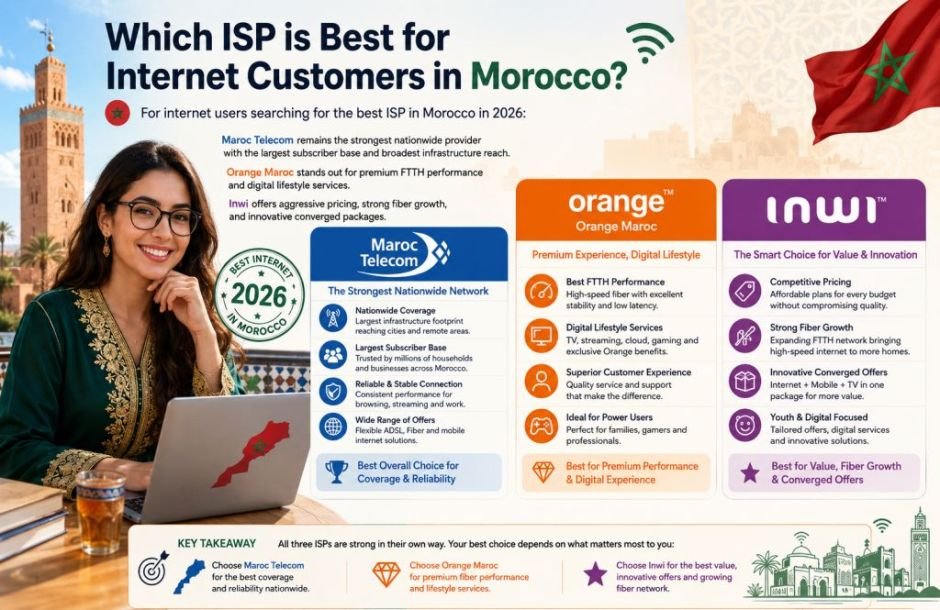
Which ISP is Best for Internet Customers in Morocco?
For internet users searching for the best ISP in Morocco in 2026:
Maroc Telecom remains the strongest nationwide provider with the largest subscriber base and broadest infrastructure reach.
Orange Maroc stands out for premium FTTH performance and digital lifestyle services.
Inwi offers aggressive pricing, strong fiber growth, and innovative converged packages. Morocco’s broadband market in 2026 is rapidly evolving into a fiber-first digital ecosystem where gigabit connectivity, symmetrical broadband, converged entertainment, and AI-ready infrastructure are becoming essential standards for households and businesses across the country.
FASNA SHABEER