

The sharp rise in DRAM and NAND prices is no longer just a challenge for PCs and smartphones. The broadband industry is emerging as one of the biggest casualties of the ongoing memory supply crunch, with routers, gateways, and set-top boxes facing steep cost increases that could slow global fiber and fixed wireless access (FWA) deployments in 2026.

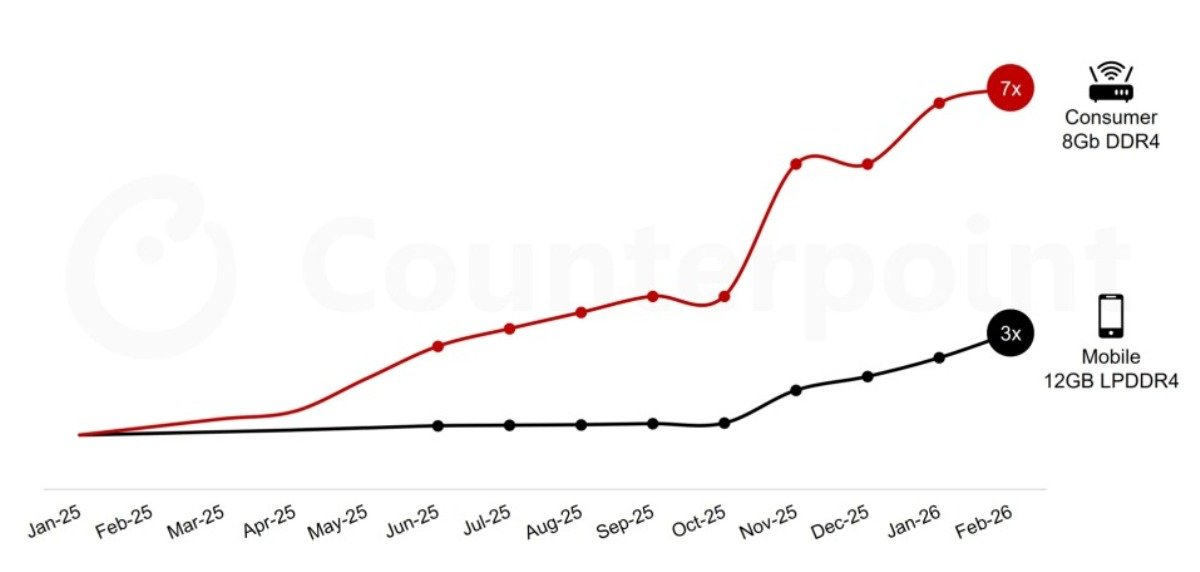
Memory prices surge more than 600 percent year over year
Driven by booming demand from higher-margin AI servers, memory prices for consumer electronics have surged more than 600 percent over the past year, according to Counterpoint Research’s February 2026 Memory Price Tracker.|
The supply squeeze has hit conventional DRAM and NAND used in consumer products, and the trend is expected to continue at least until June 2026. While prices could peak in the first half of the year, supply shortages are likely to persist beyond that period.
Consumer electronics segments are feeling the strongest impact, with broadband hardware among the most affected categories.
Broadband equipment hit harder than smartphones
Although smartphone memory prices have jumped roughly three times over the past nine months, memory prices for broadband devices have increased nearly seven times during the same period.
Routers are experiencing the most severe impact, particularly for OEMs without long-term supply agreements or strong negotiating power. Memory now accounts for more than 20 percent of the bill of materials in low- to mid-range routers, compared with only about 3 percent a year ago.
This dramatic shift is forcing equipment makers to rethink pricing, hardware configurations, and product roadmaps.
Rising router and CPE costs threaten telco broadband expansion
The memory price surge is raising alarms for telecom operators planning aggressive broadband expansion in 2026.
Telcos globally are investing heavily in fiber and FWA rollouts, both of which rely on large volumes of customer premises equipment such as routers, gateways, and set-top boxes. Higher component costs are expected to:
Increase procurement expenses for operators
Slow deployment timelines
Force renegotiation of vendor contracts
Reduce margins on broadband services
For operators working with tight capital expenditure budgets, the sudden rise in hardware costs could delay large-scale deployments.
AI-powered CPE ambitions face new headwinds
Many operators had planned to introduce AI-powered CPE devices capable of advanced network optimization, security, and smart home integration. These devices require more compute power and significantly higher memory capacity.
The current memory crunch threatens these plans by increasing the cost of advanced broadband hardware and limiting supply availability.
As a result, telcos may need to delay or scale back next-generation CPE rollouts until supply conditions stabilize.
Supply chain strategy becomes critical for telcos
With memory becoming a major cost driver, telecom operators must closely monitor supply chain dynamics. Key priorities include:
Identifying equipment vendors with secured memory supply
Tracking bill of materials changes across CPE portfolios
Adjusting procurement strategies and rollout timelines
Evaluating pricing models to protect margins
The ability to secure stable hardware supply could become a competitive differentiator in broadband markets.
Outlook: “Memory winter” may slow broadband momentum
The ongoing memory shortage is emerging as a significant risk for broadband expansion worldwide. As DRAM and NAND prices remain elevated, router and set-top box costs will continue rising, potentially slowing fiber and FWA rollouts.
For the broadband industry, the memory crunch represents a new supply chain challenge that could shape deployment strategies throughout 2026.
BABURAJAN KIZHAKEDATH