

Telecom operators worldwide are intensifying competition in the fixed wireless access (FWA) broadband market as Reliance Jio, Bharti Airtel, T-Mobile, Verizon and AT&T monetize their 5G network investments, challenge traditional broadband providers and expand connectivity across residential and enterprise markets.

India’s 5G FWA subscriber base reached 13.61 million in September 2026, while Verizon recorded an 18.1 percent annual increase in fixed wireless broadband connections to 6.37 million. Australia’s FWA market is forecast to expand at 3.6 percent annually through 2031, supported by investments from NBN Co, Telstra, Optus and TPG Telecom.
However, slowing subscriber additions, network congestion, broadband speed inconsistencies and growing competition are prompting telecom operators to focus on service quality alongside customer acquisition.
The Ericsson Mobility Report forecasts that global FWA connections will increase from 185 million in 2025 to 350 million in 2031, representing growth of approximately 89 percent.
5G technology is expected to account for approximately 85 percent of global FWA connections by 2031, equivalent to nearly 298 million connections.
Ericsson identified 175 telecom service providers offering 5G FWA services, representing 71 percent of operators with fixed wireless broadband offerings.
Global FWA data traffic is forecast to reach 187 exabytes per month by 2031, accounting for 36 percent of worldwide mobile network data traffic.
Reliance Jio and Airtel expand India’s fixed wireless broadband market
India added 151,740 new 5G FWA subscribers in September 2026, registering monthly growth of 1.13 percent, according to TRAI’s September 2026 telecom subscription report.
Reliance Jio added 98,386 5G FWA subscribers, taking its customer base to 9.52 million and securing approximately 70 percent market share.
Bharti Airtel added 53,354 subscribers, increasing its 5G FWA customer base to 4.09 million, with monthly growth of 1.32 percent compared with Reliance Jio’s 1.04 percent.
Reliance Jio also added 215,469 Unlicensed Band Radio (UBR) broadband subscribers, taking its UBR customer base to 5.58 million, representing monthly growth of 4.01 percent.
India’s fixed wireless broadband market, including other wireless access technologies, reached 19.70 million connections in September 2026, an increase of 1.84 percent from August.
Rural customers accounted for 51.89 percent of India’s 5G FWA subscriber base, highlighting the importance of wireless broadband in addressing connectivity gaps outside metropolitan markets.
Verizon faces slowdown in FWA customer acquisition
Verizon’s Q3 2026 financial and operating results reveal both the growth potential and emerging challenges in the US fixed wireless broadband market.
Verizon’s FWA subscriber base increased 18.1 percent year-on-year to 6.37 million in September 2026, while its fiber broadband customer base reached 11.07 million.
However, Verizon’s quarterly FWA net additions declined from 214,000 in Q1 2026 to 193,000 in Q2 and 159,000 in Q3.
The Q3 figure represented a 39.1 percent decline from 261,000 additions in the corresponding quarter of 2025.
Verizon added 566,000 fixed wireless broadband customers during the first nine months of 2026.
Verizon is increasingly aligning FWA availability with customers’ speed requirements, restricting sales in locations where available network capacity cannot deliver the expected performance.
The US telecom operator is targeting 8–9 million FWA subscribers by 2028, while exploring higher-speed wireless broadband services and enterprise connectivity opportunities.
T-Mobile and AT&T strengthen wireless broadband competition
T-Mobile is targeting 15 million fixed wireless broadband connections by 2030, compared with 8.5 million at the end of 2025.
In its Q3 2026 earnings announcement, T-Mobile highlighted Ookla’s recognition of the operator as the fastest US 5G FWA provider for both download and upload speeds.
AT&T is expanding its Internet Air broadband business as part of a strategy combining fiber and fixed wireless connectivity.
AT&T added 292,000 fixed wireless connections during Q1 2026. T-Mobile, Verizon and AT&T collectively exceeded 17 million FWA connections during the first quarter of 2026.
The expansion of these services is increasing competitive pressure on traditional cable broadband operators, particularly among price-sensitive households seeking alternatives to conventional wired connections.
NBN, Telstra, Optus and TPG drive Australia’s FWA investment
Australia’s fixed wireless broadband connections are forecast to increase at a compound annual growth rate of 3.6 percent between 2026 and 2031, according to GlobalData’s Australia Fixed Communication Forecast Q3 2026.
FWA’s share of Australia’s fixed broadband market is projected to increase from 10.4 percent in 2026 to 11.5 percent in 2031.
The upgraded NBN Fixed Wireless network covers approximately 800,000 premises, supporting broadband connectivity across regional and remote communities.
Telstra introduced two new fixed wireless broadband plans in June 2026, offering average busy-period download speeds of 183 Mbps and 298 Mbps.
The Optus 5G Home Internet portfolio offers unlimited data, with selected plans delivering typical busy-period download speeds of 93 Mbps and upload speeds of 15 Mbps.
Vodafone, TPG Telecom and iiNet are also competing for residential broadband customers through 4G and 5G wireless connectivity.
A new NBN fixed wireless tower in Narrabri East has extended connectivity to more than 700 homes and businesses, with five additional towers under construction across the local government area.
European operators target premium FWA revenue
Greece’s COSMOTE TELEKOM nearly tripled its fixed wireless broadband subscriber base to more than 100,000 connections by Q1 2026 following the introduction of differentiated 5G connectivity.
Telia has introduced differentiated FWA services in Estonia and Lithuania, targeting customers requiring improved broadband performance.
European telecom operators have opportunities to monetize 5G standalone infrastructure through premium broadband packages, enterprise connectivity and differentiated service levels.
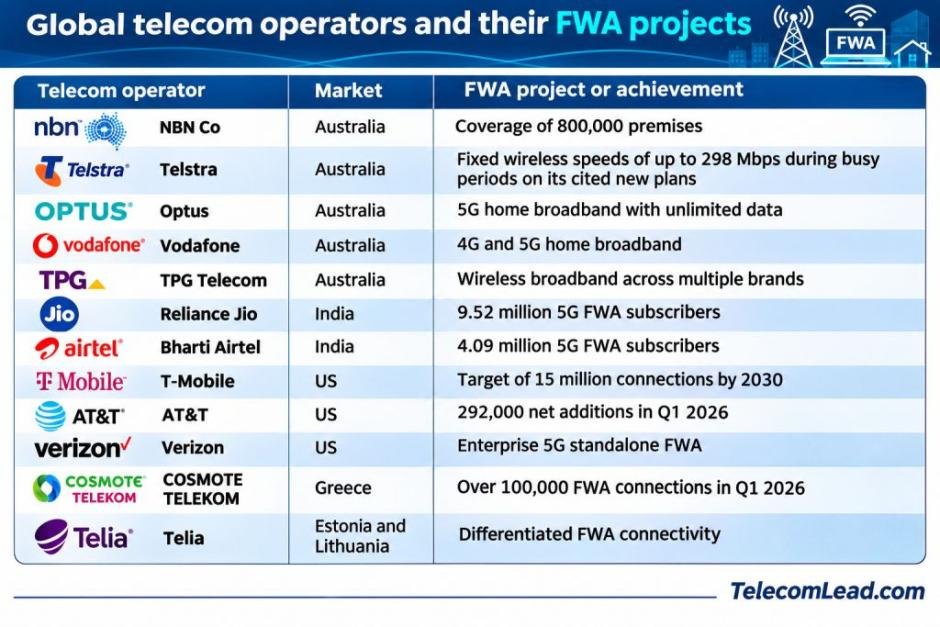
Global telecom operators: FWA performance comparison
| Telecom operator | Market | FWA achievement or target |
| Reliance Jio | India | 9.52 million 5G FWA subscribers |
| Bharti Airtel | India | 4.09 million 5G FWA subscribers |
| Verizon | US | 6.37 million FWA connections |
| T-Mobile | US | 15 million connections targeted by 2030 |
| AT&T | US | 292,000 net additions in Q1 2026 |
| NBN Co | Australia | 800,000 premises covered |
| Telstra | Australia | 298 Mbps average busy-period speed on its faster new plan |
| Optus | Australia | Unlimited 5G home broadband |
| Vodafone | Australia | 4G and 5G home broadband |
| TPG Telecom | Australia | Multibrand wireless broadband |
| COSMOTE TELEKOM | Greece | Over 100,000 FWA connections |
| Telia | Estonia and Lithuania | Differentiated FWA connectivity |
FWA customer experience emerges as a major business challenge
Network congestion, insufficient upload speeds, higher latency, service interruptions and inconsistent broadband performance remain significant challenges for fixed wireless broadband providers.
The Australian Competition and Consumer Commission’s broadband performance data for June 2026 highlights the gap between broadband plan speeds and actual customer experience.
| NBN Fixed Wireless performance indicator | ACCC findings |
| Download performance across all hours | 89.7% of plan speed |
| Download performance during busy hours | 83.8% |
| Upload performance across all hours | 70.1% |
| Upload performance during busy hours | 63.7% |
| Average latency | 41.7 ms |
| Busy-hour latency | 43.5 ms |
| Tests without packet loss | 79.7% |
Fixed wireless outages increased approximately 33 percent to 295 from 222 in the previous quarter, while speed performance rebates declined to 176 from 207 a year earlier.
These performance challenges underline the need for telecom operators to invest in spectrum capacity, massive MIMO, network optimization and advanced customer premises equipment.
FWA business outlook for 2027
The next phase of global FWA competition will increasingly depend on broadband revenue, network reliability, subscriber retention and service differentiation rather than subscriber growth alone.
Telecom operators offering converged mobile and home broadband packages, premium connectivity and enterprise services have opportunities to improve revenue per customer and reduce churn.
Verizon’s slowing FWA additions and India’s continued subscriber expansion illustrate the different stages of market development.
Telecom operators that balance customer acquisition with network capacity and consistent broadband performance will be better positioned to generate sustainable returns on their 5G investments in 2027 and beyond.
FASNA SHABEER