

Japan Fixed Broadband H1 2026: So-net emerged as Japan’s strongest fixed broadband provider for overall network performance, delivering a 357.71 Mbps download speed, 240.55 Mbps upload speed and 11 ms latency, according to Ookla’s H1 2026 assessment.

The results highlight the strength of Japan’s high-speed broadband infrastructure as operators compete on download and upload speeds, latency, gaming performance, network consistency and customer experience.
So-net achieved a Speedtest Connectivity Score of 80.98, ahead of BIGLOBE at 79.80 and au at 76.87, giving it the strongest overall performance among the providers evaluated.
So-net Tops Japan Fixed Broadband Speed at 357.71 Mbps
Speed was one of So-net’s biggest advantages during H1 2026.
So-net delivered a median fixed broadband download speed of 357.71 Mbps, compared with 311.60 Mbps for BIGLOBE, according to Ookla.
That gives So-net a 46.11 Mbps advantage, or nearly 15 percent, over BIGLOBE’s median download performance.
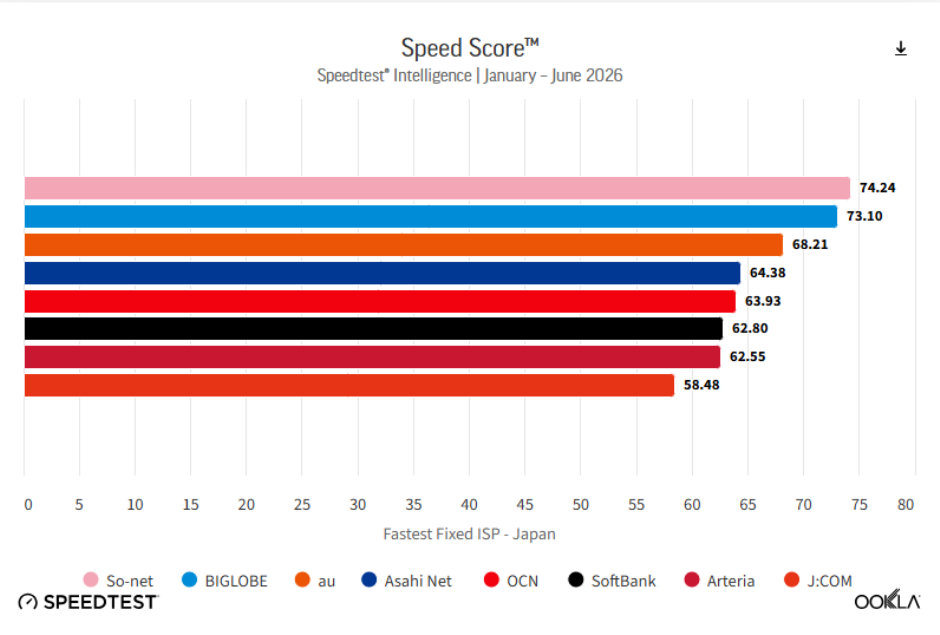
So-net also achieved the highest Speed Score of 74.24, reinforcing its leadership in broadband speed.
Upload performance was another strength. So-net recorded a 240.55 Mbps median upload speed, an important metric as households increasingly use broadband connections for cloud applications, video conferencing, online gaming, content creation and large-file transfers.
So-net Records Lowest Latency at 11 ms
Broadband performance increasingly depends on more than headline download speeds.
So-net recorded 11 ms median latency, the lowest among the evaluated providers. Low latency can significantly improve real-time applications including online gaming, video calls and interactive cloud services.
The combination of 357.71 Mbps download, 240.55 Mbps upload and 11 ms latency explains why So-net performed strongly across Ookla’s broader connectivity measurements.
Its 80.98 Connectivity Score was 1.18 points higher than BIGLOBE’s 79.80 and 4.11 points above au’s 76.87.
So-net Leads Japan Fixed Broadband Gaming
So-net also emerged as the leading broadband provider for gaming performance, recording a Game Score of 94.64.

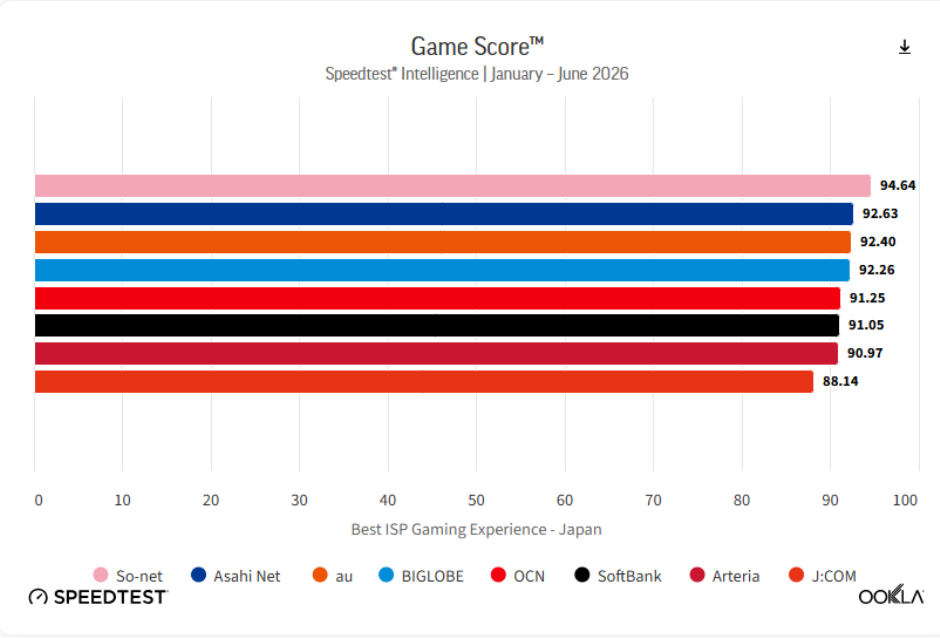
Asahi Net followed with 92.63, while au achieved 92.40.
The difference between the three providers was relatively narrow, indicating strong gaming connectivity among Japan’s leading fixed broadband networks. However, So-net’s combination of high bandwidth and low latency helped it secure the highest score.
For operators, gaming performance is becoming an increasingly important network-quality indicator as cloud gaming and other latency-sensitive applications place greater demands on fixed broadband infrastructure.
BIGLOBE Records 94.8% Network Consistency
So-net did not lead every broadband performance category.
BIGLOBE recorded the highest measured Consistency Score of 94.8 percent, narrowly ahead of So-net at 94.4 percent.
The difference was only 0.4 percentage points, and Ookla did not identify a statistically significant winner in the Consistency category.
The result nevertheless demonstrates that Japan’s leading broadband providers are delivering consistently strong connectivity to users rather than relying solely on high peak speeds.
Network consistency is particularly important for households using multiple connected devices and bandwidth-intensive applications simultaneously.
Arteria Posts Highest Measured Video Streaming Score
Competition was also close for video streaming.
Arteria recorded the highest measured Video Streaming Score at 79.95, while J recorded 75.90.
However, Ookla did not identify a statistically significant winner in this category. Arteria’s result should therefore be regarded as the highest measured score rather than a definitive category victory.
Video performance remains an important broadband benchmark because streaming services account for a substantial portion of household internet traffic and require both sufficient bandwidth and stable network performance.
Arteria Leads Measured Customer Ratings
Network speed did not translate directly into the highest customer rating.
Arteria achieved the highest measured customer satisfaction result with 3.72 out of 5 stars, followed closely by So-net at 3.67.
Again, Ookla found no statistically significant winner for customer ratings.
The results illustrate an important distinction in Japan’s broadband market: technical network leadership and customer satisfaction are not necessarily identical.
Price, customer service, installation experience, service reliability and broadband packages can influence consumer perceptions alongside network speed.
Japan Telecom Companies Step Up Network Investment
Japan’s broadband performance is supported by continued investment across fiber, mobile, data center and next-generation network infrastructure.
NTT’s 2026 Medium-Term Strategy calls for approximately ¥12 trillion of investment between FY2026 and FY2030. Around ¥4 trillion to ¥4.5 trillion is earmarked for the Connectivity Domain.
The investment is broader than fixed broadband alone, but NTT’s connectivity spending is significant for Japan’s communications infrastructure as the group develops advanced networks and services.
KDDI reported approximately ¥679 billion in FY2026 capital expenditure. Its investment priorities are increasingly extending into data centers and AI infrastructure as large-scale mobile network investment starts to peak.
KDDI is also targeting a CAPEX-to-sales ratio of 12 percent or lower during FY2026-FY2028, indicating greater emphasis on investment efficiency.
SoftBank Corp., meanwhile, plans approximately ¥1.5 trillion in telecom-related capital expenditure during FY2026-FY2028, equivalent to roughly ¥500 billion per year on average over the three-year period.
Its investment priorities include strengthening telecom network quality and resilience, although the spending covers the broader telecom network rather than fixed broadband alone.
Japan Fixed Broadband H1 2026: Key Numbers
Japan’s H1 2026 broadband results show strong competition across different dimensions of network performance:
So-net Connectivity Score: 80.98
So-net Speed Score: 74.24
So-net median download: 357.71 Mbps
So-net median upload: 240.55 Mbps
So-net median latency: 11 ms
So-net Game Score: 94.64
BIGLOBE Consistency: 94.8%
Arteria Video Streaming Score: 79.95
Arteria customer rating: 3.72/5
NTT FY2026-FY2030 investment: approximately ¥12 trillion
KDDI FY2026 CAPEX: ¥679 billion
SoftBank FY2026-FY2028 telecom CAPEX: ¥1.5 trillion
So-net Establishes Broad Performance Lead
Ookla’s H1 2026 data establishes So-net as the standout provider for core fixed broadband network performance in Japan.
Its 357.71 Mbps median download speed, 240.55 Mbps upload speed, 11 ms latency, 80.98 Connectivity Score and 94.64 Game Score give it leadership across several of the metrics that directly affect broadband user experience.
BIGLOBE’s 94.8 percent Consistency Score and Arteria’s 79.95 Video Streaming Score and 3.72 customer rating demonstrate that competitors remain strong in individual categories.
More broadly, the results show how Japan’s fixed broadband competition is moving beyond headline download speed. Upload capacity, latency, consistency, gaming and streaming performance are becoming increasingly important differentiators as homes depend more heavily on cloud applications, video, gaming and other high-bandwidth digital services.
FASNA SHABEER