

India’s fixed broadband market is entering a new growth phase as telecom operators expand fiber-to-the-home (FTTH) networks while simultaneously using 5G Fixed Wireless Access (FWA) to connect homes and businesses without waiting for fiber deployment.

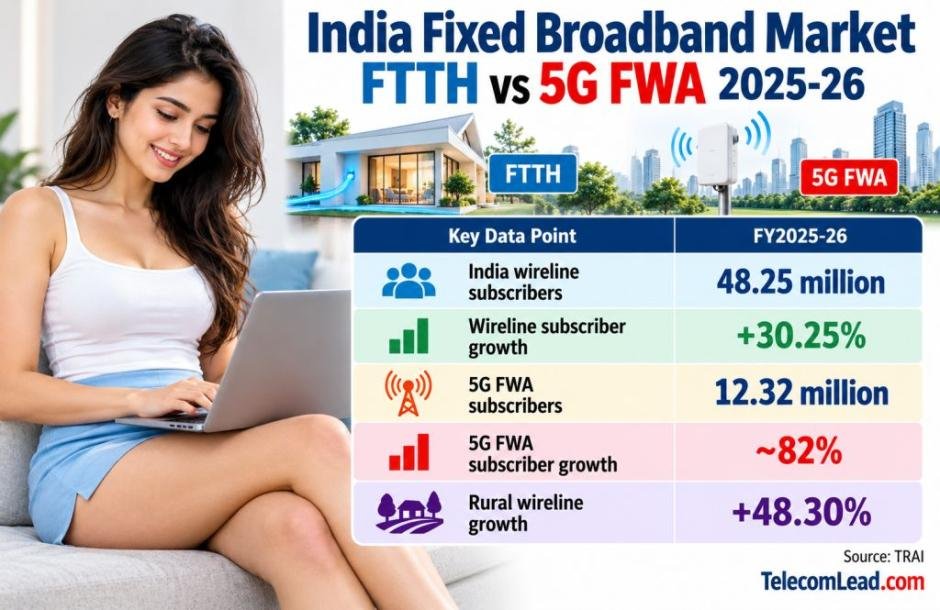
The latest TRAI annual performance report shows that India’s wireline subscriber base jumped 30.25 percent to 48.25 million at the end of March 2026, from 37.04 million a year earlier. The market added 11.21 million wireline connections during FY2025-26.
That growth substantially exceeded the 10.19 percent increase recorded by India’s overall wireless market, although TRAI notes that Bharti Airtel began including its M2M cellular base in wireless subscriber reporting during FY2025-26.
At the same time, another fixed-broadband technology is expanding even faster: 5G FWA subscribers surged from 6.77 million to 12.32 million, an increase of about 82 percent in just one year.
The numbers point to an emerging battle for India’s home broadband customer: fiber versus 5G FWA.
India Adds 11.21 Million Wireline Connections
Wireline has historically represented a relatively small part of India’s telecom market, which is overwhelmingly mobile. Even after the latest expansion, India’s 48.25 million wireline connections represented only about 3.6 percent of the country’s 1.33 billion telephone subscriptions.
But its growth trajectory is changing.
Wireline subscribers have increased from 28.41 million in March 2023 to 33.79 million in March 2024, 37.04 million in March 2025 and 48.25 million in March 2026.
This means India added almost 20 million wireline connections in three years, representing growth of around 70 percent.
Wireline teledensity consequently increased from 2.62 percent to 3.38 percent during FY2025-26.
The biggest absolute opportunity remains obvious: even after this expansion, fixed connections reach only a fraction of India’s households and businesses.
Rural Wireline Growth Outpaces Urban India
One of the more interesting findings in the TRAI report is where the growth occurred.
Urban wireline subscriptions increased 28.37 percent, from 33.54 million to 43.06 million.
But rural wireline subscriptions grew considerably faster — 48.30 percent, from 3.50 million to 5.19 million.
Rural India still represented only 10.76 percent of total wireline connections, so the growth comes from a low base. Nevertheless, it indicates that the fixed-broadband opportunity is no longer confined to India’s largest cities.
That trend becomes particularly important when combined with 5G FWA.
Of India’s 12.32 million 5G FWA connections in March 2026, 6.17 million were urban and 6.15 million rural. Rural India therefore accounted for 49.63 percent of 5G FWA subscriptions.
This near-even urban-rural split suggests FWA could become particularly important where extending fiber to individual premises is slower or commercially difficult.
Fiber vs 5G FWA Becomes the New Broadband Contest
India effectively has two rapidly expanding routes for delivering fixed broadband.
The first is traditional wired connectivity, increasingly based on FTTH. The second is FWA, where an operator uses its wireless network to connect a fixed customer location through customer-premises equipment.
TRAI reported 46.54 million wired Internet subscribers at the end of March 2026. Meanwhile, the country’s wireless fixed-access base comprised 12.32 million 5G FWA connections and 4.29 million UBR FWA connections, taking total wireless FWA subscriptions to 16.61 million.
The two figures should not simply be added and described as identical broadband categories because TRAI classifies the technologies differently. But together they show how India’s fixed-connectivity market is diversifying beyond conventional wired access.
The appeal of 5G FWA is deployment speed. An operator with adequate 5G coverage and network capacity can potentially connect a home without extending fiber all the way to that building.
Fiber has different advantages: dedicated physical infrastructure, high capacity, consistent performance and a long upgrade path.
The competitive question is therefore unlikely to be whether fiber or FWA completely replaces the other. Operators increasingly have an incentive to use both technologies depending on deployment economics and location.
Jio Leads India’s Wireline Market
Reliance Jio remained India’s largest wireline operator at the end of March 2026, increasing its subscriber base from 12.86 million to 15.24 million.
Jio added 2.38 million connections, representing growth of 18.49 percent. Its wireline market share nevertheless declined from 34.72 percent to 31.58 percent because the overall market expanded faster.
Jio is particularly interesting because it can pursue both sides of the fixed-broadband market through fiber and JioAirFiber.
FWA business of Reliance Jio has expanded as the company uses its nationwide 5G network to target premises that are difficult or expensive to reach immediately with fiber. JioAirFiber had already reached approximately 7.4 million subscribers by June 2025, while Jio had crossed 20 million connected premises across its home broadband operations.
This hybrid strategy allows Jio to acquire a broadband customer through wireless access while retaining fiber as part of its longer-term network architecture.
For more on the wireless side of this transition, see TelecomLead’s analysis of the 5G FWA equipment market and its 2026 growth outlook.
Airtel Expands Its Fixed Broadband Position
Bharti Airtel also strengthened its wireline business during FY2025-26.
Its wireline subscriber base increased from 10.14 million to 11.42 million, adding 1.28 million connections and producing annual growth of 12.61 percent. Airtel held 23.67 percent of the wireline market at the end of March.
More recent TRAI figures show continued growth in India’s fixed-wired market. By May 2026, wired broadband subscriptions had reached 47.40 million, with Jio at 14.47 million, Airtel at 10.98 million and BSNL at 4.50 million in TRAI’s fixed-wired broadband classification.
Airtel, like Jio, can combine fiber with 5G-based home broadband. This gives India’s two largest private telecom operators an important strategic option: use fiber where network density and economics support it, while deploying FWA to accelerate customer acquisition elsewhere.
TelecomLead’s coverage of India’s broadband subscriber growth shows that both wired broadband and FWA continued expanding after the end of FY2025-26.
BSNL Faces Pressure Despite Its Fiber Footprint
BSNL presents a different picture.
Its wireline subscriber base declined from 7.68 million in March 2025 to 7.46 million in March 2026, a fall of 2.90 percent. As a result, BSNL’s wireline market share dropped sharply from 20.74 percent to 15.46 percent. BSNL(1)
The decline is notable because BSNL has a substantial fixed-network presence across India, including smaller cities and rural areas.
The challenge for BSNL is therefore not simply network reach. It is converting that infrastructure footprint into broadband subscriber growth while competing against private operators that can bundle mobile, fiber, 5G FWA, entertainment and other digital services.
The contrast is particularly striking because India’s overall wireline market expanded by 30.25 percent while BSNL contracted.
That makes fixed broadband another important area to watch alongside BSNL’s mobile subscriber and revenue performance.
Karnataka Emerges as India’s Fastest-Growing Major Wireline Market
TRAI’s geographic numbers reveal another underappreciated trend.
Every telecom service area recorded wireline subscriber growth during FY2025-26, but growth varied significantly.
Karnataka led with 66.91 percent growth, rising from 3.68 million to 6.14 million connections. Mumbai increased 50.78 percent to 5.32 million, Maharashtra rose 48.14 percent to 2.72 million, Odisha grew 41.58 percent to 0.77 million, and Gujarat expanded 40.78 percent to 2.66 million.
Kerala, despite its relatively developed broadband market, recorded more modest growth of 7.57 percent, reaching 1.88 million wireline subscribers.
These variations suggest the next phase of fixed broadband growth may not follow the same geographic pattern everywhere. Fiber availability, housing density, enterprise demand, local broadband providers and 5G capacity can all affect which technology makes the strongest commercial case.
5G FWA Is Growing Much Faster Than Wireline
The most significant comparison is the relative pace of expansion.
India’s wireline market grew 30.25 percent during FY2025-26.
5G FWA grew approximately 82 percent, increasing from 6.77 million to 12.32 million subscribers.
The absolute base remains much smaller, but the trajectory suggests that FWA is evolving from a niche 5G application into an important broadband access technology.
India is also unusual in the composition of its FWA equipment market. Around 99 percent of FWA CPE shipments in India are expected to be 5G-capable, highlighting the country’s rapid move toward next-generation fixed wireless broadband. Globally, 5G FWA CPE shipments are forecast to reach 16 million units in 2026.
The rise of Fixed Wireless Access as a broadband alternative is also occurring globally as operators look for additional ways to monetize 5G network capacity.
Fixed Broadband Could Become Telecom’s Next Growth Engine
India remains fundamentally a mobile-first telecom market. But FY2025-26 provides evidence that fixed connectivity is becoming a more important growth layer.
Three numbers capture the shift: 48.25 million wireline subscribers, 30.25 percent annual wireline growth and 12.32 million 5G FWA subscribers after roughly 82 percent FWA growth.
The opportunity is not necessarily a winner-takes-all contest between FTTH and 5G FWA.
Fiber is likely to remain critical for high-capacity and long-term connectivity, while FWA gives operators a faster route to customers where last-mile fiber deployment is difficult, expensive or time-consuming. For Jio and Airtel in particular, having both technologies provides flexibility to choose the most economical access method for each market.
The next broadband competition in India may therefore be less about fiber versus 5G FWA and more about which operator can combine fiber and wireless most effectively to connect millions of still-unserved homes and businesses.
BABURAJAN KIZHAKEDATH