

AT&T is accelerating its fixed wireless access (FWA) strategy in Houston, Texas — a key market where it already operates a robust fiber network. The company’s growing FWA presence is expected to intensify competition with other internet providers like Comcast’s Xfinity and Ezee Fiber.

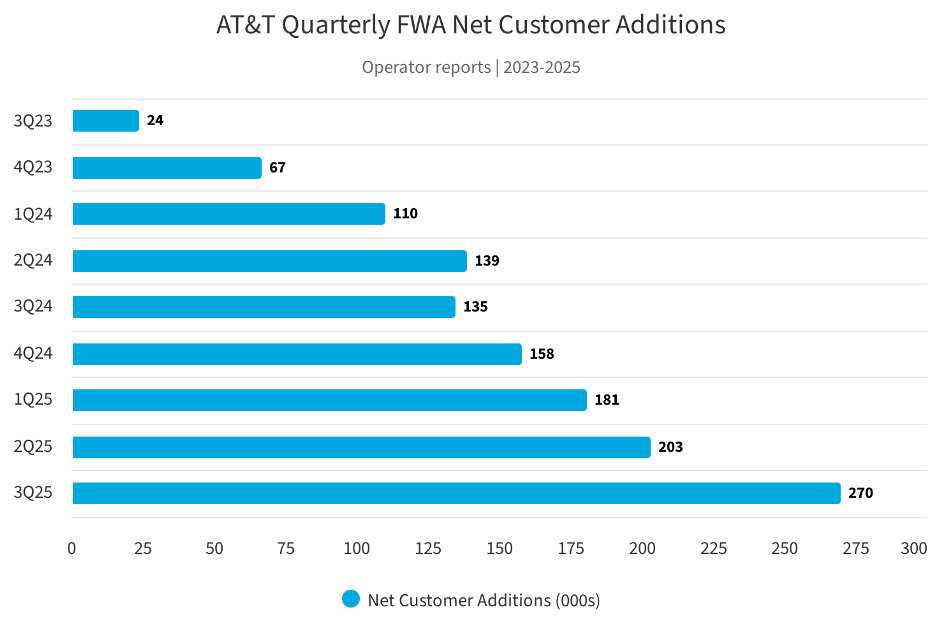
By the second quarter of 2025, AT&T surpassed 1 million FWA customers, while T-Mobile led the market with 7.3 million and Verizon followed with 5.1 million. Data from Ookla report shows FWA speeds have been steadily improving across all three operators. Collectively, these telecom giants added 3.7 million FWA customers in 2024, while major U.S. cable companies lost about 1 million broadband subscribers — highlighting a major market shift.
AT&T’s FWA deployment serves three purposes: to reach areas beyond its fiber network, to replace its decommissioned copper network, and to act as an interim solution within its future fiber footprint. The company aims to double its fiber coverage from 30 million to 60 million U.S. locations by 2030.
This strategy supports AT&T’s goal of driving customer convergence. In Q3 2025, over 41 percent of AT&T’s fiber subscribers also used its mobile service, while more than half of its Internet Air (FWA) users were also AT&T mobile customers — a sign of stronger retention and higher lifetime value.
According to Crown Castle CFO Sunit Patel, Houston is an ideal market for fixed wireless access (FWA), particularly in suburban and rural border areas where such technology performs best. Houston’s rapid population growth — adding over 1.5 million residents from 2010 to 2023, second only to Dallas-Fort Worth — makes it an attractive expansion zone for internet service providers.
Despite its potential, AT&T’s FWA performance in Houston trails fiber and cable offerings. In September 2025, AT&T Internet Air recorded download speeds of 106.4 Mbps and uploads of 7.42 Mbps. In comparison, Comcast delivered 292.81 Mbps downloads and 41.49 Mbps uploads, while AT&T Fiber achieved 366.56 Mbps and 306.90 Mbps respectively. Ezee Fiber led the market with 545.39 Mbps download and 464.46 Mbps upload speeds.
Speedtest Insights shows that AT&T’s FWA coverage is distributed across the Houston metro area, primarily targeting zones where its fiber network has not yet expanded — such as Conroe and League City. This approach helps the company leverage unused 5G capacity without overloading its mobile network.

Unlike fiber, which has abundant capacity and high infrastructure costs (averaging $18.25 per foot), FWA is strategically deployed where building fiber is not yet feasible. The result is a complementary strategy: using FWA to bridge coverage gaps in high-growth suburban areas until fiber becomes available.
AT&T is strengthening its 5G and fixed wireless access (FWA) capabilities through a $23 billion spectrum acquisition deal with EchoStar, announced in August 2025. The deal includes an average of 30 MHz of nationwide 3.45 GHz midband spectrum and 20 MHz of 600 MHz lowband spectrum, pending regulatory approval.
Midband frequencies such as 3.45 GHz and C-band are essential for 5G-powered FWA services, offering both wide coverage and high capacity. AT&T has steadily expanded its midband holdings—spending $23.4 billion in the 2021 C-band auction and $9 billion in a 2022 FCC auction for 3.45 GHz licenses.
The EchoStar acquisition will allow AT&T to quickly integrate the new 3.45 GHz spectrum via a software upgrade, avoiding the need for costly tower hardware changes. Through a leasing agreement, AT&T can activate EchoStar’s midband spectrum on sites covering nearly two-thirds of the U.S. population by mid-November 2025. Analysts at New Street Research estimate the added capacity could support up to 900,000 additional FWA customers nationwide.
In the Houston market, AT&T will gain 30 MHz of EchoStar’s 3.45 GHz licenses, boosting its total midband spectrum to 150 MHz (80 MHz of C-band and 70 MHz of 3.45 GHz). Recent Ookla RootMetrics data shows AT&T already relies heavily on its midband holdings to deliver 5G coverage in Houston.
Spectrum utilization data from 2H 2025 indicates AT&T used 120 MHz of midband spectrum in 37.3 percent of tests and 80 MHz in another 46 percent, suggesting room for further performance gains once EchoStar’s additional spectrum is deployed — enhancing both mobile and FWA network speeds and capacity.
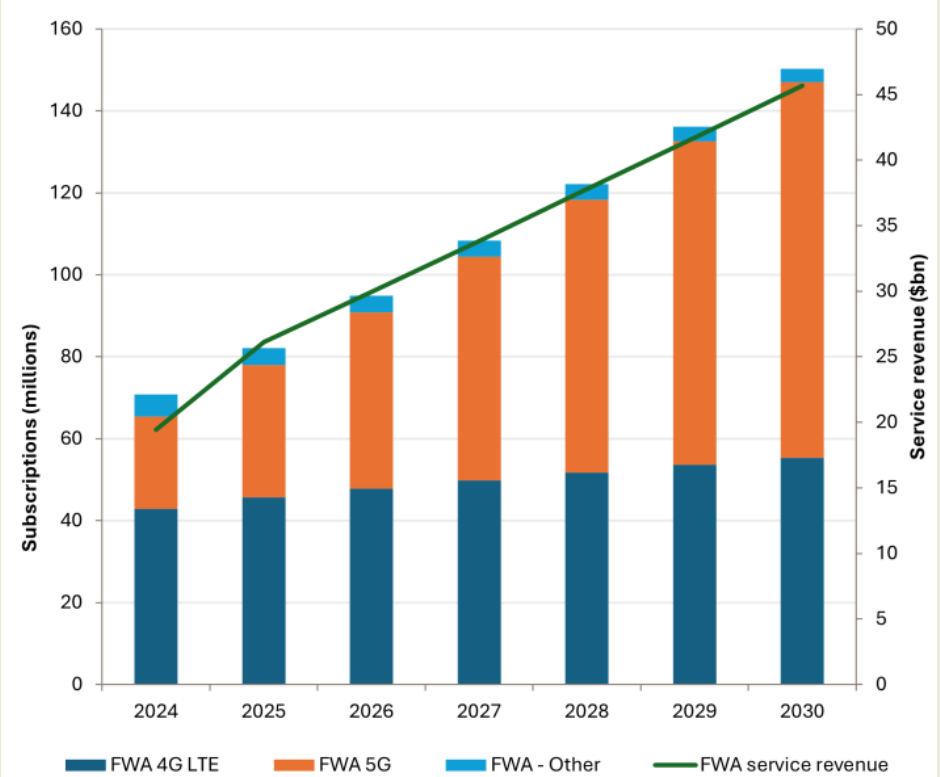
Recently, Omdia report said global 5G FWA subscriptions will grow from 71 million in 2024 to 150 million by 2030, representing 88 percent of total FWA connections. The 5G FWA market is projected to expand at a 23 percent CAGR, generating $46 billion in service revenues, driven by premium offerings and AI-enabled personalization. United States will reach 20 million subscriptions as operators diversify FWA offerings.
Baburajan Kizhakedath