

Telecom operators in the Gulf region are accelerating investments in advanced Wi-Fi technologies, mesh networking, and Fiber-to-the-Room (FTTR) solutions after Ookla’s latest Speedtest analysis revealed that poor Customer Premises Equipment (CPE) placement inside homes can reduce broadband performance by up to 50 percent.

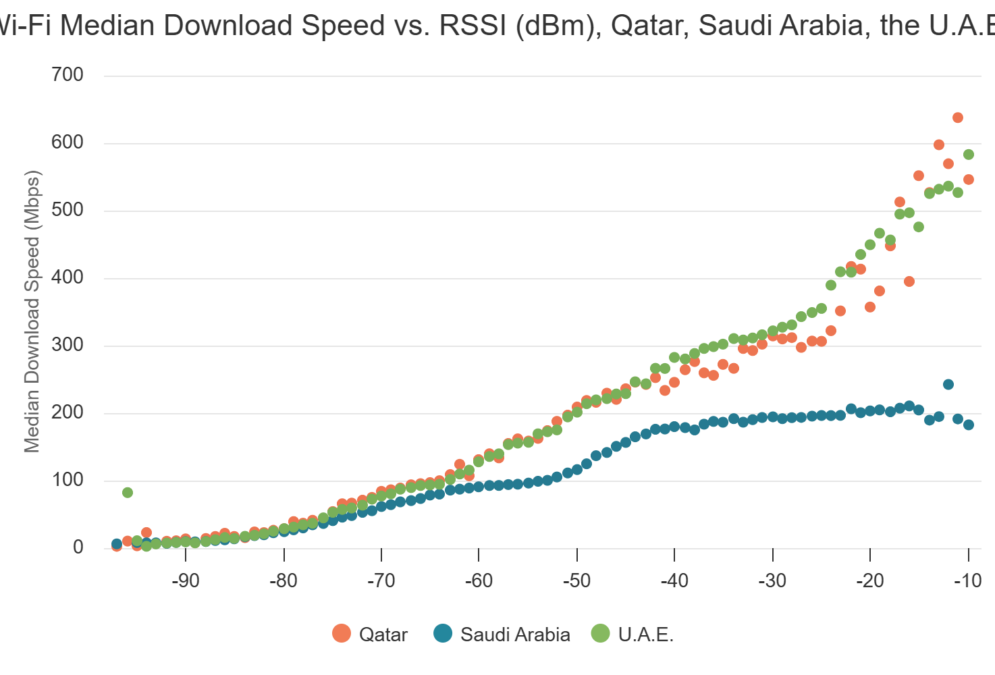
Ookla’s latest analysis highlights that while Qatar, Saudi Arabia, and the U.A.E. rank among the global leaders in fiber penetration and gigabit broadband deployment, the main performance bottleneck increasingly lies inside homes rather than in operator access networks.
Ookla’s data, collected between October 2025 and February 2026, shows that Wi-Fi performance deteriorates rapidly as devices move away from routers or encounter walls and physical barriers. The study found that median download speeds can collapse by nearly 50 percent when signal strength weakens from –50 dBm to –70 dBm.
For Gulf telecom operators, the findings reinforce the importance of upgrading subscribers to Wi-Fi 6 and Wi-Fi 7 gateways, deploying mesh Wi-Fi systems, and expanding FTTR architectures to ensure users experience the full benefits of multi-gigabit fiber plans.
Gulf Operators Expand Gigabit Fiber and Wi-Fi 7 Rollouts
Operators across the Gulf region have been aggressively increasing fiber broadband speeds and upgrading home networking equipment to support rising demand for streaming, gaming, cloud applications, and AI-enabled services.
Ookla noted that Qatar and the U.A.E. achieved significantly higher indoor Wi-Fi download speeds than Saudi Arabia because of stronger fiber penetration, broader adoption of 500+ Mbps broadband plans, and faster migration toward modern Wi-Fi standards.
The report said the growing deployment of Wi-Fi 6 and Wi-Fi 7 CPEs is significantly improving in-home broadband experiences, allowing operators to better monetize premium fiber packages and reduce customer complaints related to indoor coverage.
Wi-Fi 7 emerged as the strongest-performing technology in the study. In Qatar, Wi-Fi 7 maintained download speeds above 500 Mbps even when RSSI levels weakened to between –60 dBm and –70 dBm.
In Saudi Arabia, Wi-Fi 7 delivered 75.81 Mbps at –80 dBm, almost double the 39.11 Mbps achieved by Wi-Fi 6 at the same signal level.
The performance gains are driven by technologies such as Multi-Link Operation (MLO), OFDMA, Preamble Puncturing, and 4096-QAM modulation, enabling operators to support multi-gigabit broadband experiences across more connected devices.
Operators Face Indoor Coverage Challenges in Dense Urban Markets
The study also revealed that U.A.E. operators face greater indoor Wi-Fi challenges because of dense high-rise environments and the extensive use of low-emissive (low-E) glass in buildings.
Ookla found that the Wi-Fi 7 “breaking point” in the U.A.E. occurs at around –55 dBm, earlier than in Qatar and Saudi Arabia. Median download speeds in the U.A.E. dropped from 641.61 Mbps at –50 dBm to 549.45 Mbps at –55 dBm before falling to 416.01 Mbps at –59 dBm.
According to Ookla, co-channel interference from neighboring networks and signal distortion caused by low-E glass accelerate Wi-Fi degradation even when users receive relatively strong signals.
This presents a growing operational challenge for Gulf telecom providers as urban density increases and households adopt more connected devices, including smart home systems, AI-powered applications, and ultra-high-definition streaming services.
Mesh Networks and FTTR Become Strategic Priorities
To address indoor connectivity bottlenecks, Gulf telecom operators are increasingly bundling mesh Wi-Fi extenders with fiber broadband subscriptions and upgrades.
Ookla said mesh networking is particularly important for large villas and apartments common across Gulf markets, where a single router often cannot deliver consistent coverage throughout the property.
The report also highlighted the growing deployment of FTTR solutions, which extend fiber deeper inside homes to provide undegraded gigabit connectivity across multiple rooms.
Operators are additionally using remote diagnostics, indoor Wi-Fi monitoring, and site surveys to optimize router placement and improve subscriber experience. Technicians increasingly measure RSSI and throughput during installations to recommend ideal router locations.
Wi-Fi 5 Networks Lose Up to 44 Percent Speed
Ookla’s analysis showed that legacy Wi-Fi technologies continue to limit broadband performance despite ultra-fast fiber connections.
Wi-Fi 4 throughput plateaued at around 30 Mbps to 50 Mbps across Gulf markets even under strong signal conditions, limiting the ability of operators to fully deliver gigabit broadband experiences.
Wi-Fi 5 improved throughput substantially but suffered sharp deterioration below –60 dBm. Median download speeds dropped by:
- 44 percent in the U.A.E.
- 40 percent in Qatar
- 33 percent in Saudi Arabia
over a 10 dB signal reduction between –60 dBm and –70 dBm.
The 6 GHz spectrum used in Wi-Fi 6E and Wi-Fi 7 delivered the strongest results, maintaining speeds above 500 Mbps in Qatar and the U.A.E. even at weaker signal levels.
Ookla said the lower congestion in the 6 GHz band allows operators to maintain very high throughput despite the higher susceptibility of high-frequency signals to walls and obstacles.
Operators Shift Toward Intelligent Home Connectivity
According to Ookla, Gulf telecom operators must move beyond the traditional “one-router” deployment model to maximize the value of fiber broadband investments.
The company said intelligent mesh placement, continuous monitoring, automated channel optimization, and dynamic band steering are becoming critical for delivering consistent gigabit experiences indoors.
As Gulf operators continue expanding multi-gigabit fiber plans, AI-powered broadband management, Wi-Fi 7 adoption, and FTTR deployments are expected to become key competitive differentiators in improving customer experience, reducing churn, and increasing broadband ARPU.
BABURAJAN KIZHAKEDATH