

Germany’s fixed broadband market is undergoing a major transformation as fiber deployment accelerates, improving network performance across Internet service providers (ISPs). While DSL still accounts for the majority of broadband connections, Speedtest Intelligence data for Q1 2026 shows significant improvements in download speeds, upload speeds, latency, and gigabit adoption across Germany.

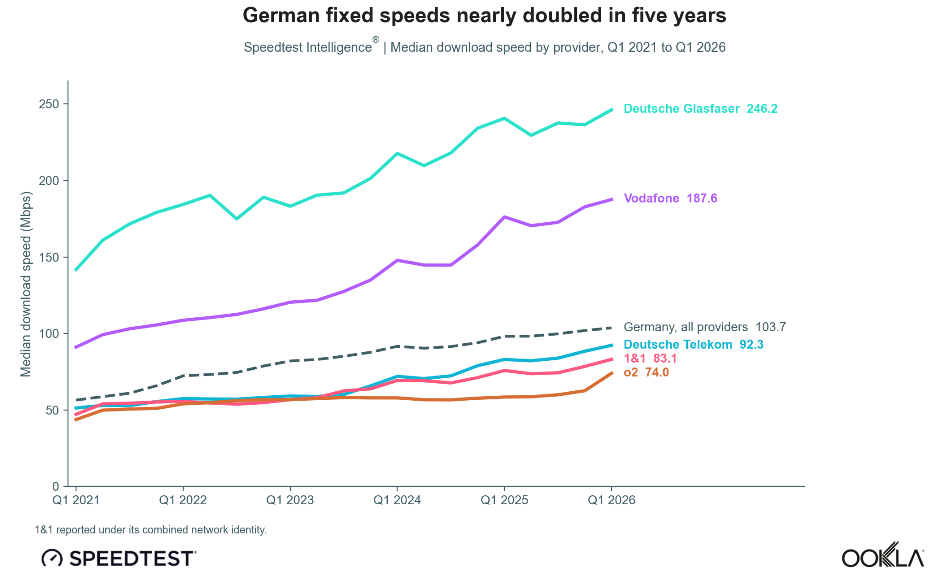
Germany ended 2025 with 48.9 percent of households passed by fiber networks, while Deutsche Telekom alone had expanded fiber coverage to 13.2 million homes. Despite this progress, DSL still accounts for 58.5 percent of Germany’s 39.2 million fixed broadband lines, while 44 percent of subscribers remain on broadband plans below 100 Mbps.
The country’s broadband performance has improved substantially over the past five years. Median download speed increased by approximately 84 percent, while median upload speed more than doubled from 14.56 Mbps to 37.87 Mbps. The share of users experiencing download speeds of at least 100 Mbps rose from 29 percent in early 2021 to 53 percent in Q1 2026. Meanwhile, users receiving less than 50 Mbps declined from 44 percent to 23 percent, and the slowest 10 percent of broadband connections improved from 10.97 Mbps to 21.69 Mbps.
Deutsche Glasfaser Leads ISP Speed Rankings
Among Germany’s broadband operators, Deutsche Glasfaser delivered the fastest fixed broadband experience with a median download speed of 246.23 Mbps and the highest median upload speed of 153.68 Mbps, reflecting its full-fiber network strategy.
Cable operators followed closely. PYUR achieved a median download speed of 233.11 Mbps, while Vodafone Germany reached 187.58 Mbps, benefiting from widespread gigabit cable offerings.
Deutsche Telekom recorded a median download speed of 92.28 Mbps, reflecting its large VDSL customer base, although its median speed has nearly doubled since 2021 as fiber adoption increases.
Among broadband resellers, 1&1 delivered a median download speed of 83.10 Mbps, while o2 recorded 74.00 Mbps, with both operators continuing to rely heavily on Deutsche Telekom’s copper infrastructure.
Fiber Delivers Lowest Latency
Fiber providers also dominated latency performance. M-net recorded Germany’s lowest median multi-server latency at 11 ms, followed by Deutsche Telekom at 17 ms. Cable operators generally delivered latency between 20 ms and 22 ms.
Loaded latency, which measures responsiveness during heavy network usage, highlighted fiber’s advantage. Deutsche Glasfaser achieved a median loaded latency of 73 ms, compared with 124 ms for Vodafone’s cable network, reflecting the higher latency characteristics of DOCSIS technology despite its high download speeds.
Across Germany’s 20 largest cities, Deutsche Telekom maintained relatively consistent median download speeds between 84 Mbps and 100 Mbps. Vodafone delivered speeds ranging from 116 Mbps to 208 Mbps, while Deutsche Glasfaser achieved between 210 Mbps and 330 Mbps in cities where it has significant fiber coverage.
Rural Germany Sees Strongest Broadband Improvement
Broadband improvements have extended well beyond Germany’s major cities. Between 2021 and Q1 2026, median download speeds increased by 59 percent in large cities, 76 percent in urban districts, 87 percent in dense rural districts, and 89 percent in sparsely populated rural areas.
Eastern Germany recorded the fastest progress, with median download speeds rising 93 percent, compared with 72 percent in western Germany. This reduced the East-West broadband performance gap from 27 percent to 13 percent. Even the slowest 10 percent of rural broadband connections nearly doubled their speeds during the period.
By the end of 2024, fiber coverage reached 35.9 percent of urban households and 33.3 percent of rural households, indicating that Germany’s broadband rollout is becoming increasingly balanced between cities and the countryside.
Fiber Adoption Remains the Biggest Challenge
Despite expanding infrastructure, Germany continues to face a fiber adoption challenge. Fiber take-up stands at around 27 percent of homes passed, compared with approximately 34 percent for alternative fiber operators and about 15 percent for Deutsche Telekom. Industry association BREKO forecasts fiber coverage could reach 92 percent of homes by 2030, while only around two-thirds of households may actually subscribe.
Pricing remains a key obstacle. Gigabit broadband packages range from around €39.99 ($45.35) on cable networks to between €64.99 ($73.70) and €89.99 ($102.05) on fiber services. Germany also lacks a broadband social tariff, making fiber adoption slower in areas where fiber is the only gigabit option.
Germany’s planned copper network retirement also depends on stronger fiber adoption. Under the Bundesnetzagentur’s draft migration framework released in January 2026, operators must achieve 80 percent FTTH coverage within an area before copper migration can begin.
Wi-Fi Upgrades Become Critical for Broadband Performance
The study found that home Wi-Fi equipment increasingly determines broadband performance. Median download speeds reached 34.74 Mbps on Wi-Fi 4, 101.39 Mbps on Wi-Fi 5, 157.07 Mbps on Wi-Fi 6, and 251.83 Mbps on Wi-Fi 7. Loaded latency improved dramatically from 361 ms on Wi-Fi 4 to 107 ms on Wi-Fi 7. Telekom and Deutsche Glasfaser customers using Wi-Fi 7 experienced loaded latency of around 60 to 65 ms.
However, 61 percent of German Wi-Fi connections still use Wi-Fi 5 or older technologies. Modern Wi-Fi adoption (Wi-Fi 6 and newer) increased from 9 percent in early 2022 to 39 percent in Q1 2026.
Among smartphones supporting the 6 GHz band, 50 percent still connected through Wi-Fi 5 or older, while 24 percent remained on the slower 2.4 GHz band. When connected to modern Wi-Fi, median download speeds increased from 80.67 Mbps to 176.89 Mbps.
Cable operators lead Wi-Fi modernization. Tele Columbus recorded 49 percent adoption of Wi-Fi 6 or newer, followed by PYUR at 44 percent and Vodafone at 43 percent. Starlink increased modern Wi-Fi adoption from 26 percent to 47 percent within one year.
Deutsche Telekom and Deutsche Glasfaser both stood at 39 percent, while 1&1 trailed at 33 percent because of its larger installed base of older DSL routers.
Germany’s router market remains dominated by AVM’s FRITZ!Box, which accounts for roughly two-thirds of identifiable routers. Market penetration reaches 95 percent at 1&1, 93 percent at Deutsche Glasfaser, 63 percent at Deutsche Telekom compared with 32 percent for Telekom’s own Speedport devices, while Vodafone’s installed base is almost evenly split at 48 percent/49 percent between FRITZ!Box and other equipment. A YouGov survey commissioned by AVM estimates that more than half of German households now use a FRITZ!Box router.
BABURAJAN KIZHAKEDATH