

The latest findings from Ookla highlight how regulations from the Federal Communications Commission (FCC) could significantly disrupt the U.S. home networking market. The rules, aimed at addressing cybersecurity risks linked to foreign-manufactured routers, are expected to impact leading vendors and slow the transition to next-generation Wi-Fi technologies.

FCC’s New Router Rules Trigger Industry Concerns
FCC’s directive requires all newly introduced routers manufactured outside the United States to obtain special waivers before being sold domestically. This follows cybersecurity concerns tied to incidents such as the Flax Typhoon cyberattack, Volt Typhoon cyberattack, and Salt Typhoon cyberattack, where vulnerabilities in networking equipment were reportedly exploited.
The latest regulation from FCC could create supply chain disruptions. With most consumer-grade routers manufactured in Asia, shifting production to the U.S. is not immediately feasible due to long-term contracts and the lack of a complete domestic component ecosystem.
Top Wi-Fi Router Vendors in the U.S.
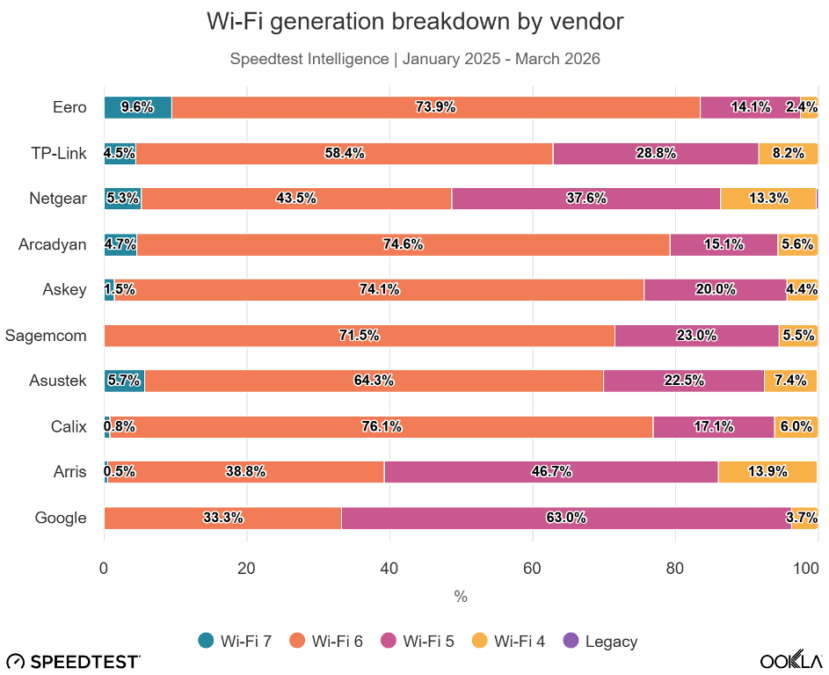
According to Speedtest Intelligence data from January 2025 to March 2026, the U.S. router market is dominated by a mix of global and U.S.-based vendors:
Eero – 10 percent
TP-Link – 9.9 percent
Netgear – 9.6 percent
Arcadyan – 8.9 percent
Askey – 5.1 percent
Sagemcom – 4.9 percent
Asustek – 4.8 percent
Calix – 4.4 percent
Arris – 3.8 percent
Google – 2.8 percent
These rankings reflect the share of Speedtest samples, serving as a proxy for installed base across residential and public Wi-Fi networks. Many of these companies rely heavily on overseas manufacturing, placing them directly in the crosshairs of the new FCC rules.
Aging Routers and Security Risks Persist
A major concern highlighted by Ookla’s data is the continued use of older Wi-Fi technologies across U.S. households. Around 28 percent of Speedtest samples were recorded on Wi-Fi 5, while approximately 7 percent still rely on Wi-Fi 4 or older standards.
Older Wi-Fi generations lack advanced security features found in newer standards, making them more vulnerable to cyber threats. This creates a dual challenge: regulatory pressure to replace foreign-made devices and a technological need to upgrade aging infrastructure.
Transition to Wi-Fi 7 May Slow Down
While newer technologies like Wi-Fi 7 promise speeds up to 46 Gbps and enhanced security, adoption could face delays. Increased compliance requirements and rising hardware costs may discourage rapid upgrades.
Additionally, Wi-Fi 6E adoption may also be impacted despite the FCC opening the 6 GHz band for unlicensed use. Vendors may need to reassess product strategies to align with the new regulatory environment.
ISP Ecosystem Adds Another Layer of Complexity
U.S. internet service providers (ISPs) play a key role in router distribution, often supplying equipment directly to customers. The top vendors vary across major ISPs:
Verizon: Arcadyan, Wistron, Netgear
Comcast: Arris, Netgear, Technicolor
Charter: Askey, Sagemcom, Netgear
AT&T: Humax, Nokia, Netgear
This ecosystem means regulatory changes will ripple across both manufacturers and service providers, complicating compliance and deployment strategies.
Outlook: Vendors Face Strategic Decisions
The FCC’s router rules introduce a period of uncertainty for the U.S. networking industry. Vendors must now evaluate supply chains, manufacturing locations, and compliance pathways, while also addressing consumer demand for faster and more secure Wi-Fi.
BABURAJAN KIZHAKEDATH