

The U.S. fixed broadband market is becoming increasingly competitive as fiber providers, cable operators, and 5G home internet companies battle to attract new customers with faster speeds, lower prices, and value-added services.

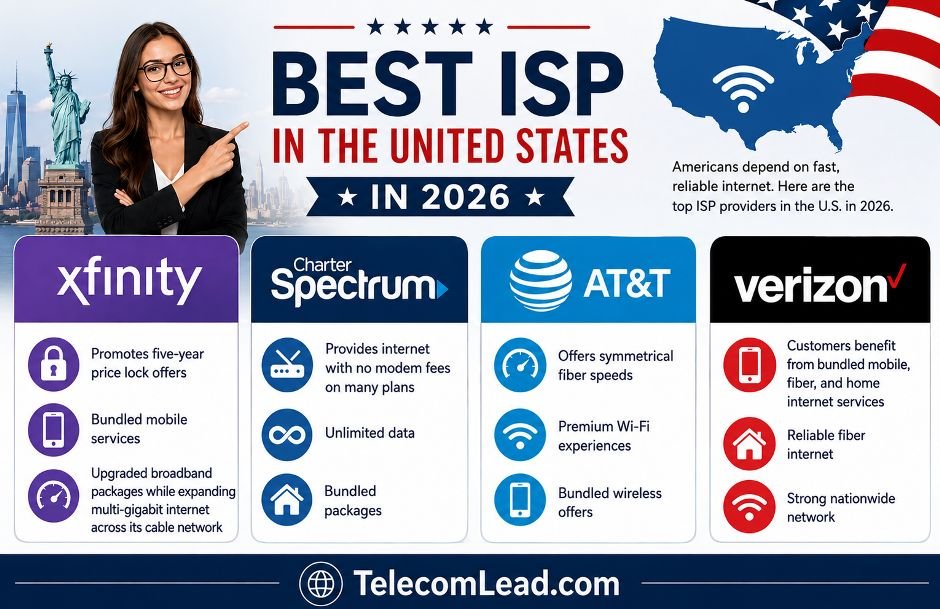
For internet customers looking for the best ISP in the United States, providers are introducing multi-gigabit plans, price guarantees, bundled mobile services, streaming offers, and next-generation Wi-Fi to stand out.
The U.S. fixed broadband market size is projected to reach US$137.10 billion in 2026 with approximately 131.03 million fixed broadband connections, making it one of the world’s largest broadband markets.
Comcast Xfinity Defends Market Leadership
Comcast Xfinity remains the nation’s largest broadband provider with 31.30 million subscribers and 23.9 percent market share.
To retain customers, Xfinity is promoting five-year price lock offers, bundled mobile services, and upgraded broadband packages while expanding multi-gigabit internet across its cable network. It is well known for its extensive cable and fiber-backed network, multi-gigabit internet plans, nationwide Wi-Fi hotspot network, and bundled offerings that combine broadband, mobile, TV, home security, and streaming services. Xfinity also invests heavily in DOCSIS and fiber technologies to improve speed, reliability, and customer experience.
Comcast Xfinity has also expanded its wireless business to 9.7 million Xfinity Mobile lines, adding a record 435,000 mobile lines during the quarter. Comcast invested $8.7 billion in its Connectivity & Platforms business during 2025 to enhance broadband infrastructure, network capacity, and customer experience. Comcast said broadband ARPU declined 3.1 percent in the first quarter of 2026 as it focused on customer retention through promotional pricing.
Charter Spectrum Keeps Broadband Contract-Free
Charter Spectrum serves 30.15 million broadband subscribers, representing 23 percent of the U.S. market.
Spectrum continues attracting customers through contract-free broadband plans, broad nationwide availability, and improved customer service. The company has also achieved a 6 percent improvement in its American Customer Satisfaction Index (ACSI) score. Charter Spectrum is recognized as one of the leading internet service providers in the United States, offering broadband services across a large footprint covering urban, suburban, and rural communities. It is known for providing high-speed internet with no modem fees on many plans, unlimited data, and bundled broadband, TV, mobile, and voice services. Spectrum has expanded its network through fiber investments and supports growing demand for gigabit-speed connectivity for households and businesses.
Charter Spectrum’s wireless business continues to grow rapidly, reaching 12.1 million Spectrum Mobile lines after adding 368,000 mobile lines in the first quarter of 2026. Charter expects to invest approximately $11.4 billion in capital expenditure during 2026 to expand and upgrade its broadband network and infrastructure.
AT&T Fiber Expands Premium Fiber Offers
AT&T Fiber has become America’s leading fiber broadband provider with 15.60 million subscribers.
Its network now passes more than 30 million locations, with expansion plans targeting 60 million locations by 2030.
AT&T continues promoting symmetrical fiber speeds, premium Wi-Fi experiences, and bundled wireless offers that appeal to households requiring reliable connectivity for remote work, gaming, and streaming.
Verizon Combines Fiber and Wireless
Verizon serves 11.20 million fixed broadband subscribers through its Fios fiber network and expanding wireless broadband portfolio.
The company is investing approximately US$16 billion annually while integrating Frontier Communications, adding another 9 million fiber passings to strengthen its nationwide broadband footprint.
Customers increasingly benefit from bundled mobile, fiber, and home internet services.
T-Mobile Home Internet Disrupts Broadband Pricing
T-Mobile Home Internet has grown rapidly to 6.80 million subscribers, representing approximately 5.2 percent market share.
Using its nationwide 5G network, the company provides an alternative to traditional cable broadband, particularly in suburban and rural markets.
T-Mobile aims to reach 15 million Fixed Wireless Access (FWA) subscribers by 2030, offering straightforward pricing without requiring wired infrastructure.
Fiber Continues Winning Customers
Cable still represents 51.2 percent of broadband connections, but its market dominance has fallen significantly from more than 65 percent just five years ago.
Fiber-to-the-Home (FTTH) now accounts for 32.4 percent of broadband connections, while 5G Fixed Wireless Access (FWA) has grown to 14.1 percent.
Legacy DSL now represents less than 2 percent of the market, while Low Earth Orbit satellite services such as Starlink account for 1.3 percent.
Best Broadband Offers for Internet Customers
Internet providers are becoming more aggressive with pricing and bundled offers.
Typical monthly broadband pricing includes:
Fiber and 5G Home Internet: US$35-US$70
Cable broadband after promotional periods: US$80-US$110
The FCC’s 2026 Urban Rate Survey reports an average benchmark price of US$96 for 100/20 Mbps broadband, compared with US$85.85 one year earlier.
Many providers also offer low-income broadband plans priced between US$10 and US$30 per month.
Popular customer offers include:
Five-year price guarantees
No annual contracts
Mobile and broadband bundle discounts
Streaming service packages
Wi-Fi 7 equipment
Whole-home Wi-Fi coverage
Home security integration
Faster Broadband Performance
Broadband speeds continue improving nationwide.
The U.S. download speed has reached 306.15 Mbps, while median upload speed has increased to 55.12 Mbps.
The FCC now defines broadband as a minimum of 100 Mbps download and 20 Mbps upload.
Fiber providers continue leading with sub-5 millisecond latency and symmetrical gigabit services, while cable operators are deploying DOCSIS 4.0 to deliver multi-gigabit speeds with latency between 10 milliseconds and 20 milliseconds.
What Internet Customers Want
Consumers increasingly prioritize reliability over headline download speeds.
Growing demand includes:
Symmetrical upload and download speeds
Wi-Fi 7 routers
Fiber-to-the-Room (FTTR)
Automatic 5G backup internet
Smart home integration
Zero-downtime connectivity
High-quality video conferencing
Fast cloud backup performance
Customer Challenges
Despite increasing competition, customers continue facing several issues.
Many report unexpected bill increases after promotional pricing expires, with additional administrative fees adding up to US$30 per month.
Cable users also experience network congestion during busy periods, with download speeds sometimes falling by 40 percent compared with advertised performance.
Many subscribers additionally express frustration with AI-powered customer support systems that delay access to technicians.
Massive Broadband Investment Continues
Broadband investment remains at record levels.
AT&T continues executing its long-term US$250 billion network investment strategy, while Verizon invests approximately US$16 billion annually.
The U.S. government has also begun deploying US$42.45 billion through the Broadband Equity, Access, and Deployment (BEAD) program to expand broadband infrastructure nationwide.
Private investment funds are contributing billions more to regional fiber providers competing against incumbent cable operators.
Outlook for U.S. Broadband Customers
The U.S. broadband market is shifting rapidly toward fiber, multi-gigabit internet, and integrated digital services.
FTTH penetration is projected to exceed 66 percent of households by 2028, while 5G Fixed Wireless Access is expected to surpass 58 million subscriptions by the end of 2026.
For consumers searching for the best ISP in the U.S., providers including Comcast Xfinity, Charter Spectrum, AT&T Fiber, Verizon Fios, and T-Mobile Home Internet are offering increasingly competitive broadband packages featuring faster speeds, transparent pricing, mobile bundles, Wi-Fi 7, streaming services, and whole-home connectivity to meet the demands of modern households.
FASNA SHABEER