

The fixed broadband market in the Philippines has entered a new phase in 2026 as fiber internet becomes the dominant connectivity platform for homes, gamers, remote workers, and streaming consumers. The country has evolved from a mobile-first internet market into a “Fiber-First” digital economy, supported by rising broadband speeds, aggressive infrastructure investments, and the rapid expansion of prepaid fiber services.

Total fixed broadband subscriptions in the Philippines are projected to reach 7.9 million by the end of 2026, reflecting annual growth of 3.7 percent since 2021. National median broadband speeds now exceed 100 Mbps, driven by more than $8 billion in network infrastructure investments and nationwide fiber expansion initiatives.
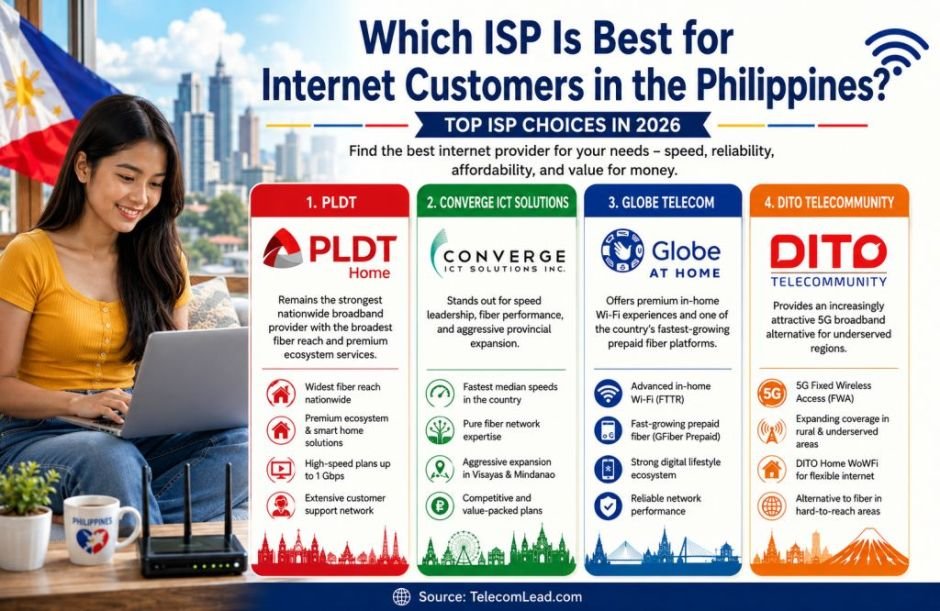
For internet customers searching for the best ISPs in Philippines in 2026, the market has effectively become a four-player battle between PLDT, Converge ICT Solutions, Globe Telecom, and DITO Telecommunity.
PLDT Home Remains the Largest Broadband Provider
PLDT continues to dominate the Philippine broadband market with a 42 percent market share. The ISP operates the country’s largest fiber backbone, currently passing more than 18.5 million homes nationwide.
PLDT focuses heavily on premium “Total Home” digital ecosystems by combining gigabit broadband, smart home services, entertainment bundles, and high-capacity fiber connectivity. The company invested more than 400 billion pesos between 2021 and 2025 to expand and modernize its infrastructure.
For 2026, PLDT plans to spend approximately 55 billion pesos to 58 billion pesos in capital expenditure while reducing capital intensity to around 28 percent to improve free cash flow performance.
PLDT remains one of the strongest options for customers seeking nationwide coverage, premium broadband reliability, smart home integration, and high-capacity fiber performance. However, customer complaints continue to focus on technical support delays, unresolved repair tickets, and service restoration issues.
Converge ICT Emerges as the Speed Leader
Converge ICT Solutions has strengthened its position as the country’s second-largest ISP with a 30 percent market share.
Converge is now widely viewed as the benchmark provider for speed and fiber reliability in the Philippine market. The ISP recorded median download speeds of 122.96 Mbps, outperforming many rivals in pure broadband performance metrics.
Unlike diversified telecom operators, Converge operates as a pure-play fiber broadband provider focused entirely on fixed internet infrastructure. In 2026, the company plans to spend 23 billion pesos to deploy more than one million new fiber ports across Visayas and Mindanao, including underserved provinces such as Bukidnon and Davao de Oro.
For customers prioritizing speed, fiber reliability, gaming performance, and competitive pricing, Converge has become one of the most attractive broadband providers in the Philippines. However, users in newly expanded provincial regions continue reporting intermittent connectivity and “Loss of Signal” (LOS) problems.
Globe At Home Focuses on Premium Broadband Experience
Globe Telecom controls approximately 25 percent of the fixed broadband market through its Globe At Home business.
Rather than focusing solely on subscriber growth, Globe is concentrating on premium broadband experiences, service consistency, and home Wi-Fi optimization. One of its major differentiators is Fiber-to-the-Room (FTTR) technology, which uses transparent micro-fiber connections to eliminate indoor Wi-Fi dead spots.
Globe is also expanding beyond connectivity into digital lifestyle ecosystems, leveraging investments in fintech, e-health, and digital services to increase customer engagement and average revenue per user.
The company has become especially aggressive in prepaid fiber broadband through GFiber Prepaid, one of the fastest-growing broadband products in the country. Globe’s prepaid fiber subscriber base surpassed 820,000 customers by early 2026.
Globe remains a strong choice for households seeking stable home connectivity, advanced Wi-Fi coverage, and bundled digital lifestyle services. However, some customers continue to criticize app-only customer support systems and limited billing adjustments during outages.
DITO Telecommunity Expands Through 5G Fixed Wireless Access
DITO Telecommunity remains the market’s fastest-growing challenger despite holding only around 3 percent to 4 percent market share.
Unlike fiber-focused rivals, DITO’s expansion strategy centers primarily on 5G Fixed Wireless Access (FWA) through DITO Home WoWFi services. This model targets customers living in areas where fiber deployment remains difficult or economically unviable.
DITO aims to reach 2 million FWA subscribers by the end of 2026 as it aggressively expands alternative broadband coverage.
For internet customers in underserved or rural locations, DITO offers an important high-speed alternative where traditional fiber infrastructure may not yet exist. However, users continue reporting inconsistent signal stability in regions with uneven 5G network coverage.
Prepaid Fiber Is Reshaping the Philippine Broadband Market
One of the biggest transformations in the Philippine ISP market is the rapid rise of prepaid fiber internet services.
Traditional broadband contracts with lengthy lock-in periods are gradually losing appeal among younger consumers, renters, students, freelancers, and transient populations. ISPs are responding with flexible prepaid broadband products that eliminate credit checks and long-term commitments.
Providers such as Globe GFiber Prepaid and Converge Surf2Sawa now offer unlimited fiber internet for as little as 50 pesos per day or approximately 700 pesos per month.
Meanwhile, standard postpaid fiber plans priced around 1,500 pesos per month now typically include broadband speeds ranging from 400 Mbps to 500 Mbps. Premium 1 Gbps plans are commonly priced between 2,099 pesos and 2,699 pesos monthly.
This prepaid broadband revolution is accelerating broadband penetration among unbanked and lower-income households while intensifying price competition across the industry.
Philippine Internet Speeds Continue Improving
The Philippines has significantly improved its global broadband reputation in 2026.
National median download speeds have reached 106.50 Mbps, while upload speeds now average approximately 101.52 Mbps. Latency has declined to around 6 ms in Metro Manila and roughly 14 ms nationwide.
Luzon continues to lead broadband performance, particularly in the CALABARZON region where speeds approach 181 Mbps. However, fiber expansion into Mindanao and Visayas is steadily reducing the country’s regional connectivity gap.
Fiber broadband lines are growing at a 17.2 percent CAGR and now contribute 91 percent of total home broadband revenues in the country.
Government Infrastructure Investments Strengthen ISP Competition
The Philippine government continues playing a major role in broadband modernization through the Department of Information and Communications Technology (DICT).
The National Fiber Backbone project, completed in June 2026, now spans 3,000 kilometers across 91 provinces. The government-backed middle-mile infrastructure aims to reduce wholesale internet costs to as low as $5 per Mbps, allowing ISPs to introduce more affordable retail broadband services in remote areas.
International connectivity is also improving through new subsea cable systems such as Bifrost and SEA-H2X, helping reduce congestion and improve latency for cloud services, AI applications, streaming platforms, and online gaming.
Which ISP Is Best for Internet Customers in the Philippines?
For internet users searching for the best ISP in the Philippines in 2026:
PLDT remains the strongest nationwide broadband provider with the broadest fiber reach and premium ecosystem services.
Converge ICT Solutions stands out for speed leadership, fiber performance, and aggressive provincial expansion.
Globe Telecom offers premium in-home Wi-Fi experiences and one of the country’s fastest-growing prepaid fiber platforms.
DITO Telecommunity provides an increasingly attractive 5G broadband alternative for underserved regions.
As Filipino consumers spend an average of 54 hours online every week, demand is shifting rapidly toward high-capacity broadband capable of supporting simultaneous 4K streaming, remote work, AI applications, and competitive gaming.
The next phase of ISP competition in the Philippines will likely center not only on speed and pricing, but also on customer support quality, service reliability, AI-powered network management, and integrated digital lifestyle ecosystems.
FASNA SHABEER