

Sweden is one of the world’s advanced broadband markets in 2026, supported by near-universal fiber availability, extensive open-access networks, unlimited data plans, and some of Europe’s fastest internet speeds.

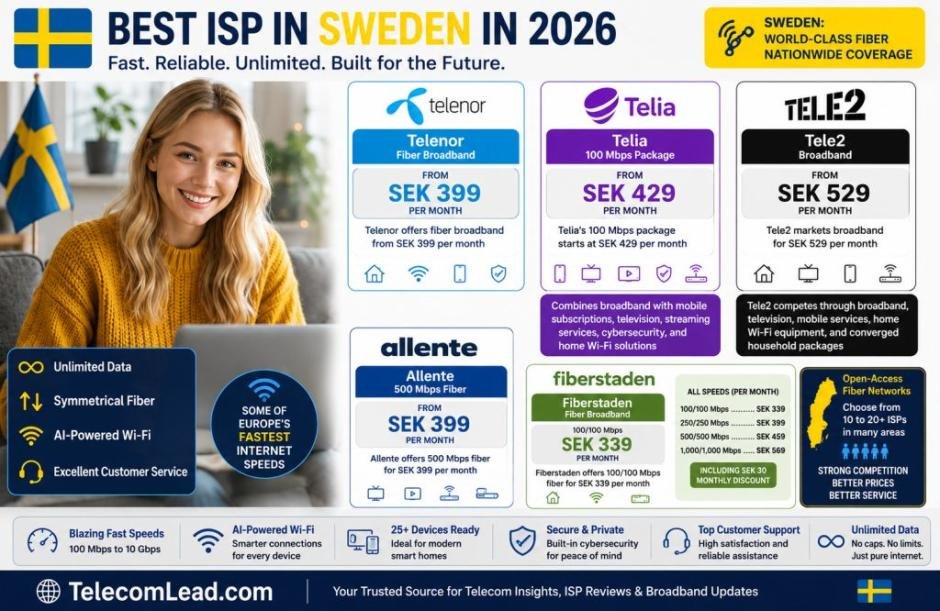
For customers looking for the best ISP in Sweden, providers including Telia, Bahnhof, Telenor, Tele2, Ownit, Allente, and regional fiber operators are competing through lower promotional prices, symmetrical fiber, multi-gigabit connections, AI-powered Wi-Fi, bundled mobile and television services, stronger customer support, and improved network reliability.
Competition is expected to intensify following Telenor’s acquisition of a controlling stake in Bahnhof, creating one of Sweden’s largest broadband groups and increasing pressure on rivals to improve pricing, customer experience, and premium fiber offers.
Best broadband offers in Sweden
Most Swedish residential fiber plans now include unlimited data and symmetrical download and upload speeds.
Entry-level 100 Mbps fiber broadband starts at approximately SEK 260 per month, including Ownit’s five-month promotional offer.
Mid-range plans offering between 250 Mbps and 500 Mbps generally cost SEK 275-SEK 399 per month during promotional periods.
Premium 1 Gbps fiber packages start from around SEK 345 per month under selected introductory campaigns.
Telenor offers fiber broadband from SEK 399 per month for the first 12 months, while Telia’s promotional 100 Mbps package starts at SEK 429 per month.
Tele2 markets comparable broadband services from approximately SEK 529 per month, while Allente offers 500 Mbps fiber for SEK 399 per month during the first year.
Customers should compare the normal monthly price as well as the introductory rate, because bills generally rise by SEK 100-SEK 200 per month after promotions expire.
Regional providers offer strong value
Sweden’s regional fiber operators remain highly competitive, particularly on open-access networks.
Fiberstaden offers:
100/100 Mbps: SEK 339 per month
250/250 Mbps: SEK 399 per month
500/500 Mbps: SEK 459 per month
1,000/1,000 Mbps: SEK 569 per month
These packages include promotional discounts of SEK 30 per month.
Customers connected to open-access fiber networks can often select from 10 to more than 20 ISPs, creating strong competition on pricing, Wi-Fi equipment, privacy, customer support, mobile bundles, television services, and cybersecurity.
Telia remains Sweden’s largest ISP
Telia continues to lead Sweden’s consumer broadband market with an estimated 30 percent market share.
The operator offers multiple fiber speed tiers and combines broadband with mobile subscriptions, television, streaming services, cybersecurity, and home Wi-Fi solutions.
Telia is likely to appeal to households seeking nationwide availability, established customer support, and combined fixed and mobile service packages.
Telenor and Bahnhof create a stronger challenger
Bahnhof ended the first quarter of 2026 with 497,902 residential fiber customers, compared with 486,461 one year earlier.
The company added 1,868 net residential customers during the quarter and serves more than 15,000 enterprise customers.
Telenor’s acquisition of a 57.5 percent stake in Bahnhof is expected to increase its consumer broadband market share from approximately 15 percent to around 27 percent.
The combined Telenor, Ownit, and Bahnhof business is therefore expected to become Sweden’s second-largest fixed broadband provider.
For customers, the expanded group could support wider service availability, stronger mobile and broadband bundles, and greater investment in high-speed fiber and premium Wi-Fi.
Tele2 remains a major broadband choice
Tele2 controls around 15 percent of Sweden’s consumer broadband market.
The company competes through broadband, television, mobile services, home Wi-Fi equipment, and converged household packages.
Independent providers including GlobalConnect, Sappa, Net at Once, and regional fiber operators collectively account for approximately 25 percent to 30 percent of broadband customers.
Typical broadband prices in Sweden
Typical monthly pricing during 2026 includes:
100 Mbps: SEK 260-SEK 430
250-500 Mbps: SEK 350-SEK 500
1 Gbps: SEK 450-SEK 700
Customers should also check whether installation, router rental, equipment return charges, television subscriptions, mobile discounts, and contract commitments are included.
A 100 Mbps plan should be sufficient for smaller households using video streaming, browsing, and remote work.
Plans between 250 Mbps and 500 Mbps offer more capacity for larger households, multiple 4K streams, online gaming, and smart home devices.
Customers using cloud backups, content creation, AI tools, or several high-bandwidth applications may benefit from 1 Gbps, 2.5 Gbps, or 10 Gbps symmetrical fiber.
Sweden offers some of Europe’s fastest broadband
According to Ookla Speedtest Intelligence for the first quarter of 2026, Sweden recorded:
Download speed: 278 Mbps
Upload speed: 174 Mbps
Latency: 8 milliseconds
Major ISPs offer broadband speeds of 100 Mbps, 250 Mbps, 500 Mbps, 1 Gbps, 2.5 Gbps, and increasingly 10 Gbps.
Bahnhof has expanded 2.5 Gbps symmetrical fiber across several open-access networks and offers 10 Gbps connections in selected cities.
Latency below 10 milliseconds makes Swedish fiber well suited to competitive gaming, cloud computing, remote work, video conferencing, and AI applications.
Wi-Fi 6, Wi-Fi 6E and Wi-Fi 7 become important
Fast fiber does not automatically guarantee strong Wi-Fi performance throughout the home.
Telia, Tele2, Telenor, and Bahnhof increasingly include Wi-Fi 6 or Wi-Fi 6E routers with premium subscriptions, while Wi-Fi 7 is beginning to appear in higher-end offers.
AI-powered Wi-Fi can automatically change wireless channels, prioritise gaming or video traffic, manage connected devices, and detect network problems before they significantly affect the customer.
The average connected household in advanced broadband markets is expected to operate more than 25 devices by 2030.
AI-assisted broadband operations can potentially reduce Wi-Fi-related support calls by up to 30 percent and lower technician visits by 20 percent or more.
Customers should therefore compare router capability, mesh Wi-Fi availability, equipment charges, and whole-home coverage rather than choosing a plan based only on advertised speed.
Customer satisfaction favours Bahnhof and Ownit
Customer service is an important differentiator in Sweden’s mature broadband market.
In the Swedish Quality Index Telecommunications Study 2025, Bahnhof ranked first among residential broadband providers with a satisfaction score of 75.8 out of 100.
Ownit followed with 74.8, while Telia scored approximately 69 and Tele2 achieved around 68.
Most complaints relate to installation delays, billing disputes, promotional price changes, router returns, Wi-Fi performance, and difficulty reaching customer support rather than widespread network reliability problems.
Sweden’s open-access fiber model also makes it easier for customers to change providers when they are dissatisfied.
5G home broadband expands in rural areas
Fiber remains Sweden’s preferred broadband technology, but 5G Fixed Wireless Access is expanding in rural and difficult-to-connect locations.
Telia, Tele2, and Telenor offer 5G home broadband delivering typical download speeds between 100 Mbps and 500 Mbps.
Premium 5G services may exceed 1 Gbps when signal strength and network conditions are favourable.
Sweden’s 5G population coverage exceeded 90 percent by the end of 2025, supporting wider FWA availability.
For customers without fiber, 5G home broadband can provide faster installation and avoid the need for new fixed cabling, although speeds may vary more than on a fiber connection.
Satellite broadband supports remote homes
Satellite broadband remains an alternative for properties outside fiber and 5G coverage.
Starlink offers download speeds ranging from 100 Mbps to more than 300 Mbps, upload speeds between 15 Mbps and 30 Mbps, and latency of approximately 20 to 40 milliseconds.
Swedish Starlink subscriptions typically cost SEK 450-SEK 550 per month, while equipment costs around SEK 3,500-SEK 4,500.
Starlink operates more than 8,000 satellites and serves over 7 million customers in more than 140 countries and territories.
Amazon’s Project Kuiper has launched more than 100 satellites toward a planned constellation of 3,236 satellites, targeting residential speeds of up to 400 Mbps and enterprise services reaching 1 Gbps.
Eutelsat OneWeb operates more than 630 satellites, focusing primarily on enterprise, aviation, maritime, and government customers.
Broadband investment expands rural coverage
The Swedish government has allocated approximately SEK 1.5 billion for broadband expansion during 2026 and 2027.
Of this amount, SEK 822 million is available during 2026 through the Post and Telecom Authority.
Regional funding includes:
Norrland: SEK 276.7 million
Svealand: SEK 280.4 million
Götaland: SEK 264.9 million
Authorities have identified 192,548 buildings eligible for broadband support, including homes, businesses, and holiday properties.
Updated rules allow broadband projects covering as few as five buildings, while the maximum project value has increased from SEK 10 million to SEK 15 million.
Between 2020 and 2025, Sweden allocated approximately SEK 5.69 billion to 1,544 broadband projects, supporting more than 139,000 households, workplaces, and holiday homes.
By June 2026, approximately 48,500 buildings had received fiber infrastructure, while around 663 projects remained under construction or in final reporting.
What customers should check before selecting an ISP
Swedish broadband customers should compare:
Introductory and regular monthly prices
Download and upload speeds
Contract length
Installation charges
Router and mesh Wi-Fi costs
Wi-Fi 6, Wi-Fi 6E, or Wi-Fi 7 support
Mobile and television bundle discounts
Customer satisfaction ratings
Cybersecurity and parental-control features
Cancellation and equipment return terms
A cheap promotional offer may become less attractive once the introductory period ends, particularly when the monthly bill rises by SEK 100-SEK 200.
Best ISP in Sweden in 2026
The best ISP depends on the customer’s location, budget, required speed, Wi-Fi needs, and preference for bundled services.
Telia remains the market leader with broad availability and extensive mobile, television, and broadband bundles.
Bahnhof stands out for customer satisfaction, privacy, symmetrical fiber, and premium speeds reaching 10 Gbps in selected locations.
Ownit combines competitive promotional pricing with a strong satisfaction score, while Telenor is becoming a much larger challenger following its Bahnhof acquisition.
Tele2 remains a major choice for households seeking combined broadband, television, and mobile services.
Regional providers can offer some of the best value, particularly on open-access networks where customers can compare offers from 10 to more than 20 ISPs.
With unlimited data, symmetrical fiber, speeds from 100 Mbps to 10 Gbps, AI-powered Wi-Fi, competitive promotions, and strong provider choice, Swedish internet customers continue to benefit from one of the world’s most advanced broadband markets.
FASNA SHABEER