

Spain’s fixed broadband market in 2026 has become one of the most advanced internet ecosystems in Europe, driven by nationwide fiber deployment, gigabit broadband adoption, and aggressive competition among leading ISPs.

For internet customers searching for the best broadband provider in Spain, the market now offers a wide mix of premium fiber, low-cost gigabit plans, converged mobile bundles, and ultra-fast symmetrical connectivity.
The Spanish broadband sector is valued at nearly $38 billion in 2026 and is guided by the government’s “Espana Digital 2026” strategy, which targets universal access to high-speed internet services across urban and rural areas. Fiber-to-the-home (FTTH) coverage now exceeds 90 percent of households, positioning Spain among the global leaders in fiber broadband infrastructure.
Spain’s broadband market has shifted from network expansion toward a service-driven model where ISPs compete on speed, reliability, customer experience, cloud gaming performance, smart home integration, and fixed-mobile convergence.
Top ISPs in Spain and Market Share in 2026
The Spanish broadband industry is now heavily consolidated, with four major operators controlling more than 82 percent of the country’s 19.8 million broadband subscriptions.
Telefónica (Movistar)
Telefónica remains Spain’s largest individual broadband provider with a 33.8 percent market share. Movistar continues to dominate the premium broadband segment through its nationwide FTTH infrastructure and bundled services.
Telefónica is accelerating the shutdown of legacy copper and ADSL infrastructure as part of its “Transform & Grow 2026” strategy. The operator aims to become one of Europe’s first major telecom companies operating entirely on fiber and 5G infrastructure.
For broadband customers, Movistar offers strong network reliability, premium TV bundles, symmetrical fiber speeds, and enterprise-grade home connectivity. Entry-level 300 Mbps fiber plans start at approximately €30 per month, while premium converged packages can reach €90 monthly.
MásOrange
MásOrange currently holds a 30.2 percent national market share following the merger of Orange Spain and MásMóvil in 2024.
The operator has become the volume leader across several Spanish regions and is targeting €500 million in annual synergies from the merger. MásOrange uses a multi-brand strategy to serve both premium and budget-conscious consumers.
For internet users, MásOrange provides extensive fiber coverage, converged mobile services, streaming bundles, and competitive gigabit pricing. However, some customers continue to report technical support confusion linked to the integration of former Orange and MásMóvil support systems.
Vodafone España
Vodafone España holds a 17.4 percent share of Spain’s broadband market after being acquired by Zegona Communications.
Vodafone España is increasingly focused on efficiency, digital sales channels, and infrastructure wholesaling for regional ISPs. The company continues to market high-speed fiber services with integrated mobile connectivity and entertainment bundles.
Customers value Vodafone’s network coverage and converged services, though some users have reported reduced loyalty discounts and slower customer service responsiveness in 2026.
Digi Spain
Digi Spain has become Spain’s fastest-growing broadband operator with an 11.2 percent market share.
Digi is investing €2 billion to expand its own XGS-PON fiber infrastructure to 20 million homes. This transition from wholesale dependency to proprietary infrastructure allows Digi to offer some of the most aggressive broadband pricing in Europe.
Digi’s pricing strategy is reshaping Spain’s broadband market. The company offers 500 Mbps fiber plans for €10 per month and 1 Gbps plans for €20 on its own network. Digi also achieved the highest median download speed in Spain during independent April 2026 audits at 321.21 Mbps.
For cost-conscious broadband customers, Digi currently delivers one of the strongest value-to-speed propositions in the Spanish market.
Broadband Speeds and Fiber Technology in Spain
Spain continues to rank among the global leaders in fixed broadband speed performance. Median fixed download speeds reached approximately 255.02 Mbps in 2026.
The country’s fiber leadership is largely powered by XGS-PON technology, which supports symmetrical broadband speeds of up to 10 Gbps. Symmetrical connectivity has become a major selling point for Spanish ISPs, especially for remote workers, gamers, content creators, and cloud users who require high upload speeds alongside fast downloads.
Independent speed audits for April 2026 showed:
Digi Spain: 321.21 Mbps median download speed
Jazztel: 273.18 Mbps median download speed
The widespread adoption of symmetrical fiber infrastructure means most Spanish households now receive identical upload and download speeds.
What Internet Customers Want in Spain in 2026
Broadband users in Spain are increasingly prioritizing service quality over basic connectivity. Consumers now expect broadband packages to support streaming, gaming, smart homes, and hybrid work environments simultaneously.
Demand for 600 Mbps to 1 Gbps plans is rising rapidly as 8K video streaming becomes more common. Spanish households now average 3.2 connected devices per person, increasing pressure on home Wi-Fi performance.
Cloud gaming demand is also growing strongly, with users prioritizing latency below 20 milliseconds for competitive gaming and real-time streaming experiences.
The smart home market is expanding at a 15.9 percent CAGR, increasing demand for broadband packages that support IoT devices, smart security systems, and energy management platforms.
Hybrid work remains a major broadband growth driver in Spain. More households are requesting Fiber-to-the-Room (FTTR) installations to guarantee enterprise-grade connectivity throughout the home.
Growth Outlook for Spain’s Broadband Market
Although the residential broadband market is approaching saturation, Spain’s wider telecommunications sector is forecast to grow at a 3.02 percent CAGR between 2025 and 2033.
Broadband subscriptions are expected to grow by 2.5 percent annually through 2026, driven mainly by rural fiber expansion and deeper penetration in underserved regions.
Connections above 1 Gbps are forecast to expand at a 13.16 percent CAGR through 2030, making ultra-fast broadband one of the industry’s biggest long-term revenue opportunities.
The SME broadband segment is also expanding rapidly at a 17.63 percent CAGR as businesses adopt cloud infrastructure using EU-backed Digital Toolkit funding programs.
While FTTH currently generates more than 41 percent of total market revenue, 5G Fixed Wireless Access (FWA) is forecast to grow at a 13.1 percent CAGR, particularly in geographically challenging regions where fiber deployment remains difficult.
Best ISP Options for Broadband Customers in Spain
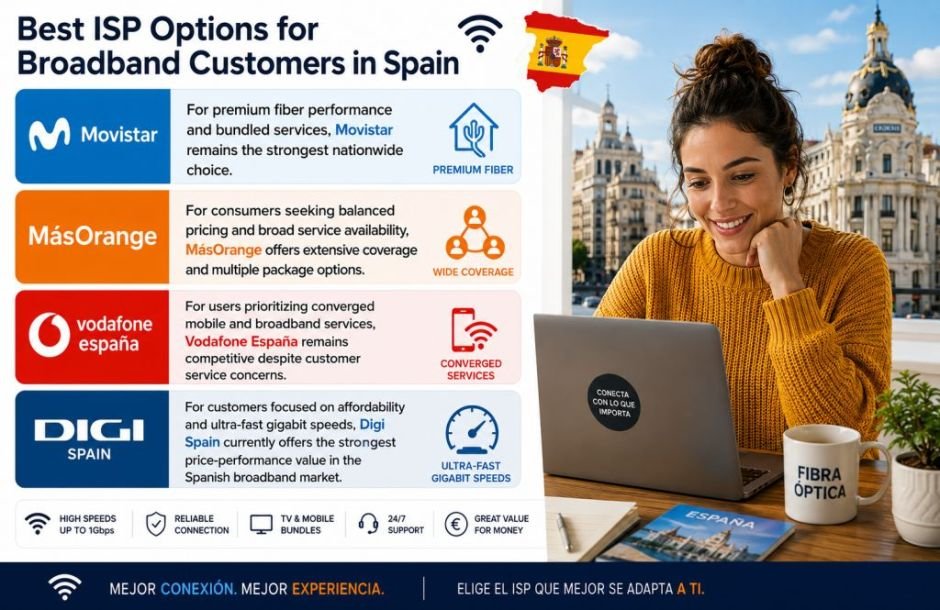
For premium fiber performance and bundled services, Movistar remains the strongest nationwide choice.
For consumers seeking balanced pricing and broad service availability, MásOrange offers extensive coverage and multiple package options.
For users prioritizing converged mobile and broadband services, Vodafone España remains competitive despite customer service concerns.
For customers focused on affordability and ultra-fast gigabit speeds, Digi Spain currently offers the strongest price-performance value in the Spanish broadband market.
Spain’s broadband industry in 2026 demonstrates how fiber infrastructure, market consolidation, and aggressive pricing competition are transforming internet access into a high-performance digital utility for households and businesses alike.
FASNA SHABEER