

Iran’s broadband market is undergoing its biggest transformation as the country shifts from aging copper networks to fiber broadband under the government’s National Fiber Optic Project. For internet users looking for the best ISP in Iran, providers are expanding fiber-to-the-home (FTTH) services while upgrading legacy ADSL and VDSL infrastructure to deliver faster broadband.

The target of Iran is to deploy 20 million FTTH ports by the end of 2026, creating one of the country’s largest broadband infrastructure projects. Despite the modernization drive, Iran’s fixed broadband market remains relatively stable with approximately 11.04 million broadband subscribers and a household penetration rate of around 12 percent.
Telecommunication Company of Iran (TCI) Leads the Broadband Market
The Telecommunication Company of Iran (TCI/Mokhaberat) remains the country’s largest internet provider, controlling approximately 50 percent of the market with around 5.52 million subscribers.
TCI owns most of Iran’s legacy copper network and is migrating millions of customers from ADSL to VDSL and FTTH services. Although the operator remains the largest ISP, its market share has declined from more than 60 percent in previous years as private providers expand fiber infrastructure.
Customers continue to rely on TCI for nationwide availability, but many users report slower technical support, aging copper infrastructure, and network quality issues caused by signal-to-noise ratio (SNR) degradation.
Shatel Becomes Iran’s Leading Private Fiber ISP
Shatel has established itself as Iran’s strongest private broadband provider with approximately 17 percent market share and around 1.88 million subscribers.
The company is aggressively expanding FTTH services across major cities including Tehran, Qom, and Fars after receiving support from the National Fiber Fund. Shatel targets premium residential customers looking for gigabit broadband and faster internet speeds than traditional ADSL connections.
While its fiber services receive positive feedback for speed and reliability, customers frequently report installation delays, with some fiber connections taking more than six months despite availability in designated rollout zones.
AsiaTech Focuses on Content and High-Speed Broadband
AsiaTech serves approximately 1.21 million subscribers, representing about 11 percent of Iran’s broadband market.
The ISP differentiates itself through integrated data center services and domestic content delivery, providing optimized access to Iranian video streaming and gaming platforms hosted on its own infrastructure. This strategy improves performance for locally hosted services, although some customers experience inconsistent international internet connectivity.
HiWEB Expands Connectivity Across Rural Iran
HiWEB holds approximately 6 percent market share with around 660,000 subscribers.
The provider focuses primarily on rural broadband and government-backed Universal Service Obligation (USO) projects. Instead of relying solely on fiber, HiWEB combines fixed broadband with 4G Fixed Wireless Access (FWA) to connect underserved communities where FTTH deployment remains economically challenging.
Broadband Prices Continue to Rise
Iran’s broadband pricing changed significantly following regulatory reforms.
Internet tariffs increased 20 percent in December 2025 and another 18 percent in February 2026, resulting in a 52 percent year-over-year increase.
Current broadband pricing includes:
ADSL/VDSL 16 Mbps: approximately 120,000 Tomans per month
FTTH 100 Mbps: between 500,000 and 750,000 Tomans
1 Gbps fiber broadband: above 1,500,000 Tomans
Optical Network Terminal (ONT) installation: between 2 million and 3 million Tomans
The government also subsidizes domestic internet usage by pricing National Information Network (NIN) traffic at approximately one-third the cost of international data.
Broadband Speeds Improve with Fiber Rollout
Iran’s internet performance varies significantly depending on network technology.
According to the speedtest data in March 2026, the country’s fixed broadband download speed is 26.1 Mbps, placing Iran 137th globally on the Speedtest Global Index.
Typical broadband performance includes:
FTTH: minimum 100 Mbps with symmetrical upload speeds
VDSL: 30-50 Mbps for customers located within 800 meters of fiber-fed cabinets
ADSL: typically 4-8 Mbps due to aging copper infrastructure
International connectivity remains affected by routing limitations, with latency to European servers typically ranging between 90 ms and 120 ms.
Massive Fiber Investment Reshapes the Market
The National Fiber Optic Fund is driving broadband expansion through direct subsidies for private ISPs.
The fund receives financing from a 2 percent levy on mobile operator revenue and will invest approximately 25 trillion Tomans during 2026 to accelerate fiber deployment across the country.
Although total broadband subscriber growth remains modest at 3.8 percent annually, operators are increasing revenue by migrating customers to higher-speed fiber packages.
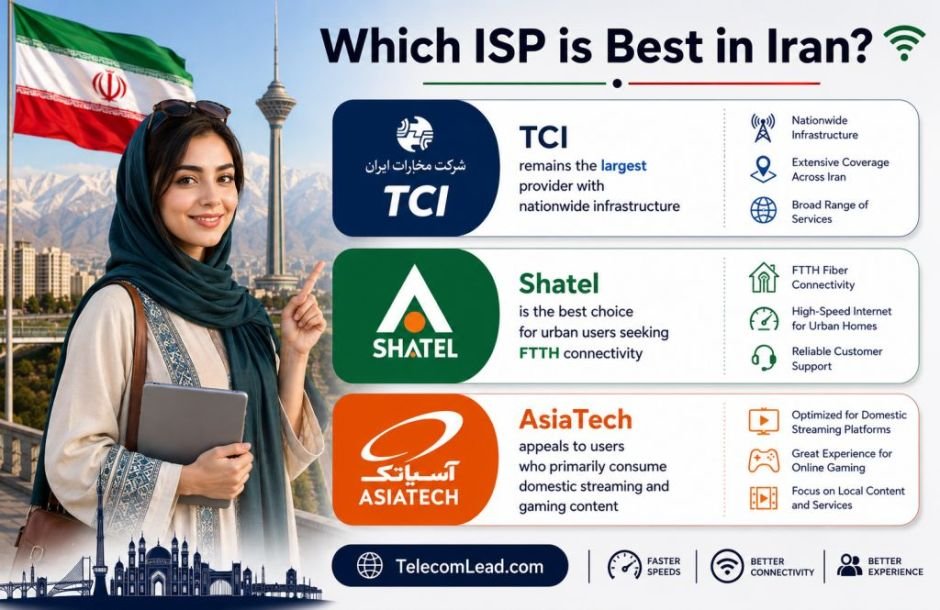
Which ISP is Best in Iran?
For customers searching for the best internet provider in Iran, each ISP offers different advantages.
TCI remains the largest provider with 5.52 million subscribers and nationwide infrastructure, making it suitable for customers requiring broad availability.
Shatel is the leading private ISP, offering premium fiber broadband with 17 percent market share and 1.88 million subscribers, making it one of the best choices for urban users seeking FTTH connectivity.
AsiaTech appeals to users who primarily consume domestic streaming and gaming content through its optimized local infrastructure, while HiWEB remains the preferred option for rural broadband and Fixed Wireless Access services.
As Iran works toward its ambitious goal of 20 million FTTH ports, fiber broadband will increasingly replace legacy ADSL networks, giving internet customers more opportunities to access faster and more reliable broadband services in 2026.
FASNA SHABEER