

Egypt’s fixed broadband market has entered a new phase of growth in 2026, driven by massive fiber-optic investments, faster internet speeds, and increasing competition among internet service providers (ISPs). For internet customers searching for the best broadband provider, the market now offers more choices, higher speeds, and improved coverage than ever before.

Egypt remains Africa’s largest fixed broadband market for the fifth consecutive year, supported by the government’s Digital Egypt strategy and a multi-billion-dollar National Fiber Optic Project. The country now has approximately 12.7 million fixed broadband subscribers, with annual growth averaging 4 percent.
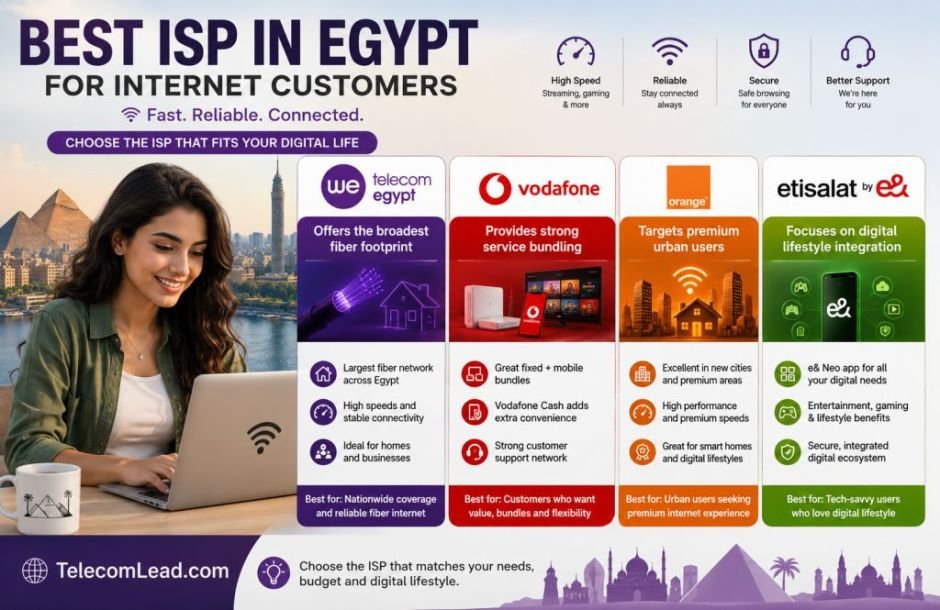
Telecom Egypt (WE) continues to dominate the market as both the largest infrastructure owner and retail broadband provider. The company serves approximately 25.25 million combined fixed broadband and voice subscribers and has completed one of the region’s largest network modernization programs, replacing more than 95 percent of legacy copper lines with fiber-optic infrastructure. Telecom Egypt is also strengthening its international connectivity position through the 2Africa subsea cable and a Regional Data Hub project valued between $230 million and $260 million.
For customers seeking extensive coverage and network reach, WE remains the leading choice. However, subscribers continue to report concerns about monthly data caps and rapid quota depletion as faster fiber speeds increase overall data consumption.
Vodafone Egypt remains the strongest private-sector challenger with approximately 1.21 million fixed broadband subscribers and an estimated market share of 8.5 percent to 10 percent. The operator benefits from a mobile customer base of 53 million users and has successfully integrated fixed broadband services with Vodafone Cash, which contributes more than 8 percent of service revenue. Customers looking for bundled internet, mobile, and digital financial services may find Vodafone’s fixed-mobile convergence strategy attractive.
Orange Egypt serves more than 1 million fixed broadband customers and holds a market share between 6.5 percent and 8 percent. Through its “Trust the Future” strategy, Orange has focused on premium residential users, smart cities, and enterprise customers. The company has become a major provider of Triple Play services in developments such as the New Administrative Capital and uses artificial intelligence to optimize network performance and reduce operational costs.
Etisalat by e& Egypt serves approximately 940,000 fixed broadband users, representing 5 percent to 7.5 percent market share. The operator is positioning itself as a digital lifestyle provider through its e& Neo platform, combining fiber broadband with services such as cloud gaming, micro-loans, insurance, and digital applications. This approach is designed to attract affluent and digitally connected households.
The country’s broadband transformation is backed by substantial investment. Egypt has invested approximately $6 billion in ICT infrastructure development, including more than $3.5 billion dedicated to upgrading fixed broadband networks. The Hayah Karima initiative has extended fiber connectivity to around 20,000 government buildings and thousands of villages, improving broadband access across rural regions.
Additional network capacity arrived in February 2026 when the National Telecommunications Regulatory Authority completed a landmark $3.5 billion spectrum allocation deal. The agreement added 410 MHz of spectrum capacity, effectively doubling the amount of spectrum available to operators compared with the previous three decades. This additional capacity supports the rollout of 5G Fixed Wireless Access (FWA), providing broadband connectivity in areas where fiber deployment remains difficult.
For broadband users focused on speed, Egypt continues to set the benchmark across Africa. The country’s median fixed broadband download speed reached 89.84 Mbps in 2026, representing a 17.5 percent annual increase. The regulator’s minimum broadband speed standard remains 30 Mbps, helping drive a 16-fold increase in average internet speeds since 2019.
Fiber-to-the-Home (FTTH) has become the standard technology for new residential developments, with premium plans delivering speeds of up to 200 Mbps. VDSL2 continues to serve many existing residential areas while operators expand fiber coverage.
Broadband pricing remains based on speed tiers and monthly data quotas. Entry-level 30 Mbps plans generally cost between 170 EGP and 210 EGP per month. Mid-tier 70 Mbps Mega packages and 100 Mbps Ultra packages offer larger monthly and annual quotas. Annual broadband packages now provide up to 7,200 GB of data, while premium 200 Mbps Max plans offer annual limits reaching 12 TB for power users, professionals, gamers, and remote workers.
While Egypt’s broadband infrastructure has improved dramatically, customer challenges remain. Subscribers continue to demand unlimited broadband plans and greater transparency in data usage monitoring. Other common issues include billing synchronization problems, repair delays linked to infrastructure leasing arrangements, port availability constraints in some urban districts, and occasional difficulties with AI-driven customer support systems.
Looking ahead, the Egyptian broadband market is shifting from subscriber growth to revenue growth and digital service expansion. The country’s digital exports have already reached $7.4 billion, with a national target of $9 billion in the next phase of development. At the same time, 5G Fixed Wireless Access is emerging as an important alternative for small businesses and residential customers seeking high-speed internet without waiting for fiber deployment.
For internet customers evaluating the best ISP in Egypt, the decision increasingly depends on individual priorities. Telecom Egypt offers the broadest fiber footprint, Vodafone provides strong service bundling, Orange targets premium urban users, and Etisalat by e& focuses on digital lifestyle integration. With fiber expansion, 5G FWA deployment, and continued infrastructure investments, Egyptian consumers now have access to faster and more sophisticated broadband services than at any point in the country’s history.
FASNA SHABEER