

Belgium’s broadband market is undergoing one of its biggest transformations as fiber-to-the-home (FTTH) expansion accelerates, cable operators upgrade their networks, and new low-cost challengers intensify competition. While Belgium has traditionally relied on cable broadband, 2026 marks a decisive shift toward fiber, with leading internet service providers (ISPs) competing on multi-gigabit speeds, AI-powered home Wi-Fi, bundled digital services, and customer experience.

Ookla’s Speedtest Intelligence Data shows fixed broadband in Belgium records a download speed of ~142.8 Mbps, an upload speed of ~28.58 Mbps, and a latency of 11 ms.
Fiber Emerges as the Main Battleground
Belgium’s broadband market has long been dominated by hybrid fiber-coaxial (HFC) cable infrastructure, particularly through Telenet and VOO. However, rising demand for cloud applications, gaming, remote work, video streaming, and smart homes is accelerating the migration toward FTTH.
Proximus remains the country’s fiber leader. Its fiber footprint reached 2.6 million homes and businesses by the end of 2025, representing approximately 42 percent population coverage, while active fiber connections increased to 731,000. By March 2026, the footprint expanded further to 2.665 million premises, with 776,000 active fiber lines, reflecting strong customer migration to next-generation broadband.
The operator is expanding fiber through Fiberklaar in Flanders and Unifiber in Wallonia while supporting open-access infrastructure that allows multiple service providers to use the network.
Cable Operators Continue to Compete
Despite fiber’s rapid growth, cable remains highly competitive.
Telenet continues strengthening its HFC network, delivering broadband speeds of up to 1 Gbps while preparing for a long-term fiber future through its Wyre infrastructure joint venture with Fluvius.
VOO maintains a strong presence across Wallonia and Brussels with upgraded cable infrastructure supporting download speeds of up to 1 Gbps.
Orange Belgium continues expanding fixed broadband through gigabit services and bundled fixed-mobile offers, while new entrant DIGI Belgium is reshaping pricing with aggressive fiber packages.
Best Broadband Offers in Belgium
Competition has shifted beyond basic internet access toward premium digital experiences.
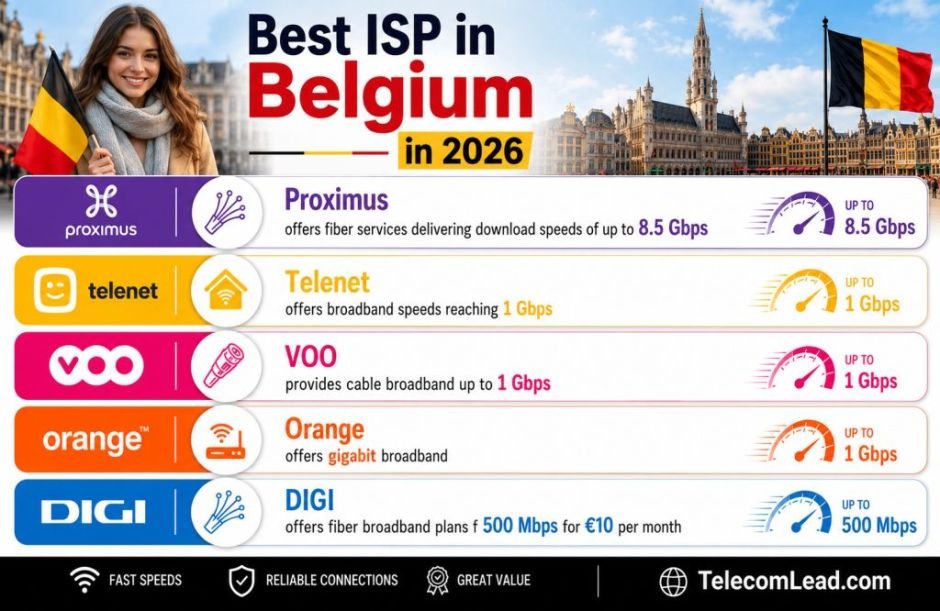
Proximus offers residential fiber services delivering download speeds of up to 8.5 Gbps in eligible locations while combining broadband, television, mobile, and digital services through Flex bundles.
Telenet continues offering broadband speeds reaching 1 Gbps across its upgraded cable network together with entertainment and mobile bundles.
VOO provides cable broadband up to 1 Gbps, while Orange Belgium offers gigabit broadband in supported areas alongside converged mobile packages.
DIGI Belgium has become Belgium’s price disruptor by introducing fiber broadband plans offering 500 Mbps for around €10 per month in selected launch markets.
Broadband Subscriber Growth
Belgium’s fixed broadband market is mature, making fiber migration the primary driver of subscriber growth.
Proximus ended 2025 with approximately 2.35 million internet subscriptions, while its residential convergent customer base increased to 1.221 million, representing approximately 4 percent annual growth.
By March 2026, convergent customers reached 1.234 million, supported by continued fiber adoption.
Telenet remains one of Belgium’s largest broadband providers in Flanders, while VOO maintains a strong regional customer base in Wallonia and Brussels. Orange Belgium continues growing through converged broadband-mobile services, while DIGI Belgium is expected to increase subscriber switching among price-sensitive consumers.
Fiber Expansion Accelerates
Fiber deployment represents Belgium’s largest broadband infrastructure investment.
Fiberklaar is deploying open-access fiber targeting approximately 1.5 million homes and businesses across Flanders.
Unifiber is expanding FTTH coverage across Wallonia with plans targeting approximately 600,000 homes.
Wyre, backed by Telenet and Fluvius, continues upgrading broadband infrastructure throughout Flanders. Collaboration among Proximus, Fiberklaar, Wyre, and Telenet is helping reduce duplicated civil works while accelerating gigabit broadband deployment.
Gigabit Broadband Becomes Mainstream
Belgium’s broadband speeds continue improving as fiber and cable networks compete.
Proximus leads the premium segment with download speeds of up to 8.5 Gbps.
Telenet and VOO offer cable broadband reaching 1 Gbps, while Orange Belgium delivers gigabit broadband where supported.
High-speed adoption is also increasing, with broadband connections delivering at least 1 Gbps accounting for approximately 8.7 percent of Belgium’s fixed broadband subscriptions during 2025.
Competition is increasingly centered on upload performance, latency, reliability, and Wi-Fi quality rather than headline download speeds alone.
AI-Powered Wi-Fi Improves Home Connectivity
Belgian ISPs are increasingly differentiating themselves through intelligent networking technologies.
Proximus and Telenet have introduced AI-powered Wi-Fi optimization that automatically improves coverage, detects network congestion, identifies weak signal areas, and enhances connectivity across multiple connected devices.
Premium broadband packages increasingly include Wi-Fi 6, while Wi-Fi 7 deployment is expected to expand during 2026, enabling higher throughput, lower latency, and improved performance in connected homes.
Operators are also using AI-driven analytics for predictive maintenance, automated troubleshooting, and faster customer support.
Fixed Wireless Access Remains a Secondary Option
Unlike countries with limited fixed infrastructure, Belgium uses Fixed Wireless Access (FWA) primarily for niche applications.
Proximus and Orange Belgium continue expanding 5G coverage, allowing FWA services delivering between 100 Mbps and more than 1 Gbps, depending on spectrum availability and network conditions.
However, Belgium’s extensive cable and fiber infrastructure means fixed broadband remains the dominant connectivity technology.
Satellite Broadband Complements Fixed Networks
Satellite broadband continues serving remote locations and specialized connectivity requirements.
Starlink remains Belgium’s leading satellite broadband provider, typically delivering download speeds between 50 Mbps and more than 200 Mbps, with latency ranging from 25 milliseconds to 60 milliseconds.
By 2026, Starlink operates more than 7,000 satellites, serving millions of users globally.
Future competition may come from Amazon Kuiper, targeting more than 3,200 satellites, and Eutelsat OneWeb, which operates a low-Earth orbit constellation exceeding 600 satellites.
Customer Experience Drives Competition
Belgian broadband customers increasingly evaluate ISPs based on reliability, installation quality, billing transparency, technical support, and Wi-Fi performance rather than speed alone.
Proximus continues investing in digital customer support and AI-powered diagnostics, while Telenet emphasizes smart Wi-Fi technologies and network monitoring. Orange Belgium differentiates itself through flexible broadband bundles.
Common customer concerns include installation delays, service interruptions, billing issues, and equipment upgrades associated with fiber migration.
Broadband Pricing Trends
Belgium remains one of Europe’s higher-priced broadband markets, although increasing competition is improving consumer value.
Entry-level broadband plans generally cost €30–€40 per month, while premium gigabit and bundled services typically range from €70 to more than €100 per month.
DIGI Belgium’s low-cost fiber strategy is putting pressure on established providers, encouraging faster speeds, richer bundles, and improved customer experiences.
Modern broadband packages increasingly include Wi-Fi 6 or Wi-Fi 7 routers, cybersecurity services, cloud storage, parental controls, and smart home features.
Outlook
Belgium’s ISP market is entering a new era defined by fiber deployment, gigabit connectivity, AI-powered networking, and stronger competition. Proximus continues leading FTTH expansion with 8.5 Gbps services, Telenet remains a formidable cable operator while investing in fiber, VOO maintains its regional strength, Orange Belgium grows through converged offers, and DIGI Belgium is reshaping pricing with affordable fiber packages.
FASNA SHABEER