

Nigeria’s fixed broadband market is undergoing a major transformation as fiber expansion, satellite broadband and infrastructure investments reshape internet connectivity.

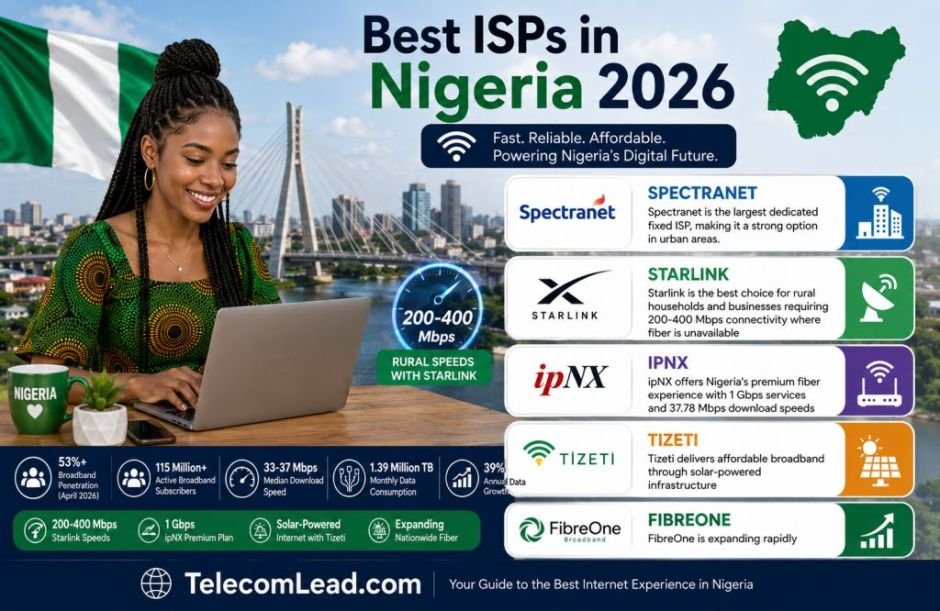
Broadband penetration has surpassed 53 percent in 2026, up from 45.6 percent in 2025, putting the country on track toward the government’s 70 percent broadband penetration target by 2030, the latest Speedtest report indicated.
For customers searching for the best ISP in Nigeria, the decision now depends on speed, coverage, affordability, fiber availability, and service reliability rather than basic internet access alone.
Spectranet Remains Nigeria’s Largest Fixed ISP
Spectranet, together with its merger partner Legend Internet, controls approximately 24 percent of Nigeria’s dedicated fixed broadband market.
The provider serves around 115,000 active users after recovering from subscriber losses in late 2025. The merger is designed to migrate legacy LTE customers onto higher-capacity fiber infrastructure while strengthening its competitive position against mobile broadband operators.
Spectranet remains a strong choice for customers living in major cities where its fixed wireless and fiber services are widely available.
Starlink Delivers the Fastest Internet in Rural Nigeria
Starlink has rapidly become Nigeria’s third-largest ISP with an 18 percent market share. Its satellite broadband consistently delivers download speeds between 200 Mbps and 400 Mbps, making it the best option for customers living in rural communities where terrestrial fiber has not yet arrived.
Starlink is widely adopted by agribusinesses, schools, remote workers and businesses that require reliable high-speed connectivity regardless of location.
However, premium performance comes at a premium price, with monthly subscriptions costing 57,000 Naira and hardware priced at approximately 590,000 Naira.
Tizeti Focuses on Affordable Unlimited Internet
Tizeti holds approximately 14 percent of the Nigerian ISP market and reaches more than 2.5 million active users through residential broadband and public Wi-Fi hotspots.
Its solar-powered infrastructure helps reduce dependence on diesel, which typically represents 40 percent of ISP operating expenses. With diesel prices increasing by 333 percent over the past three years, Tizeti’s renewable energy strategy allows it to keep broadband prices competitive for students, families and budget-conscious users.
ipNX Offers Nigeria’s Premium Fiber Experience
ipNX Nigeria controls around 9 percent of the market but dominates premium residential and enterprise fiber services.
The company recently introduced Nigeria’s first 1 Gbps residential broadband service and delivers one of the country’s fastest terrestrial fiber performances with a median download speed of 37.78 Mbps.
ipNX is particularly attractive for professionals working remotely, businesses, gamers and customers requiring symmetrical fiber connectivity with low latency.
FibreOne Continues Rapid Expansion
FibreOne is emerging as one of Nigeria’s fastest-growing fiber providers.
The company has expanded its footprint by 18 percent over the past year while competing on affordable fiber pricing. Together with regional broadband providers, FibreOne and other ISPs account for the remaining 35 percent of Nigeria’s fixed broadband market.
Massive Fiber Investment Will Improve Internet Access
Nigeria is investing heavily in broadband infrastructure through Project BRIDGE, a US$2 billion initiative that will expand the national fiber backbone from 35,000 kilometers to 125,000 kilometers.
The project includes US$845 million in secured financing from the World Bank and other development institutions, including a US$500 million credit from the International Development Association. Private investors will own up to 49 percent of the project.
Despite these investments, network operators still report approximately 150 fiber cuts every day, making infrastructure protection a critical priority.
Broadband Speeds Continue to Improve
Nigeria currently ranks 129th globally for fixed broadband performance.
Median fixed broadband download speeds range between 33 Mbps and 37 Mbps, while ipNX leads terrestrial fiber with 37.78 Mbps.
For customers requiring the highest performance, Starlink’s 200-400 Mbps satellite service remains the fastest widely available option.
Meanwhile, 5G Fixed Wireless Access (FWA) now carries 3.94 percent of total broadband traffic, while 4G continues to dominate with 53.41 percent.
Internet Prices Reflect Rising Operating Costs
Broadband pricing has increased following the 50 percent tariff adjustment approved by the Nigerian Communications Commission (NCC) in late 2025.
Entry-level fiber broadband plans now typically cost between 15,000 and 25,000 Naira per month.
Higher operating costs continue to pressure providers, with sector-wide energy expenses rising by 85 percent to 5.85 trillion Naira during the previous fiscal year.
Consumers also face rising data costs, with the average price exceeding 431 Naira per gigabyte, making affordability an important consideration for many households.
Customers Demand Faster and More Reliable Internet
Today’s Nigerian broadband users expect much more than basic connectivity.
Growing demand for remote work, cloud computing, video conferencing, online education, competitive gaming, 4K streaming, IoT devices and smart home security is pushing customers toward faster 50 Mbps to 100 Mbps fiber plans.
Power users increasingly seek 1 Gbps services to future-proof their homes and businesses.
Monthly broadband traffic has reached 1.39 million terabytes, representing annual growth of 39 percent.
Consumer Protection Improves Broadband Quality
The NCC has strengthened consumer protection by introducing automatic subscriber compensation for broadband outages lasting more than 48 hours.
Operators must also compensate users if dropped call rates exceed 1 percent.
The new Consumer Experience Index (CEI) provides neighbourhood-level transparency on actual versus advertised broadband speeds, helping Nigeria’s 115 million broadband users compare service quality before choosing an ISP.
Which is the Best ISP in Nigeria?
The best broadband provider depends on your location and internet needs.
Spectranet remains the largest dedicated fixed ISP with 24 percent market share and around 115,000 subscribers, making it a strong option in urban areas.
Starlink is the best choice for rural households and businesses requiring 200-400 Mbps connectivity where fiber is unavailable.
ipNX offers Nigeria’s premium fiber experience with 1 Gbps services and 37.78 Mbps median download speeds for professionals and enterprises.
Tizeti delivers affordable broadband through solar-powered infrastructure and serves over 2.5 million users.
FibreOne continues expanding rapidly with an 18 percent increase in network footprint.
As Nigeria expands its fiber backbone to 125,000 kilometers, broadband penetration rises beyond 53 percent, and new satellite providers enter the market, internet customers can expect stronger competition, faster speeds, wider coverage, and better value throughout 2026.
FASNA SHABEER