

Businesses in India can choose between dedicated internet leased lines, fiber broadband and 5G fixed wireless access (FWA), with monthly prices ranging from approximately ₹999 for entry-level office broadband to ₹60,000 or more for dedicated enterprise connectivity.

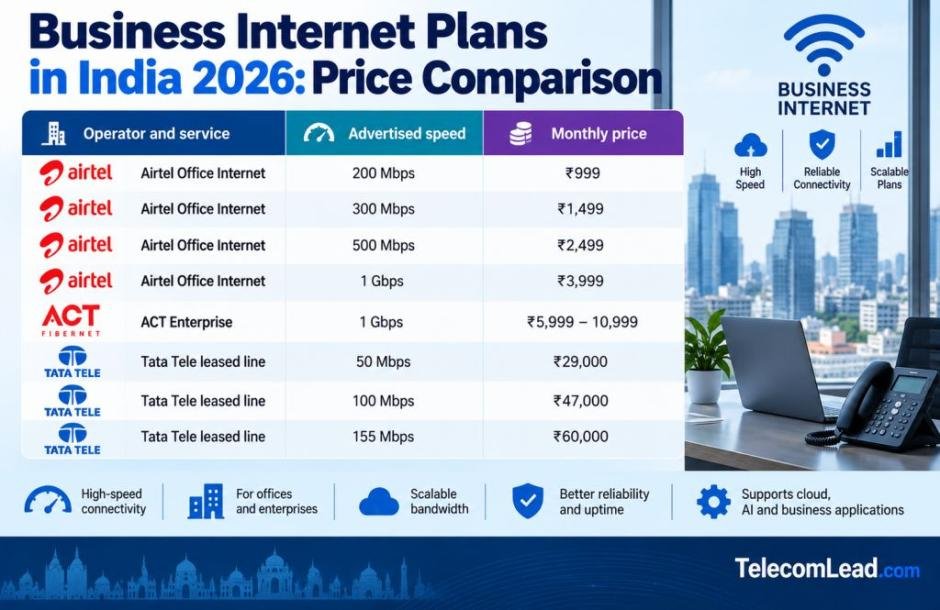
Reliance Jio, Bharti Airtel, Tata Communications, Tata Tele Business Services, BSNL and ACT Fibernet compete across different Business Internet segments.
For small offices, FTTH offers affordable high-speed internet. Enterprises running critical cloud applications, payment systems and data centers may require dedicated leased lines, while 5G FWA provides an alternative where fiber installation is difficult.
India’s broadband market continues expanding. Government statistics for August 2026 indicate 48.63 million fixed wired broadband subscriptions and 19.34 million fixed wireless access subscriptions, highlighting demand for both technologies.
Internet Leased Line vs FTTH vs 5G FWA: Key Differences
| Feature | Internet leased line | FTTH broadband | 5G FWA |
| Connectivity | Dedicated | Shared fiber access | Wireless last mile |
| Bandwidth | Contractually committed | Best effort | Coverage dependent |
| Upload speed | Usually symmetrical | Plan dependent | Often asymmetric |
| SLA | Enterprise contractual SLA | Varies | Product dependent |
| Installation | Fiber feasibility required | Fiber availability required | Requires suitable 5G coverage |
| Main customers | Enterprises, banks, IT companies | SMEs, shops, offices | Branches, remote sites, backup |
A 1 Gbps FTTH plan may cost considerably less than a 100 Mbps leased line because the leased line provides dedicated bandwidth and contractual service commitments.
Airtel Internet Leased Line: Up to 100 Gbps
Bharti Airtel offers dedicated enterprise internet connectivity ranging from 10 Mbps to 100 Gbps.
Its Airtel Internet Leased Line service advertises 99.5 percent uptime, round-the-clock support and burstable bandwidth up to five times the base capacity.
Airtel reports an infrastructure footprint exceeding 400,000 route kilometers of fiber, supported by international submarine cable connectivity and domestic network infrastructure.
The service targets enterprises requiring predictable connectivity for cloud applications, video collaboration, financial transactions and business-critical operations.
Pricing depends on location, bandwidth, contract duration and network feasibility.
Jio Internet Leased Line: Dedicated Symmetrical Connectivity
Reliance Jio offers enterprise internet leased lines with dedicated 1:1 symmetrical bandwidth scalable to 100 Gbps.
The service supports IPv4 and IPv6 connectivity, enterprise SLAs and public IP allocation.
Jio’s offering is suitable for companies operating hosted applications, enterprise resource planning systems, cloud platforms and high-volume data transfers.
A 100 Mbps dedicated connection, for example, can be more appropriate than a faster shared broadband plan when consistent uploads and contractual restoration commitments are essential.
Businesses should request quotations specifying committed bandwidth, latency, uptime, installation charges and fault-resolution terms.
Tata Tele and Tata Communications: Enterprise Connectivity
Tata Tele Business Services offers Smart Internet Leased Line packages at published benchmark prices.
| Tata Tele package | Monthly rental | Annual rental |
| 50 Mbps | ₹29,000 | ₹3.48 lakh |
| 100 Mbps | ₹47,000 | ₹5.64 lakh |
| 155 Mbps | ₹60,000 | ₹7.20 lakh |
These prices illustrate the premium associated with dedicated connectivity and should not be treated as universal location-independent quotations.
Tata Communications also serves large enterprises and multinational customers through managed internet, global IP connectivity and enterprise network services.
For businesses with multiple branches, network management, security integration and international connectivity can matter more than the lowest monthly rental.
Airtel Office Internet: Affordable Broadband for SMEs
Airtel’s office broadband plans target small businesses, professional offices, retailers and growing enterprises.
The Airtel Office Internet plans include advertised speeds from 200 Mbps to 1 Gbps.
A 200 Mbps package costs ₹999 monthly, while a 1 Gbps connection costs ₹3,999 before GST.
For example, a 20-employee office using email, cloud software, video meetings and accounting applications may find a 200–300 Mbps connection sufficient, depending on simultaneous usage.
However, businesses should verify fair-usage conditions, static IP availability, upload performance and support commitments.
ACT Enterprise: 1 Gbps Broadband with Business Features
ACT Enterprise offers 1 Gbps broadband packages priced between ₹5,999 and ₹10,999 monthly, excluding GST.
Its ACT Enterprise broadband plans advertise data allowances ranging from 10 TB to 20 TB.
Selected business features include static IP connectivity, Wi-Fi 6 equipment, network performance dashboards and endpoint security.
ACT also advertises an annual 1 Gbps package priced at ₹66,589 before GST.
Compared with a standard broadband connection, the higher rental may be justified for businesses requiring additional network management and security features.
BSNL Business Broadband and BharatNet
BSNL remains relevant for businesses operating in smaller cities and locations where private fiber coverage is limited.
Its FTTH and enterprise connectivity services provide alternatives to Airtel and Jio, subject to local availability.
BharatNet-related published tariffs include examples such as 25 Mbps at ₹259, 150 Mbps at ₹849 and 250 Mbps at ₹1,499 monthly.
However, certain packages have rural, individual-user or other eligibility restrictions. They should not automatically be considered commercially available business plans.
Enterprises should confirm BSNL’s applicable business tariff, service conditions and installation feasibility directly.
Jio AirFiber vs Airtel AirFiber: 5G Business Internet
5G FWA is becoming an alternative to wired broadband where fiber deployment is delayed or expensive.
Jio Business Broadband Max advertises speeds up to 1 Gbps, data allowances up to 10 TB, public static IP support and Wi-Fi 6 connectivity.
However, download and upload speeds are asymmetric, and the static-IP connection through LAN port 2 of its 1 Gbps business gateway is limited to 200 Mbps.
Jio Business Internet Line offers burstable bandwidth up to 100 Mbps, an assured speed of 30 Mbps, 10 TB of high-speed data and a 98.5 percent quarterly uptime SLA.
Airtel Xstream AirFiber advertises speeds up to 100 Mbps and a 1 TB monthly high-speed allowance, after which speeds may reduce to 2 Mbps.
Airtel’s standard AirFiber offering is primarily positioned as home broadband rather than a dedicated enterprise service.
Businesses should distinguish between products marketed as business internet and consumer broadband services.
Business Internet Annual Cost Comparison
The difference in annual expenditure can be substantial.
| Connection | Annual base rental |
| Airtel Office Internet 200 Mbps | ₹11,988 |
| Airtel Office Internet 300 Mbps | ₹17,988 |
| Airtel Office Internet 1 Gbps | ₹47,988 |
| ACT Enterprise 1 Gbps | ₹71,988 |
| Tata Tele leased line 50 Mbps | ₹3,48,000 |
| Tata Tele leased line 100 Mbps | ₹5,64,000 |
Calculations use advertised monthly rentals multiplied by 12, excluding GST, installation and other charges.
Airtel’s 1 Gbps office broadband package costs ₹47,988 annually before GST, compared with ₹5.64 lakh for Tata Tele’s 100 Mbps dedicated leased line.
The comparison illustrates why enterprises must evaluate service guarantees rather than price per Mbps alone.
Internet Reliability: Why SLAs Matter
Airtel’s advertised 99.5 percent leased-line uptime corresponds to approximately 3.6 hours of potential downtime over a hypothetical 30-day month.
Jio Business Internet Line’s 98.5 percent uptime commitment corresponds to approximately 10.8 hours on the same illustrative basis.
Actual SLA calculations depend on contract definitions, exclusions, measurement periods and service credits.
For businesses processing payments, operating customer support centers or accessing cloud-hosted applications, downtime can create costs far exceeding the internet rental.
Using two connections from different operators can improve resilience when their physical and network routes are sufficiently independent.
Which Business Internet Connection Should You Choose?
Small businesses: A 200–300 Mbps FTTH plan may offer sufficient performance for cloud applications, video meetings and everyday operations.
Medium-sized enterprises: A 300 Mbps–1 Gbps business broadband service with static IP, security and responsive support may provide better value.
Large enterprises: Dedicated leased lines from Airtel, Jio, Tata or BSNL are more appropriate when committed bandwidth, symmetrical uploads and contractual SLAs are essential.
Remote branches: 5G FWA can reduce installation delays and provide an additional connectivity path where fiber is unavailable.
The best business internet plan in India is not necessarily the fastest or cheapest. It is the connection that meets the company’s bandwidth, reliability, security and continuity requirements at a sustainable annual cost.
FASNA SHABEER