

Algeria’s fixed broadband market is undergoing one of the fastest fiber transformations in Africa and the Middle East as the country aggressively replaces legacy copper infrastructure with nationwide Fiber-to-the-Home (FTTH) connectivity. Backed by a state-led digital modernization strategy, Algeria’s broadband sector has reached an estimated market valuation of approximately $2.74 billion in 2026.

For internet customers searching for the best ISPs in Algeria, the market is increasingly defined by gigabit fiber speeds, lower latency, improved international connectivity, affordable pricing, and broader access to digital services. The country’s ambitious Digital Algeria 2030 framework is accelerating broadband modernization while positioning Algeria as a strategic digital corridor connecting Europe and Sub-Saharan Africa.
Algerie Telecom Dominates Algeria’s Residential Broadband Market
Algerie Telecom remains the dominant broadband provider in Algeria with nearly 100 percent control of the residential fixed broadband market.
As of early 2026, the operator manages more than 6.2 million total broadband accounts. The biggest transformation inside its subscriber base is the rapid migration toward fiber connectivity. Algerie Telecom’s FTTH subscriber base surpassed 3 million households in February 2026, representing a massive expansion that effectively doubled its fiber footprint compared with 2024 levels.
At the same time, legacy ADSL and VDSL users now account for approximately 3.2 million subscribers, with this segment declining by 15 percent to 20 percent annually as households migrate toward optical fiber services.
The company is now targeting 4 million FTTH subscribers by the end of 2026 as Algeria accelerates nationwide fiber adoption.
Fiber Broadband Becomes Algeria’s Primary Internet Technology
Fiber connectivity now represents more than 55 percent of Algeria’s total fixed broadband market, marking a major milestone in the country’s digital infrastructure transformation.
The Algerian government aims to achieve 100 percent optical broadband coverage across urban areas by the end of 2027, effectively turning high-speed internet into a universal utility for residential consumers and businesses.
This large-scale migration is enabling households to access substantially faster and more stable internet connections capable of supporting remote work, digital education, cloud applications, gaming, and high-definition streaming.
Algeria’s Internet Speeds Improve Rapidly
Algeria is rapidly overcoming its historical reputation for slow internet performance.
The country’s national median download speed has improved to approximately 37.86 Mbps to 50.2 Mbps in 2026, representing year-on-year growth of 165 percent.
In major cities including Algiers, Oran, and Constantine, consumers can now access broadband packages offering speeds of 100 Mbps, 500 Mbps, and even 1 Gbps.
This dramatic speed improvement is supported by significant upgrades to Algeria’s international internet infrastructure. The activation of the Medusa submarine cable and the Africa-1 cable system in early 2026 increased Algeria’s international bandwidth capacity toward 10.2 terabits per second, significantly reducing latency to Southern European internet hubs.
Algeria Broadband Pricing: Affordable Gigabit Fiber Expands
Algerie Telecom has implemented an aggressive “more speed for less” strategy to accelerate migration toward fiber broadband.
The operator’s flagship 1 Gbps fiber plan is priced at 4,200 DZD per month, while entry-level 20 Mbps plans start at 2,200 DZD.
The pricing structure is designed to encourage upgrades, with speed tiers often separated by only around 200 DZD between plans.
The government has also subsidized broadband hardware to increase fiber adoption, reducing fiber modem pricing to approximately 2,500 DZD.
For consumers seeking affordable high-speed internet, Algeria’s fiber pricing strategy is becoming increasingly competitive relative to regional broadband markets.
Icosnet Targets Business and Enterprise Broadband
While Algerie Telecom dominates residential broadband, Icosnet remains Algeria’s leading private ISP in the business connectivity segment.
The provider serves more than 2,700 corporate customers ranging from small businesses to multinational enterprises. It also manages over 4,300 projects across 33 Points of Presence nationwide.
Icosnet differentiates itself through premium service-level agreements, enterprise-grade reliability, cloud connectivity, and managed internet solutions for business customers.
Although the company relies on Algerie Telecom’s wholesale infrastructure, it continues to play an important role in Algeria’s enterprise internet ecosystem.
Satellite Broadband Supports Remote Areas and Energy Infrastructure
Connectivity in Algeria’s remote desert regions remains heavily dependent on satellite infrastructure.
Algerie Telecom Satellite currently supports more than 15,000 remote sites through the Alcomsat-1 satellite platform. These locations include schools, government offices, border facilities, and remote administrative centers.
Specialized VSAT providers including NTvsat support approximately 300 to 500 industrial locations, primarily serving Algeria’s hydrocarbon extraction industry in the Sahara region.
Algerian Internet Users Demand Better Stability and Low Latency
As internet infrastructure improves, Algerian broadband users are becoming more demanding regarding performance and service quality.
Consumers increasingly expect:
Stable internet connectivity without service interruptions
Symmetrical upload and download speeds for cloud backups and content creation
Low-latency gaming and real-time collaboration performance
Fast troubleshooting through mobile apps
Instant balance top-ups and digital customer support
Transparency regarding actual versus advertised speeds
Reliable broadband for remote work and digital education
Gaming communities and digital creators are particularly driving demand for lower latency and higher upload speeds.
Customer Complaints and ISP Challenges
Despite rapid progress, Algeria’s broadband transformation still faces operational challenges.
Customers of Algerie Telecom frequently report delays in physical fiber installation in older residential districts. Some users also experience occasional disruptions in digital payment systems such as BaridiMob.
Private ISPs operating in the enterprise market face challenges due to their wholesale dependence on Algerie Telecom’s national backbone infrastructure. When major trunk faults occur, these providers often have limited control over restoration timelines.
Remote satellite broadband operators also encounter logistical difficulties because Algeria’s vast Sahara geography creates long lead times for equipment replacement and technical maintenance.
Algeria’s Broadband Strategy Focuses on Digital Sovereignty
The country’s broadband modernization strategy in 2026 is centered around a “Total Digital Sovereignty” initiative.
This includes:
Mass decommissioning of legacy copper networks
Nationwide FTTH deployment
Expansion of submarine cable connectivity
Development of resilient rural broadband infrastructure
Growth of localized cloud platforms and content delivery networks
Integration of digital governance services under Digital Algeria 2030
The government is also developing the Trans-Saharan Backbone project to strengthen regional connectivity with Mauritania and Niger.
Algeria Broadband Market Outlook Through 2033
Algeria’s fixed broadband market is projected to grow from approximately $2.74 billion in 2026 to around $2.81 billion by 2033.
The broadband industry is increasingly viewed as a critical pillar in Algeria’s efforts to diversify its economy beyond hydrocarbons.
By expanding low-cost high-speed fiber connectivity, Algeria is supporting growth across AI, Fintech, e-health, remote work, cloud computing, and startup innovation ecosystems.
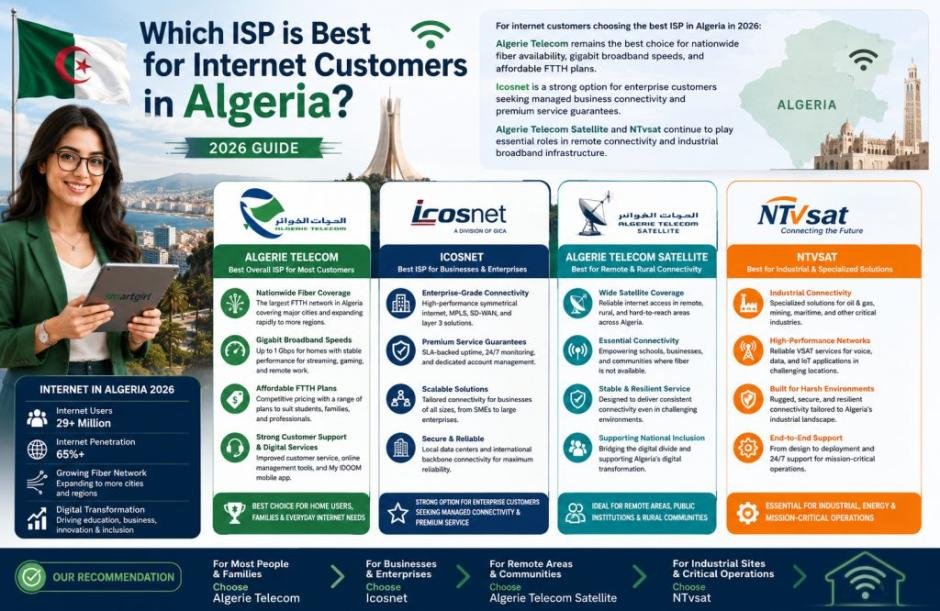
Which ISP is Best for Internet Customers in Algeria?
For internet customers choosing the best ISP in Algeria in 2026:
Algerie Telecom remains the best choice for nationwide fiber availability, gigabit broadband speeds, and affordable FTTH plans.
Icosnet is a strong option for enterprise customers seeking managed business connectivity and premium service guarantees.
Algerie Telecom Satellite and NTvsat continue to play essential roles in remote connectivity and industrial broadband infrastructure.
Algeria’s broadband market in 2026 is no longer defined by slow legacy internet. The country is rapidly building a modern gigabit-ready digital infrastructure designed to support economic diversification, cloud services, AI innovation, and the next generation of connected consumers.
FASNA SHABEER